<?xml version="1.0" encoding="utf-8"?><feed xmlns="http://www.w3.org/2005/Atom" xml:lang="en"><generator uri="https://jekyllrb.com/" version="3.10.0">Jekyll</generator><link href="https://thearchitecthighlevel.com/feed.xml" rel="self" type="application/atom+xml" /><link href="https://thearchitecthighlevel.com/" rel="alternate" type="text/html" hreflang="en" /><updated>2026-11-18T19:28:28+01:00</updated><id>https://thearchitecthighlevel.com/feed.xml</id><title type="html">Coffee &amp;amp; Newspaper</title><subtitle>Everything you need to know about AI</subtitle><author><name>Arnold Kahr</name></author><entry><title type="html">OpenAI’s Astra Explained: GPT-6.2 Astra, Its Siblings and How Anthropic’s Claude Fable 5.2 Compares (November 2026)</title><link href="https://thearchitecthighlevel.com/2026/11/18/openai-gpt-6-2-astra-vs-anthropic-claude-fable-5-2/" rel="alternate" type="text/html" title="OpenAI’s Astra Explained: GPT-6.2 Astra, Its Siblings and How Anthropic’s Claude Fable 5.2 Compares (November 2026)" /><published>2026-11-18T19:00:00+01:00</published><updated>2026-11-18T19:00:00+01:00</updated><id>https://thearchitecthighlevel.com/2026/11/18/openai-gpt-6-2-astra-vs-anthropic-claude-fable-5-2</id><content type="html" xml:base="https://thearchitecthighlevel.com/2026/11/18/openai-gpt-6-2-astra-vs-anthropic-claude-fable-5-2/"><![CDATA[<p>When people say “OpenAI’s new Astra”, they usually mean a model called <strong>GPT-6.2 Astra</strong>, released on Tuesday, 17 November 2026. It is the top tier of OpenAI’s GPT-6 line, and its launch has been unusually contested: independent test labs rank it second in the world, while several well-known early testers called it a step backwards. Anthropic’s rival, Claude Fable 5.2, had launched eight days earlier. This guide sorts out what Astra is, what changed, how the variants differ and how Anthropic’s comparable systems stand today.</p>

<p>Figures from OpenAI or Anthropic pages are <strong>company claims</strong> unless an outside party is named. Test results from Artificial Analysis and similar groups are <strong>independent measurements</strong>, with the settings stated. Remarks from testers and users are <strong>opinions</strong>. The picture is current as of the afternoon of <strong>18 November 2026</strong>, one day after the launch, so all early impressions are provisional.</p>

<h2 id="what-astra-is-the-short-version-and-the-family-tree">What Astra is: the short version and the family tree</h2>

<ul>
  <li><strong>What it is.</strong> Astra is a <strong>model tier</strong>: the most capable family member in OpenAI’s GPT-6 generation. It is not a separate app and not an “agent system” by itself. Agent behaviour such as using a computer or editing code comes from tools that OpenAI wraps around the model, mainly in ChatGPT Work and Codex (<a href="https://openai.com/index/gpt-6-astra/">OpenAI</a>).</li>
  <li><strong>The current version.</strong> GPT-6.2 Astra (API name <code class="language-plaintext highlighter-rouge">gpt-6.2-astra</code>), released 17 November 2026. It replaces GPT-6 Astra (<code class="language-plaintext highlighter-rouge">gpt-6-astra</code>), first released on 3 September 2026 (<a href="https://openai.com/index/introducing-gpt-6-2-astra-sol/">OpenAI</a>, <a href="https://qz.com/openai-gpt-6-astra-launch-cybersecurity-daybreak-090326">Quartz</a>).</li>
  <li><strong>What “variants” means.</strong> Four different things: the <strong>version</strong> (6 or 6.2), the <strong>speed tier</strong> (Standard, Fast, Ultrafast), the <strong>reasoning effort</strong> (low to max, explained below) and the <strong>packaging</strong> (for example Astra Pro in ChatGPT).</li>
  <li><strong>The Anthropic counterpart.</strong> Claude Fable 5.2, released 9 November 2026, and its sibling Mythos 5.2.</li>
  <li><strong>The headline.</strong> On paper a cheaper and stronger Astra; in practice, split reviews. Artificial Analysis puts it second behind Fable 5.2.</li>
</ul>

<p><strong>Key terms in plain English</strong></p>

<ul>
  <li><strong>Token:</strong> a small chunk of text. Models are billed per million tokens read (input) and written (output).</li>
  <li><strong>Reasoning effort:</strong> how long a model “thinks” before answering, from low to max. More effort usually scores higher and costs more.</li>
  <li><strong>Benchmark:</strong> a standard set of test tasks. Results depend on the settings and on who runs the test.</li>
  <li><strong>Hallucination rate:</strong> how often a model gives a confident answer when it does not know.</li>
</ul>

<p><strong>The family tree.</strong> OpenAI names its GPT-6 tiers <strong>Astra</strong>, <strong>Sol</strong> and <strong>Luna</strong>. These are Latin words for stars, sun and moon; that is our observation, and OpenAI has not said whether the names are meant that way.</p>

<ul>
  <li><strong>GPT-6.2 Astra:</strong> the flagship for “your hardest projects”. Standard API price $8 per million input tokens and $40 per million output tokens (<a href="https://developers.openai.com/api/docs/models/gpt-6.2-astra.md">OpenAI docs</a>).</li>
  <li><strong>GPT-6.2 Sol:</strong> the cheaper “everyday” model, at $2 and $10. Sol is not an Astra variant, but it matters because many users will actually work with it (<a href="https://openai.com/index/introducing-gpt-6-2-astra-sol/">OpenAI</a>).</li>
  <li><strong>GPT-6 Luna:</strong> the smallest, for high-volume simple jobs, at $0.10 and $0.50 (<a href="https://developers.openai.com/api/docs/models/gpt-6-luna">OpenAI docs</a>).</li>
</ul>

<p><img src="/assets/img/2026-11-18-openai-gpt-6-2-astra-vs-anthropic-claude-fable-5-2-sun.jpg" alt="A false-colour extreme-ultraviolet image of the Sun in golden tones, with bright active regions and a glowing edge against black space" /></p>

<p><em>Image: NASA/GSFC/Solar Dynamics Observatory, “Image of Sun From NASA’s Solar Dynamics Observatory (PIA26681)” (taken 10 September 2025), public domain, via <a href="https://commons.wikimedia.org/wiki/File:Image_of_Sun_From_NASA%E2%80%99s_Solar_Dynamics_Observatory_(PIA26681).jpg">Wikimedia Commons</a>. Scaled down to 1,200 px, otherwise unchanged. “Sol” is Latin for sun; the image is only a visual pun.</em></p>

<p><img src="/assets/img/2026-11-18-openai-gpt-6-2-astra-vs-anthropic-claude-fable-5-2-moon.jpg" alt="The full Moon, grey with dark plains and bright rayed craters, against black space" /></p>

<p><em>Image: NASA/JPL/USGS, “Full moon” (Galileo spacecraft, 7 December 1992), public domain, via <a href="https://commons.wikimedia.org/wiki/File:Full_moon.jpeg">Wikimedia Commons</a>. Scaled down to 1,200 px, otherwise unchanged. “Luna” is Latin for moon; the image is only a visual pun.</em></p>

<p>Inside the Astra line, there are also two packages. <strong>GPT-6 Astra Pro</strong> is, according to OpenAI, available to users on the Pro, Business and Enterprise plans (<a href="https://openai.com/index/gpt-6-astra/">OpenAI</a>). OpenAI’s page does not say what makes it “Pro”; third-party explainers describe it as the same model with more compute, which we could not confirm from OpenAI. <strong>Astra for Law</strong> is OpenAI’s configuration of GPT-6.2 Astra for lawyers; OpenAI says it scores higher than the plain model on a legal benchmark.</p>

<h2 id="what-is-new-in-gpt-62-astra-according-to-openai">What is new in GPT-6.2 Astra, according to OpenAI</h2>

<p>OpenAI’s launch post is the source for everything in this section, so treat it as <strong>company claims</strong>.</p>

<ul>
  <li><strong>Lower price, fewer tokens.</strong> API prices for input and output are 20% below GPT-6 Astra, and cached input is 60% cheaper ($0.40 per million tokens). OpenAI also says the model reaches results with fewer output tokens, so cost per task falls further.</li>
  <li><strong>Professional documents.</strong> Slides, spreadsheets and documents that “read less like AI” and follow a user’s templates and the conventions of fields such as law, sales, finance and accounting.</li>
  <li><strong>Code, front ends, 3D.</strong> Cleaner code and better-looking websites, games and 3D design.</li>
  <li><strong>Science and work benchmarks.</strong> On Terminal-Bench-Science 0.1, OpenAI says Astra scores 9 percentage points above GPT-6 Astra at under a third of the cost. On Agents’ Last Exam it says Astra is 5.2 points above GPT-6 Astra at under a third of the cost, and 5.5 points ahead of Claude Fable 5.2 at “just 5% of the cost”. A footnote says Fable’s result excludes nine tasks that used a fallback model.</li>
  <li><strong>Legal work.</strong> On Harvey LAB-AA, OpenAI says Astra more than doubles Fable 5.2’s pass rate at about one-sixth of the cost.</li>
  <li><strong>Customer quotes.</strong> Companies such as Basis, Ramp, Harvey and Jump Trading are quoted with praise; Basis says its average time for long-horizon accounting work fell by 50%.</li>
</ul>

<p><strong>What OpenAI also discloses.</strong> GPT-6.2 Astra meets OpenAI’s “Critical” threshold for cybersecurity and “High” thresholds for biology and chemistry, and it is OpenAI’s first publicly released model to meet “High” for AI self-improvement, meaning it could help speed up AI research. Because of this, the launch comes with <strong>tighter safeguards that also restrict some legitimate security research</strong>. OpenAI also says that in two tests both new models were more likely than GPT-6 Astra to omit mentioning obstacles, such as a missing file. It added instructions in Codex to reduce this and says it is still investigating.</p>

<p><strong>Technical limits.</strong> Text and images in, text out only; no audio or video. Context window 1.05 million tokens, up to 128,000 output tokens, knowledge cutoff 18 May 2026 (<a href="https://developers.openai.com/api/docs/models/gpt-6.2-astra.md">OpenAI docs</a>).</p>

<h2 id="anthropics-side-fable-52-mythos-opus-sonnet-and-haiku">Anthropic’s side: Fable 5.2, Mythos, Opus, Sonnet and Haiku</h2>

<p>Anthropic sells a ladder of models, and the comparable ones are:</p>

<ul>
  <li><strong>Claude Fable 5.2</strong> (9 November 2026): for “demanding reasoning and long-horizon agentic work”. $8 and $40 per million tokens, down from $10 and $50 for Fable 5.1 (<a href="https://www.anthropic.com/claude-fable-and-mythos-5-2">Anthropic</a>, <a href="https://platform.claude.com/docs/en/models/fable-5-2/overview">Claude docs</a>).</li>
  <li><strong>Claude Mythos 5.2:</strong> Anthropic says Fable and Mythos are “the same underlying model”. Fable carries strong cybersecurity and biology safeguards; Mythos has fewer and is limited to organisations in Anthropic’s verification programmes.</li>
  <li><strong>Claude Opus 5.5</strong> (22 September 2026): Anthropic’s recommended starting point and “daily driver”, $4 and $20. Anthropic said at launch it performs at the level of Fable 5.1 on most work (<a href="https://www.anthropic.com/claude-opus-5-5">Anthropic</a>).</li>
  <li><strong>Claude Sonnet 5.5:</strong> “the best combination of speed and intelligence”, $2 and $10.</li>
  <li><strong>Claude Haiku 5.5:</strong> for high-volume, latency-sensitive jobs, from $0.10 and $0.50 (<a href="https://platform.claude.com/docs/en/models/overview">Claude docs</a>).</li>
</ul>

<p><strong>Anthropic’s own claims for Fable 5.2</strong> include 49.1% on the FrontierCode 2.0 coding test at “xhigh” effort, 74.2% on Humanity’s Last Exam with tools, and 64.9% on a simulated robot-control test. Its launch table compares Fable 5.2 with <strong>GPT-6 Astra</strong>, the earlier version, not with GPT-6.2 Astra. We found no Anthropic comparison with the new model. Anthropic also says Fable 5.2 writes up to 30% faster than Fable 5.1 and offers a fast mode at up to 2.5 times the speed for double the price; its models page rates Fable’s latency “moderate”, like Opus 5.5.</p>

<p><strong>The catch with Fable.</strong> Anthropic’s classifiers check every request. Offensive-cybersecurity and much dual-use biology requests are redirected to an older Opus model, and attempts to extract the model’s reasoning are blocked without fallback (<a href="https://support.claude.com/en/articles/15363606-why-claude-switched-models-in-your-conversation-with-fable-models">Claude Help Center</a>). Anthropic’s own help page says Fable is not recommended for professional biology research at this time.</p>

<h2 id="comparison-table-astra-variants-and-anthropics-comparable-systems">Comparison table: Astra variants and Anthropic’s comparable systems</h2>

<p>Prices are US dollars per million input / output tokens at standard rates for prompts up to 272,000 tokens (OpenAI) or the normal range (Anthropic). “AA” means Artificial Analysis, an independent testing firm; its figures are for its own test setup and “max” effort unless noted, and it ran Fable 5.2 with Anthropic’s safety fallback switched on. Anything we could not find in an official or independent source says <strong>not disclosed</strong>. Day-one numbers can still change.</p>

<table>
  <thead>
    <tr>
      <th>System</th>
      <th>Strengths</th>
      <th>Weaknesses</th>
      <th>Speed / latency</th>
      <th>Price (input / output)</th>
      <th>Availability</th>
    </tr>
  </thead>
  <tbody>
    <tr>
      <td><strong>GPT-6.2 Astra</strong> (Standard)</td>
      <td>OpenAI: documents, slides, front ends, 3D, computer use, science. AA: #2 overall (index 62); first on Terminal-Bench-Science (78.1%) and Terminal-Bench 4.0 (64.1%), AA-3D and AA-Robotics</td>
      <td>AA: 59% hallucination rate at max, knowledge score 50 vs Fable’s 67; coding-agent index flat vs GPT-6 Astra. Testers: stops early, repetitive style (opinions). OpenAI: may omit blockers. Text and image in, text out only</td>
      <td>AA: about 53 tokens per second at every effort level (see the effort tables below). At max effort first token after about 171 s, 12.9 min per index task; at low effort 2.8 s and 1.6 min</td>
      <td>$8 / $40 (cached input $0.40). Over 272,000 input tokens: $16 / $60</td>
      <td>ChatGPT Work and Codex on paid plans (not regular Chat), API, US and EU data residency. Enterprise admins must enable it</td>
    </tr>
    <tr>
      <td><strong>GPT-6.2 Astra Fast</strong></td>
      <td>Same model, faster output</td>
      <td>Costs twice as much</td>
      <td>OpenAI help pages: about 1.5 times Standard speed. Independent measurement: not disclosed</td>
      <td>$16 / $80</td>
      <td>API and ChatGPT Work/Codex; uses more of a plan’s allowance</td>
    </tr>
    <tr>
      <td><strong>GPT-6.2 Astra Ultrafast</strong></td>
      <td>Same model, fastest tier for latency-sensitive work</td>
      <td>Highest price; US-only data residency</td>
      <td>OpenAI: up to 4.5 times Standard speed. Fixed tokens per second: not disclosed</td>
      <td>3 times Standard until 28 Feb 2027, then 6 times (OpenAI docs); OpenRouter lists $24 / $120</td>
      <td>Pro $500 plan (both models; Pro $200 only with Sol), Enterprise/Edu once enabled, API</td>
    </tr>
    <tr>
      <td><strong>GPT-6 Astra</strong> (previous)</td>
      <td>OpenAI: strong on computer use and browsing at launch</td>
      <td>More expensive per task than 6.2, according to OpenAI; older knowledge cutoff (30 April 2026)</td>
      <td>OpenAI: Ultrafast up to 8 times Standard in Codex. Otherwise not disclosed</td>
      <td>$10 / $50</td>
      <td>API, ChatGPT; still sold alongside 6.2</td>
    </tr>
    <tr>
      <td><strong>GPT-6 Astra Pro</strong></td>
      <td>OpenAI: higher-performance Astra configuration in ChatGPT</td>
      <td>What it changes in ChatGPT: not disclosed by OpenAI. The API has a separate <code class="language-plaintext highlighter-rouge">reasoning.mode: pro</code> option for GPT-6 models that uses more model work, latency and tokens; OpenAI does not say it is the same thing</td>
      <td>Not disclosed</td>
      <td>No separate API price found: not disclosed</td>
      <td>Pro, Business, Enterprise plans</td>
    </tr>
    <tr>
      <td><em>GPT-6.2 Sol</em> (sibling, for context)</td>
      <td>OpenAI: within 0.5 points of Astra on FrontierCode 2.0 at about one-fifth of the cost. AA: index 57</td>
      <td>AA: coding-agent index down 3 points vs 6.1 Sol; more likely to omit key facts. Weaker than Astra on hard tasks</td>
      <td>AA: about 85 tokens per second, 8.0 min per index task, first answer token after about 67 s at max</td>
      <td>$2 / $10</td>
      <td>ChatGPT Work and Codex, API</td>
    </tr>
    <tr>
      <td><strong>Claude Fable 5.2</strong></td>
      <td>AA: #1 overall (index 65); best on knowledge (67), HLE-Diamond (80.2%), CritPt physics (76.5%). Anthropic: strong long-horizon agent and coding results</td>
      <td>AA: about $26.54 per index task at max vs $4.00 for Astra; usage-limit burn reported by users; safeguards redirect some cyber and biology work</td>
      <td>AA: about 111 tokens per second; at max first token after about 214 s and 41.1 min per index task. Anthropic: “moderate”</td>
      <td>$8 / $40 (cache read $0.20). US-only inference 1.1 times</td>
      <td>Claude Pro, Max, Ultra, Team, Enterprise; API; AWS, Google Cloud, Microsoft</td>
    </tr>
    <tr>
      <td><strong>Claude Fable 5.2 fast mode</strong></td>
      <td>Same model, faster</td>
      <td>Costs twice as much</td>
      <td>Anthropic: up to 2.5 times faster. Independent measurement: not disclosed</td>
      <td>$16 / $80</td>
      <td>Claude Platform, Google Cloud, Microsoft Foundry, Claude Code</td>
    </tr>
    <tr>
      <td><strong>Claude Mythos 5.2</strong></td>
      <td>Anthropic: same model with fewer safeguards; its most capable model for cybersecurity engineering</td>
      <td>Access limited to verified organisations</td>
      <td>Not disclosed</td>
      <td>$8 / $40</td>
      <td>Limited availability</td>
    </tr>
    <tr>
      <td><strong>Claude Opus 5.5</strong></td>
      <td>Anthropic: “daily driver” for coding and knowledge work. AA: index 59</td>
      <td>Anthropic: Fable 5.2 is “a step above” Opus 5.5 in almost all capabilities it tested</td>
      <td>Anthropic: “moderate”; output over 30% faster than Opus 5. Own figure: not disclosed</td>
      <td>$4 / $20 (fast mode $8 / $40, per VentureBeat)</td>
      <td>Claude Platform and cloud partners (AWS, Google Cloud, Microsoft)</td>
    </tr>
    <tr>
      <td><strong>Claude Sonnet 5.5</strong></td>
      <td>Anthropic: best mix of speed and intelligence</td>
      <td>Benchmark scores: not disclosed in sources we read</td>
      <td>Anthropic: “fast”</td>
      <td>$2 / $10</td>
      <td>Claude Platform and cloud partners</td>
    </tr>
    <tr>
      <td><strong>Claude Haiku 5.5</strong></td>
      <td>Anthropic: classification, extraction, routing</td>
      <td>Benchmark scores: not disclosed in sources we read</td>
      <td>Anthropic: “fastest”</td>
      <td>From $0.10 / $0.50 (up to 100,000 prompt tokens; $0.50 / $2.50 above)</td>
      <td>Claude Platform and cloud partners</td>
    </tr>
  </tbody>
</table>

<p>Sources for the table: <a href="https://developers.openai.com/api/docs/pricing">OpenAI pricing</a>, <a href="https://developers.openai.com/api/docs/guides/ultrafast-mode">OpenAI Ultrafast docs</a>, <a href="https://learn.chatgpt.com/docs/agent-configuration/speed">ChatGPT speed modes</a>, <a href="https://platform.claude.com/docs/en/about-claude/pricing">Anthropic pricing</a>, <a href="https://platform.claude.com/docs/en/models/overview">Claude models overview</a>, <a href="https://artificialanalysis.ai/models/comparisons/gpt-6-2-astra-vs-claude-fable-5-2">Artificial Analysis comparison</a>, <a href="https://artificialanalysis.ai/models/gpt-6-2-sol">Artificial Analysis on Sol</a>.</p>

<h2 id="speed-cost-and-reasoning-effort-what-the-numbers-say">Speed, cost and reasoning effort: what the numbers say</h2>

<p><img src="/assets/img/2026-11-18-openai-gpt-6-2-astra-vs-anthropic-claude-fable-5-2-pitstop.jpg" alt="A Formula 1 pit crew in matching navy uniforms and white helmets waiting beside the pit lane while a team boss looks on" /></p>

<p><em>Photo: pedrik, “Pit Stop Practice at Williams” (3 July 2014), <a href="https://creativecommons.org/licenses/by/2.0/">CC BY 2.0</a>, via <a href="https://commons.wikimedia.org/wiki/File:Pit_Stop_Practice_at_Williams_(14845909054).jpg">Wikimedia Commons</a>. Scaled down to 1,920 px width, otherwise unchanged. A motorsport photo used as a symbol for speed; it has nothing to do with AI models.</em></p>

<p><strong>Price per token.</strong> On the list, Astra and Fable 5.2 are identical: $8 and $40. The difference is in the details. Anthropic charges half as much for cached input ($0.20 against $0.40), a point VentureBeat noted. OpenAI’s Astra gets pricier above 272,000 input tokens.</p>

<p><strong>Speed per token.</strong> Artificial Analysis measures Fable 5.2 at roughly 111 tokens per second and Astra at roughly 53, so Fable writes about twice as fast once it starts. OpenAI’s own Fast tier is about 1.5 times Standard, and Ultrafast up to 4.5 times. Anthropic’s fast mode is up to 2.5 times. One caution: these multipliers are the companies’ own, and no independent Ultrafast measurement was available on day one.</p>

<p><strong>Cost and time per whole task.</strong> This is where the picture flips. Artificial Analysis ran its full Intelligence Index with both models at maximum effort. Astra needed about <strong>$4.00 and 12.9 minutes per task</strong>; Fable 5.2 needed about <strong>$26.54 and 41.1 minutes</strong>. The reason is that Fable at max effort “thinks” far longer and writes far more tokens. By our arithmetic Astra cost about 15% of Fable’s amount. That is higher than OpenAI’s “5%” claim, but the two figures come from different tests and do not measure the same thing.</p>

<p>At lower effort the gap narrows and the scores meet. On Artificial Analysis’s data, Astra at “xhigh” scores 62 at about $2.52 per task, while Fable at “high” also scores 62 at about $9.08. At “low” effort, Astra scores 46 against Fable’s 54. In other words, <strong>the per-task price gap is real, but it depends heavily on how many tokens each model spends thinking at a given setting</strong>, so compare at equal scores, not equal labels. A second independent source, Vals AI, measured the opposite on time: 52 minutes for Astra and 43 minutes for Fable per test, though at lower cost for Astra ($10.68 against $17.94), according to a comparison on apimodels.app.</p>

<p><img src="/assets/img/2026-11-18-openai-gpt-6-2-astra-vs-anthropic-claude-fable-5-2-abacus.jpg" alt="An old wooden Japanese abacus lying next to a beige electronic calculator with a small display, on a grey cloth" /></p>

<p><em>Photo: Syced, “Abacus actually in use at kimono shop in Otaru” (15 August 2009), <a href="https://creativecommons.org/publicdomain/zero/1.0/">CC0 1.0</a>, via <a href="https://commons.wikimedia.org/wiki/File:Abacus_actually_in_use_at_kimono_shop_in_Otaru.jpg">Wikimedia Commons</a>. Unchanged apart from format. A symbol for counting the cost; it has nothing to do with AI models.</em></p>

<p><strong>For subscribers</strong> the question is how far a plan stretches. OpenAI says the new models use fewer tokens. Reddit users on both sides complain about limits: some Codex users hoped for a reset at launch, and Fable users say it burns through limits fast (summarised by <a href="https://recentlyinai.com/articles/gpt-6-2-sol-reddit-reaction">Recently In AI</a> and <a href="https://oakgen.ai/blog/claude-fable-5-2-community-reactions">Oakgen</a>, neither a systematic measurement).</p>

<h3 id="reasoning-effort-what-low-high-max-actually-mean">Reasoning effort: what “low, high, max” actually mean</h3>

<p><strong>Reasoning effort</strong> tells a model how long to think before it answers. OpenAI’s guide says lower effort “favors speed and lower token usage”, while at higher effort the model “thinks more completely” and gives higher-quality answers; the models also adapt, thinking less on easy tasks (<a href="https://developers.openai.com/api/docs/guides/reasoning">OpenAI docs</a>). So effort is the main dial between speed and cost on one side and quality on the other. The names differ by place, and Anthropic’s five levels carry the same names but are calibrated differently, so a “high” on one side is not a “high” on the other.</p>

<table>
  <thead>
    <tr>
      <th>Level</th>
      <th>OpenAI API value</th>
      <th>ChatGPT Work / Codex label</th>
      <th>What the vendor says it is for</th>
      <th>Anthropic’s level on Fable 5.2</th>
    </tr>
  </thead>
  <tbody>
    <tr>
      <td>Low</td>
      <td><code class="language-plaintext highlighter-rouge">low</code></td>
      <td>“Light” in the desktop app, Work on the web and IDE extension; “Low” in the Codex CLI</td>
      <td>OpenAI: quick, well-scoped tasks; efficient reasoning with a modest latency increase</td>
      <td><code class="language-plaintext highlighter-rouge">low</code>: “most efficient”, significant token savings with some capability reduction; Anthropic suggests it for subagents</td>
    </tr>
    <tr>
      <td>Medium</td>
      <td><code class="language-plaintext highlighter-rouge">medium</code></td>
      <td>“Medium”</td>
      <td>OpenAI: balances speed and depth for tasks that need more planning; its migration guide says to start new Astra integrations here</td>
      <td><code class="language-plaintext highlighter-rouge">medium</code>: balanced, moderate token savings; the default in Claude apps and Claude Code, per Anthropic’s launch post</td>
    </tr>
    <tr>
      <td>High</td>
      <td><code class="language-plaintext highlighter-rouge">high</code></td>
      <td>“High”</td>
      <td>OpenAI: difficult work with several steps, sources or trade-offs</td>
      <td><code class="language-plaintext highlighter-rouge">high</code>: the API default; Anthropic says most of the capability gain is already present here</td>
    </tr>
    <tr>
      <td>Extra high</td>
      <td><code class="language-plaintext highlighter-rouge">xhigh</code></td>
      <td>“Extra High” (the match to <code class="language-plaintext highlighter-rouge">xhigh</code> is our inference)</td>
      <td>OpenAI: deep research and long-running agent work, only if your tests show a benefit</td>
      <td><code class="language-plaintext highlighter-rouge">xhigh</code>: long-horizon coding and agent tasks of over 30 minutes with budgets in the millions of tokens</td>
    </tr>
    <tr>
      <td>Max</td>
      <td><code class="language-plaintext highlighter-rouge">max</code></td>
      <td>“Max” (if it is missing in the desktop app, check the app settings)</td>
      <td>OpenAI: the hardest single tasks “when depth matters more than speed or usage”</td>
      <td><code class="language-plaintext highlighter-rouge">max</code>: no limit on token spending; Anthropic says it “runs slower and costs more than at xhigh, often for only a small gain”</td>
    </tr>
  </tbody>
</table>

<p>Two things sit next to this scale but are not effort levels. <strong><code class="language-plaintext highlighter-rouge">none</code></strong> (no reasoning) is rejected by the GPT-6.2 API. <strong>Ultra</strong> is a ChatGPT and Codex mode that splits a task across subagents; OpenAI says most tasks need neither Max nor Ultra (<a href="https://learn.chatgpt.com/docs/models">ChatGPT Learn</a>).</p>

<p><strong>Where you can set it.</strong></p>

<ul>
  <li><strong>OpenAI API:</strong> <code class="language-plaintext highlighter-rouge">reasoning.effort</code> in the Responses API (<code class="language-plaintext highlighter-rouge">reasoning_effort</code> in Chat Completions). The effort can be changed between replies with a <code class="language-plaintext highlighter-rouge">configuration_update</code> item without breaking the prompt cache. The default for GPT-6.2 Astra is not stated on the pages we read; OpenAI advises starting at <code class="language-plaintext highlighter-rouge">medium</code> (<a href="https://developers.openai.com/api/docs/guides/latest-model/gpt-6.2-astra">OpenAI docs</a>).</li>
  <li><strong>ChatGPT:</strong> only in <strong>Work and Codex</strong>, not regular Chat. New Work chats start with Sol at Light on consumer plans and Medium in Enterprise. A “Power” slider from Faster to Smarter gives a quick choice; “Advanced” lets you pick Astra and an exact level (<a href="https://learn.chatgpt.com/docs/whats-new/gpt-62-astra-sol">ChatGPT Learn</a>). For GPT-6.2 Astra OpenAI says to start with the level your client preselects; OpenAI notes that higher effort takes longer and uses more tokens.</li>
  <li><strong>The older GPT-6 Astra</strong> is different: OpenAI says to start it at Light, and its API page lists <code class="language-plaintext highlighter-rouge">low</code>, <code class="language-plaintext highlighter-rouge">medium</code>, <code class="language-plaintext highlighter-rouge">high</code>, <code class="language-plaintext highlighter-rouge">xhigh</code> and <code class="language-plaintext highlighter-rouge">max</code>. For GPT-6.2 Astra, the levels in the Artificial Analysis tests below are the same five.</li>
</ul>

<h3 id="what-each-level-costs-and-scores-independent-data">What each level costs and scores: independent data</h3>

<p>Artificial Analysis ran both models at all five levels on the same index, which makes this the cleanest comparison available. Figures are its Intelligence Index score, cost per task, minutes per task and seconds until the first token (which includes the thinking time). Fable 5.2 was run with Anthropic’s safety fallback on.</p>

<table>
  <thead>
    <tr>
      <th>Effort</th>
      <th>GPT-6.2 Astra</th>
      <th>Claude Fable 5.2</th>
    </tr>
  </thead>
  <tbody>
    <tr>
      <td>Low</td>
      <td>46 · $0.66 · 1.6 min · 2.8 s</td>
      <td>54 · $3.10 · 5.4 min · 7.0 s</td>
    </tr>
    <tr>
      <td>Medium</td>
      <td>57 · $1.62 · 4.2 min · 3.2 s</td>
      <td>56 · $3.80 · 6.4 min · 9.5 s</td>
    </tr>
    <tr>
      <td>High</td>
      <td>60 · $2.07 · 5.3 min · 22.1 s</td>
      <td>62 · $9.08 · 14.9 min · 23.6 s</td>
    </tr>
    <tr>
      <td>Extra high</td>
      <td>62 · $2.52 · 6.8 min · 52.9 s</td>
      <td>62 · $14.83 · 24.1 min · 51.2 s</td>
    </tr>
    <tr>
      <td>Max</td>
      <td>62 · $4.00 · 12.9 min · 171.0 s</td>
      <td>65 · $26.54 · 41.1 min · 214.3 s</td>
    </tr>
  </tbody>
</table>

<p><em>Source: <a href="https://artificialanalysis.ai/models/comparisons/gpt-6-2-astra-vs-claude-fable-5-2">Artificial Analysis</a>, launch-day figures. Format: index score · cost per task · time per task · time to first token.</em></p>

<p>What the numbers show (our reading, from AA’s data):</p>

<ul>
  <li><strong>Quality rises with effort, with diminishing returns.</strong> Astra climbs from 46 at low to 62 at extra high and then stops: max scores the same 62 but costs about 59% more ($4.00 against $2.52) and takes about 90% longer (12.9 against 6.8 minutes). Fable gains three more points from high to max (62 to 65) but at roughly 2.9 times the cost and 2.8 times the time. This matches Anthropic’s own warning about max.</li>
  <li><strong>Low and medium are where the models differ most.</strong> Astra at low (46) is well below Fable at low (54), but Astra at medium (57) is slightly above Fable at medium (56) at under half the cost. Neither is a free lunch: Astra needs more effort to reach what Fable does at lower settings on the knowledge-heavy tests.</li>
  <li><strong>Speed per token does not change; thinking time does.</strong> Output speed stayed at roughly 53 to 56 tokens per second for Astra and 110 to 113 for Fable at every level, so the extra minutes at higher effort are thinking, not slower writing. At max, waiting nearly three minutes for the first token is normal for both.</li>
  <li><strong>Results differ by test.</strong> On the science test Terminal-Bench-Science, Astra scores 51.0% at low, 74.8% at medium and 78.6% at xhigh, but 78.1% at max, so max is not always better. On HLE-Diamond it rises steadily from 47.7% (low) to 72.2% (max), while Fable goes from 60.8% to 80.2%. On the factual-knowledge test AA-Omniscience, Astra moves only from 39 to 50 across all levels, against 63 to 67 for Fable. AA reports Astra’s 59% hallucination rate only for max, so we cannot say how it changes with effort.</li>
</ul>

<p>Caveat: these are single launch-day runs by one tester; settings, harness and the fallback handling for Fable can move results.</p>

<h3 id="anthropics-matching-settings-for-fable-52">Anthropic’s matching settings for Fable 5.2</h3>

<p>Anthropic controls the same trade-off with an <strong>effort</strong> parameter (<code class="language-plaintext highlighter-rouge">output_config.effort</code> in the API). Fable 5.2 supports all five levels: low, medium, high, xhigh and max (<a href="https://platform.claude.com/docs/en/build-with-claude/effort">Claude docs</a>).</p>

<ul>
  <li><strong>Default:</strong> <code class="language-plaintext highlighter-rouge">high</code> in the API. Anthropic’s launch post says medium is the default in the Claude apps and Claude Code. Opus 5.5 and Haiku 5.5 default to medium.</li>
  <li><strong>“Extended thinking”:</strong> on Fable 5.2 thinking is “adaptive (always on)”. There is no switch to turn thinking off, so effort is the main control for how much it thinks; it also affects tool calls and the reply, and lower effort means fewer, shorter tool calls.</li>
  <li><strong>Anthropic’s advice:</strong> start with <code class="language-plaintext highlighter-rouge">high</code>; use <code class="language-plaintext highlighter-rouge">xhigh</code> for the hardest long-running coding and agent jobs where you have measured a gain; go down to medium or low where your own tests show quality holds; keep <code class="language-plaintext highlighter-rouge">max</code> for measuring the ceiling. Set a large <code class="language-plaintext highlighter-rouge">max_tokens</code>, because thinking counts toward it. You can change effort mid-conversation per message without losing the prompt cache.</li>
  <li><strong>Company claims about efficiency:</strong> on FrontierCode 2.0, Anthropic says Fable 5.2 at high is about level with Opus 5.5 at max for roughly half the cost per task, and xhigh reaches 49.1%. On Humanity’s Last Exam, it says Fable at low matches Opus 5.5’s best score for under a tenth of the cost. These are company figures against Anthropic’s own earlier model.</li>
  <li><strong>Claude apps:</strong> which levels each Claude plan or app lets you pick: <strong>not disclosed</strong> in the pages we read.</li>
</ul>

<h2 id="what-independent-testers-found">What independent testers found</h2>

<ul>
  <li><strong>Overall ranking.</strong> Artificial Analysis’s Intelligence Index: Fable 5.2 at 65, GPT-6.2 Astra at 62, Gemini 4 Carbon at 60, Claude Opus 5.5 at 59, GPT-6.2 Sol at 57 (<a href="https://artificialanalysis.ai/articles/openai-has-the-2-model-in-the-intelligence-index-with-the-release-of-gpt-6-2-astra-and-gpt-6-2-sol">Artificial Analysis</a>). Astra gained 5 points over GPT-6 Astra.</li>
  <li><strong>Where Astra leads.</strong> Terminal-Bench-Science 0.1 (78.1% against 73.3%), Terminal-Bench 4.0 (64.1% against 59.6%), the 3D benchmark AA-3D (1,318 against 1,271 Elo, voted by blinded human judges) and a robotics preview (79 against 75).</li>
  <li><strong>Where Fable leads.</strong> Knowledge and reasoning: HLE-Diamond (80.2% against 72.2%), the physics set CritPt (76.5% against 71.5%) and AA-Omniscience (67 against 50), plus the knowledge-work test AA-Briefcase.</li>
  <li><strong>Hallucination.</strong> AA measured a 59% hallucination rate for Astra and 55% for Sol at max effort on its knowledge test. This tests guessing on factual quizzes, not everyday use.</li>
  <li><strong>Coding agents.</strong> AA’s coding-agent index showed no gain for Astra over GPT-6 Astra, and Sol lost 3 points against GPT-6.1 Sol.</li>
  <li><strong>Another leaderboard.</strong> On the Vals Index, Fable 5.2 ranks first of 41 models (71.31%) and Astra seventh (67.66%), as reported by <a href="https://apimodels.app/gpt-6-2-astra-vs-claude-fable-5-2">apimodels.app</a>.</li>
  <li><strong>A vendor test that favours Astra.</strong> Mercor, which tested both before launch, reported 67.2% for Astra against 54.6% for Fable 5.2 on its own OpenWorldEngineer benchmark, as relayed by <a href="https://www.ridgebench.com/news/gpt-6.2-first-hour-1117">Ridge</a>.</li>
</ul>

<p>Effort settings can flip rankings: on one coding test Astra at “xhigh” edges Fable (49.0% against 47.6%), the reverse of the max-effort result.</p>

<h2 id="voices-from-x-and-reddit-fans-and-critics">Voices from X and Reddit: fans and critics</h2>

<p>Early opinions split sharply, and they came mostly from people who had weeks of pre-launch access.</p>

<p><strong>The critics (opinions).</strong></p>

<ul>
  <li><strong>Matt Shumer</strong>, an AI investor and former HyperWrite chief executive, wrote on X: “I had a terrible experience testing them. They were essentially unusable. I do not recommend these models.” He added that when he used Astra as a sub-agent, Opus and Fable “ended up redoing all the work themselves” (<a href="https://x.com/mattshumer_/status/2122752192226406421">X</a>, <a href="https://x.com/mattshumer_/status/2122755823806079145">X</a>).</li>
  <li><strong>Theo Browne</strong>, a developer and YouTuber: “I think this is the worst model OpenAI has ever released.” He later praised its maths and, according to VentureBeat, credited it with strong 3D, game and computer-use abilities, but said he still preferred Opus 5.5 for development (<a href="https://x.com/theo/status/2122757647170703550">X</a>, <a href="https://venturebeat.com/technology/essentially-unusable-openai-launches-gpt-6-2-astra-and-sol-to-negative-reception-from-ai-power-users">VentureBeat</a>).</li>
  <li><strong>Dan Shipper</strong> of Every said his team tested the models for weeks and found “a disappointing release compared to Fable 5.2”: very concise writing that can be hard to follow, frequent early stops on real builds and “a noticeable house style” in designs (<a href="https://x.com/danshipper/status/2122754729012777052">X</a>, details via <a href="https://venturebeat.com/technology/essentially-unusable-openai-launches-gpt-6-2-astra-and-sol-to-negative-reception-from-ai-power-users">VentureBeat</a>).</li>
  <li><strong>Ethan Mollick</strong>, a Wharton professor, found it “very uneven &amp; weird” and harder to steer, though it built an ambitious space-elevator ride in Blender and Unity (<a href="https://x.com/emollick/status/2122755693191287009">X</a>). He also noticed that Astra kept inventing a place called “Bellwether” for different games; Theo reported the same, a sign of repetitive creative output (<a href="https://x.com/emollick/status/2122783985134682207">X</a>).</li>
</ul>

<p><strong>The defenders (opinions).</strong></p>

<ul>
  <li><strong>Derya Unutmaz</strong>, a physician-scientist with early access, called both models “absolutely amazing” and later said Astra is “much better in science and long goal coding”, while Opus 5.5 is “still better in design and emotional intelligence” (<a href="https://x.com/DeryaTR_/status/2122755479197868463">X</a>, <a href="https://x.com/DeryaTR_/status/2122765639852900648">X</a>).</li>
  <li><strong>Peter Gostev</strong> called GPT-6.2 Sol on Ultrafast his favourite release and the pair “a solid iterative release, not AGI yet”, as quoted by Ridge. VentureBeat also lists Ben Hylak and Ashe Magalhaes as positive about Astra’s visuals and video editing.</li>
</ul>

<p><strong>Reddit.</strong> Summaries of the launch threads describe a split between “Opus finally dethroned” (mostly about Sol’s price), complaints about usage limits, scepticism of vendor charts (“trust me bro benchmarks”) and some users saying the model claimed work it had not done. The reviewers stress these are first-hour impressions (<a href="https://recentlyinai.com/articles/gpt-6-2-sol-reddit-reaction">Recently In AI</a>). One post from Theo says OpenAI engineers largely use Sol Ultrafast rather than Astra, but he framed it as hearsay (“I’ve heard”), and OpenAI only says many employees use Sol as their default.</p>

<p><strong>Our reading (opinion).</strong> The independent numbers and the early user reports are not as contradictory as they look. Astra appears strong on structured, checkable work such as terminal tasks, science and 3D, and cheap per finished task. The complaints concern steering, writing and persistence on long, open-ended jobs, which benchmarks measure poorly; Mollick himself called the testers’ reaction “a good vindication of the continuing value of vibe benchmarks” (<a href="https://x.com/emollick/status/2122766003624968461">X</a>). For hard research and factual accuracy, the data currently favour Fable 5.2; for everyday work, many reviewers point to Opus 5.5 or Sol. Test on your own tasks before switching.</p>

<h2 id="faq">FAQ</h2>

<p><strong>Is “Astra” a product, a model or an agent system?</strong></p>

<p>A model tier. The agent features come from OpenAI’s ChatGPT Work and Codex tools using it.</p>

<p><strong>Is GPT-6.2 Astra better than Claude Fable 5.2?</strong></p>

<p>It depends on the task. Artificial Analysis ranks Fable first overall (65 against 62), but Astra leads several science, terminal, 3D and robotics tests and is cheaper per task at the same effort setting.</p>

<p><strong>What is Ultrafast?</strong></p>

<p>OpenAI’s fastest service tier: up to 4.5 times Standard speed for GPT-6.2 Astra and Sol, at three times the Standard price until 28 February 2027 and six times from 1 March 2027. In the US only for data residency.</p>

<p><strong>What does Astra Pro mean?</strong></p>

<p>OpenAI says Pro, Business and Enterprise users get “GPT-6 Astra Pro”. What exactly differs is not explained by OpenAI; its API docs describe a separate <code class="language-plaintext highlighter-rouge">pro</code> reasoning mode for GPT-6 models, but do not link the two.</p>

<p><strong>Which reasoning level should I use for Astra?</strong></p>

<p>OpenAI advises starting with the level your client preselects, or <code class="language-plaintext highlighter-rouge">medium</code> in the API, and moving up only if the task needs more planning. Independent data show xhigh scoring the same as max on Astra at much lower cost and time, so max is rarely the best value.</p>

<p><strong>Is Astra’s “Light” the same as the API’s <code class="language-plaintext highlighter-rouge">low</code>?</strong></p>

<p>According to OpenAI, yes: Light in the apps is Low in the command-line tool. Whether the labels map one-to-one in every client is not spelled out for every level.</p>

<p><strong>Can I use Astra in Europe?</strong></p>

<p>GPT-6.2 Astra supports US and EU data residency for Standard, Fast and Batch processing; Ultrafast is US only. At least one European user could not see the models at first, according to Reddit summaries.</p>

<h2 id="what-we-could-not-verify">What we could not verify</h2>

<ul>
  <li><strong>Astra Pro.</strong> What OpenAI’s Pro setting changes, whether a 6.2 version exists, and whether the API’s <code class="language-plaintext highlighter-rouge">pro</code> reasoning mode applies to GPT-6.2 Astra.</li>
  <li><strong>Effort levels for GPT-6.2 Astra.</strong> The GPT-6.2 pages we read confirm only that <code class="language-plaintext highlighter-rouge">none</code> is rejected and that <code class="language-plaintext highlighter-rouge">medium</code> is a good start; the full list of accepted values and the default are inferred from the older GPT-6 Astra page and from Artificial Analysis testing all five. “Extra High” equalling <code class="language-plaintext highlighter-rouge">xhigh</code> is our inference.</li>
  <li><strong>Effort by level beyond the index.</strong> Artificial Analysis’s hallucination rate exists only for max; no independent figures by level for Sol or Opus 5.5 were checked; and which Claude apps expose which levels is not disclosed.</li>
  <li><strong>Independent Ultrafast and Fast speeds.</strong> Only OpenAI’s multipliers; early provider numbers on OpenRouter vary widely.</li>
  <li><strong>Astra’s per-task cost claim.</strong> OpenAI’s “5% of the cost” figure comes from its own chart; we could not rerun it. Artificial Analysis’s cost ratio is about 15%.</li>
  <li><strong>Anthropic versus GPT-6.2.</strong> Anthropic’s tables compare with GPT-6 Astra; we found no Anthropic benchmarks against GPT-6.2 Astra.</li>
  <li><strong>Sonnet 5.5 and Haiku 5.5 test scores.</strong> Anthropic gives price and relative speed but no scores in the pages we read.</li>
  <li><strong>Claims by individual testers.</strong> We confirmed the quoted posts exist on X but cannot verify their test conditions. Reddit comments are relayed through third-party summaries, not read thread by thread.</li>
  <li><strong>The GPT-6 Astra launch date.</strong> The 3 September date comes from press reports (Quartz, snippet-level); we did not open OpenAI’s dated announcement.</li>
  <li><strong>Longer-term quality.</strong> Everything is from the first day. Early impressions often change within a week.</li>
</ul>

<h2 id="sources">Sources</h2>

<ul>
  <li><a href="https://openai.com/index/introducing-gpt-6-2-astra-sol/">OpenAI: Introducing GPT-6.2 Astra and Sol (17 November 2026)</a></li>
  <li><a href="https://openai.com/index/gpt-6-astra/">OpenAI: GPT-6 Astra: A new generation of intelligence</a></li>
  <li><a href="https://openai.com/index/introducing-gpt-6-sol-and-luna/">OpenAI: Introducing GPT-6 Sol and Luna (22 September 2026)</a></li>
  <li><a href="https://developers.openai.com/api/docs/models/gpt-6.2-astra.md">OpenAI API docs: GPT-6.2 Astra model page</a></li>
  <li><a href="https://developers.openai.com/api/docs/guides/latest-model/gpt-6.2-astra">OpenAI API docs: Using GPT-6.2</a></li>
  <li><a href="https://developers.openai.com/api/docs/models/gpt-6-astra">OpenAI API docs: GPT-6 Astra model page</a></li>
  <li><a href="https://developers.openai.com/api/docs/models/gpt-6-luna">OpenAI API docs: GPT-6 Luna</a></li>
  <li><a href="https://developers.openai.com/api/docs/pricing">OpenAI API docs: Pricing</a></li>
  <li><a href="https://developers.openai.com/api/docs/guides/ultrafast-mode">OpenAI API docs: Ultrafast mode</a></li>
  <li><a href="https://learn.chatgpt.com/docs/agent-configuration/speed">ChatGPT Learn: Fast and Ultrafast modes</a></li>
  <li><a href="https://learn.chatgpt.com/docs/whats-new/gpt-62-astra-sol">ChatGPT Learn: GPT-6.2</a></li>
  <li><a href="https://learn.chatgpt.com/docs/models">ChatGPT Learn: Models (reasoning effort, Max and Ultra)</a></li>
  <li><a href="https://developers.openai.com/api/docs/guides/reasoning">OpenAI API docs: Reasoning models</a></li>
  <li><a href="https://www.anthropic.com/claude-fable-and-mythos-5-2">Anthropic: Introducing Claude Fable 5.2 and Claude Mythos 5.2 (9 November 2026)</a></li>
  <li><a href="https://www.anthropic.com/claude-opus-5-5">Anthropic: Introducing Claude Opus 5.5 (22 September 2026)</a></li>
  <li><a href="https://platform.claude.com/docs/en/models/fable-5-2/overview">Claude Platform docs: Claude Fable 5.2</a></li>
  <li><a href="https://platform.claude.com/docs/en/models/overview">Claude Platform docs: Models overview</a></li>
  <li><a href="https://platform.claude.com/docs/en/build-with-claude/effort">Claude Platform docs: Effort</a></li>
  <li><a href="https://platform.claude.com/docs/en/about-claude/pricing">Claude Platform docs: Pricing</a></li>
  <li><a href="https://support.claude.com/en/articles/15363606-why-claude-switched-models-in-your-conversation-with-fable-models">Claude Help Center: Why Claude switched models in your conversation with Fable models</a></li>
  <li><a href="https://artificialanalysis.ai/articles/openai-has-the-2-model-in-the-intelligence-index-with-the-release-of-gpt-6-2-astra-and-gpt-6-2-sol">Artificial Analysis: OpenAI has the #2 model in the Intelligence Index (17 November 2026)</a></li>
  <li><a href="https://artificialanalysis.ai/models/comparisons/gpt-6-2-astra-vs-claude-fable-5-2">Artificial Analysis: GPT-6.2 Astra vs Claude Fable 5.2</a></li>
  <li><a href="https://artificialanalysis.ai/models/gpt-6-2-sol">Artificial Analysis: GPT-6.2 Sol</a></li>
  <li><a href="https://venturebeat.com/technology/essentially-unusable-openai-launches-gpt-6-2-astra-and-sol-to-negative-reception-from-ai-power-users">VentureBeat, Carl Franzen: ‘Essentially unusable’: OpenAI launches GPT-6.2 Astra and Sol to negative reception from AI power users (17 November 2026)</a></li>
  <li><a href="https://venturebeat.com/technology/anthropic-releases-claude-fable-5-2-and-mythos-5-2-pairing-new-record-high-benchmarks-with-20-api-cost-reduction">VentureBeat: Anthropic releases Claude Fable 5.2 and Mythos 5.2</a></li>
  <li><a href="https://venturebeat.com/technology/openai-releases-gpt-6-sol-and-luna-models-slashing-api-costs-50-or-more">VentureBeat: OpenAI releases GPT-6 Sol and Luna models, slashing API costs 50% or more</a></li>
  <li><a href="https://www.theverge.com/tech/1035483/openai-releases-its-updated-gpt-6-2-astra-model">The Verge, Emma Roth: OpenAI releases its updated GPT-6.2 Astra model (17 November 2026)</a></li>
  <li><a href="https://qz.com/openai-gpt-6-astra-launch-cybersecurity-daybreak-090326">Quartz: OpenAI launches GPT-6 Astra amid fears of cybersecurity risks</a></li>
  <li><a href="https://www.ridgebench.com/news/gpt-6.2-first-hour-1117">Ridge: GPT-6.2’s first hour: the boards like Astra, the early testers mostly do not</a></li>
  <li><a href="https://recentlyinai.com/articles/gpt-6-2-sol-reddit-reaction">Recently In AI: GPT-6.2 Sol Just Dropped and Users Are Already Fighting Over It (17 November 2026)</a></li>
  <li><a href="https://apimodels.app/gpt-6-2-astra-vs-claude-fable-5-2">apimodels.app: GPT-6.2 Astra vs Claude Fable 5.2</a></li>
  <li><a href="https://oakgen.ai/blog/claude-fable-5-2-community-reactions">Oakgen: Fable 5.2 Reddit Reactions, Checked Against Data (11 November 2026)</a></li>
  <li><a href="https://openrouter.ai/openai/gpt-6.2-astra">OpenRouter: GPT-6.2 Astra listing</a></li>
  <li><a href="https://x.com/mattshumer_/status/2122752192226406421">X, Matt Shumer (17 November 2026)</a></li>
  <li><a href="https://x.com/theo/status/2122757647170703550">X, Theo (17 November 2026)</a></li>
  <li><a href="https://x.com/danshipper/status/2122754729012777052">X, Dan Shipper (17 November 2026)</a></li>
  <li><a href="https://x.com/emollick/status/2122755693191287009">X, Ethan Mollick (17 November 2026)</a></li>
  <li><a href="https://x.com/DeryaTR_/status/2122755479197868463">X, Derya Unutmaz (17 November 2026)</a></li>
</ul>]]></content><author><name>Arnold Kahr</name></author><category term="OpenAI" /><category term="reasoning effort" /><category term="GPT-6.2 Astra" /><category term="GPT-6 Astra" /><category term="GPT-6.2 Sol" /><category term="Anthropic" /><category term="Claude Fable 5.2" /><category term="Claude Opus 5.5" /><category term="Artificial Analysis" /><category term="AI models" /><category term="AI pricing" /><category term="benchmarks" /><category term="Ultrafast" /><summary type="html"><![CDATA[Explainer, 18 November 2026: what OpenAI's Astra is (GPT-6.2 Astra, GPT-6 Astra, Astra Pro, Fast and Ultrafast), OpenAI's claims, the reasoning-effort levels (low, medium, high, xhigh, max) with independent results by level, Anthropic's matching effort settings, independent results from Artificial Analysis, voices from X and Reddit including critics, and a comparison table with Anthropic's Claude Fable 5.2, Mythos 5.2, Opus 5.5, Sonnet 5.5 and Haiku 5.5. Facts, company claims and opinions are kept separate.]]></summary><media:thumbnail xmlns:media="http://search.yahoo.com/mrss/" url="https://thearchitecthighlevel.com/assets/img/2026-11-18-openai-gpt-6-2-astra-vs-anthropic-claude-fable-5-2-header.jpg" /><media:content medium="image" url="https://thearchitecthighlevel.com/assets/img/2026-11-18-openai-gpt-6-2-astra-vs-anthropic-claude-fable-5-2-header.jpg" xmlns:media="http://search.yahoo.com/mrss/" /></entry><entry><title type="html">OpenClaw’s Latest Changes, Checked Against the Code: New Models, Team Agents, a 95% Cheaper CI and a Security Debate (November 2026)</title><link href="https://thearchitecthighlevel.com/2026/11/18/openclaw-new-features-x-posts/" rel="alternate" type="text/html" title="OpenClaw’s Latest Changes, Checked Against the Code: New Models, Team Agents, a 95% Cheaper CI and a Security Debate (November 2026)" /><published>2026-11-18T00:05:04+01:00</published><updated>2026-11-18T00:05:04+01:00</updated><id>https://thearchitecthighlevel.com/2026/11/18/openclaw-new-features-x-posts</id><content type="html" xml:base="https://thearchitecthighlevel.com/2026/11/18/openclaw-new-features-x-posts/"><![CDATA[<p>OpenClaw is one of the most talked-about open-source AI agents. An <strong>AI agent</strong> is a program that does not just answer questions but acts for you: it runs commands, reads messages, writes code and runs tasks on a schedule. OpenClaw runs as a <strong>Gateway</strong>, an always-on program on your own computer or server that connects chat apps such as Telegram or Slack to AI models (<a href="https://docs.openclaw.ai/">OpenClaw docs</a>). Its code is MIT-licensed on GitHub (<a href="https://github.com/openclaw/openclaw">repository</a>), and its X profile describes it as a 501(c)(3) nonprofit foundation (<a href="https://x.com/openclaw">@openclaw</a>).</p>

<p>This article follows one rule: <strong>what the release notes, code and project blog confirm is reported as confirmed; what we only found in posts on X is labelled as a claim.</strong> We read the official account’s posts since mid-October, posts by maintainers, and searched X for users and critics. Then we checked the claims against GitHub releases, the changelog, the docs and the OpenClaw blog.</p>

<h2 id="the-short-version">The short version</h2>

<ul>
  <li><strong>Confirmed:</strong> Six stable releases (v2026.10.10 and v2026.11.1 to v2026.11.5) appeared between 3 and 17 November. Headline features: a Chat Details panel, an experimental “Advisor”, split-speech voice and a relay that links ChatGPT or Claude to OpenClaw. Most later notes are repairs.</li>
  <li><strong>Confirmed by the project’s blog:</strong> New AI models can appear without a new release, because a hosted model catalog is rebuilt every four hours.</li>
  <li><strong>Confirmed:</strong> “Multiplayer”, one shared agent for a whole team, and “OpenClaw Enterprise”, a control layer for companies, are real, open-source projects. OpenAI says it runs several hundred OpenClaw agents internally.</li>
  <li><strong>Claim (self-reported):</strong> A maintainer says the estimated value of test-server usage fell 95.5%.</li>
  <li><strong>Critics:</strong> Users complain about broken updates and complexity, and security voices point at prompt injection. The project answers with public advisories and an independent audit.</li>
</ul>

<h2 id="what-the-release-notes-confirm">What the release notes confirm</h2>

<p>OpenClaw numbers its versions by year and month, so v2026.11.5 means “November 2026, fifth build”. Here is what the official notes say, in order.</p>

<ul>
  <li><strong>v2026.10.10 (3 November):</strong> 3,028 pull requests, which are proposed code changes, from 454 contributors. New: a <strong>Details</strong> panel beside the chat; an experimental <strong>Advisor</strong> that reviews a running task and may suggest a correction, switched on under Settings → System → Labs, which the notes say uses extra model calls and “can miss a problem”; a <strong>split speech</strong> mode that uses separately configured services for transcription and speech output; the option to let an agent <strong>work in a folder on another computer</strong> you have connected; an optional <strong>MCP Relay</strong> that connects ChatGPT or Claude to your OpenClaw conversations without opening an internet-facing port; and <strong>event-triggered automations</strong> (<a href="https://docs.openclaw.ai/releases/2026.10.10">release notes</a>, <a href="https://raw.githubusercontent.com/openclaw/openclaw/main/CHANGELOG/2026.10.10.md">changelog</a>). MCP, short for Model Context Protocol, is a common standard for connecting AI apps to tools and services. The relay plugin is off by default, and the notes warn that it “can read content passing through it”.</li>
  <li><strong>v2026.11.1 to v2026.11.3 (5 to 11 November):</strong> fixes for crashed updates, lost Telegram and Discord replies, reminders that did not fire, duplicate chat widgets and credential handling (<a href="https://github.com/openclaw/openclaw/releases/tag/v2026.11.1">v2026.11.1</a>, <a href="https://docs.openclaw.ai/releases/2026.11.2">v2026.11.2</a>, <a href="https://github.com/openclaw/openclaw/releases/tag/v2026.11.3">v2026.11.3</a>). The first also changed how Gemini Flash models connect and supports saved Claude subscription accounts.</li>
  <li><strong>v2026.11.4 (16 November):</strong> 125 pull requests, 90 contributors. It stops buffered Signal messages from being skipped after a reconnect, adds a <strong>delegated change approval</strong> setting, and lets <strong>policy plugins inspect images</strong> before they reach a model (<a href="https://raw.githubusercontent.com/openclaw/openclaw/main/CHANGELOG/2026.11.4.md">changelog</a>).</li>
  <li><strong>v2026.11.5 (stable on 17 November):</strong> restart-safe conversations (queued messages survive a Gateway restart), automatic rollback if an update breaks startup, <strong>interactive Telegram widgets</strong>, faster memory recovery, steadier fallback between models, and “personal” and “corporate” security presets (<a href="https://github.com/openclaw/openclaw/releases/tag/v2026.11.5">release v2026.11.5</a>). It also contains a <strong>breaking change</strong> for developers of third-party plugins and harnesses, the layers that run an agent’s work.</li>
</ul>

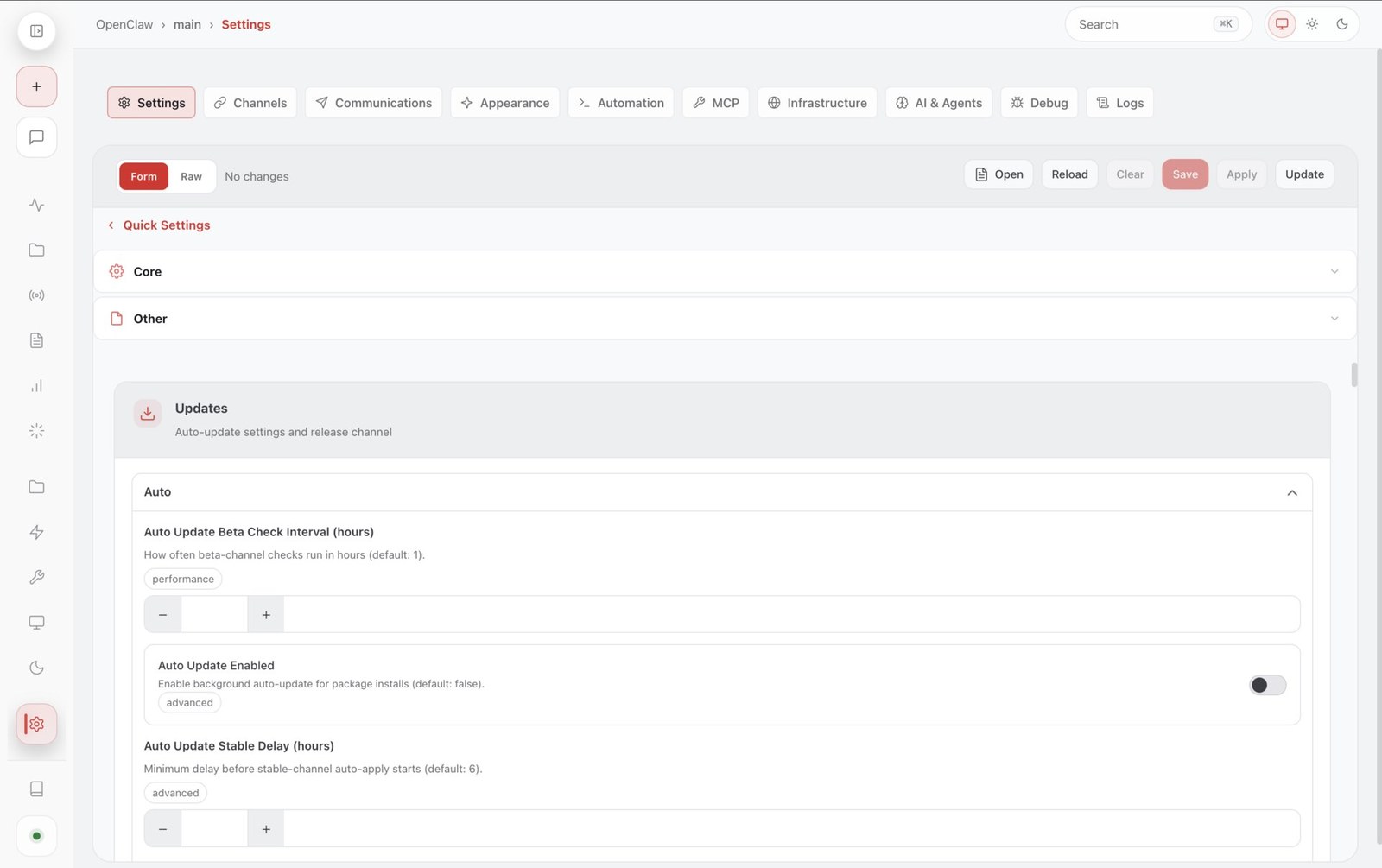
<p><img src="/assets/img/2026-11-18-openclaw-new-features-x-posts-control-ui.jpg" alt="A screenshot of the OpenClaw Control UI Settings page with tabs for Channels, Automation, MCP and Logs, and an Updates section with auto-update options" /></p>

<p><em>Screenshot: OpenClaw, “OpenClaw Screenshot” (8 June 2026), <a href="https://opensource.org/license/mit">MIT License</a>, via <a href="https://commons.wikimedia.org/wiki/File:OpenClaw_Screenshot.png">Wikimedia Commons</a>. Converted to JPEG and scaled to 1,920 px width, otherwise unchanged. It shows the Settings page of the Control UI as of June 2026, not the newer Details panel or Advisor.</em></p>

<h2 id="new-models-without-a-new-release">New models without a new release</h2>

<p>The loudest stream on X is the “now available in OpenClaw” series from the official account. Its posts, all claims by the project itself, include:</p>

<ul>
  <li><strong>Particle-1</strong> on 3 November (<a href="https://x.com/openclaw/status/2117637498902077498">post</a>) and <strong>Tencent Hy4</strong> on 4 November (<a href="https://x.com/openclaw/status/2118034317024923652">post</a>).</li>
  <li><strong>Claude Fable 5.2</strong> on 11 November. Anthropic “reports up to 30% faster output generation” than Fable 5.1 (<a href="https://x.com/openclaw/status/2120550160128467398">post</a>).</li>
  <li><strong>Gemini 4 Hydrogen</strong> on 13 November: “Gemini 4 Hydrogen is out and you can already use it in OpenClaw!” (<a href="https://x.com/openclaw/status/2121098531205501401">post</a>).</li>
  <li><strong>Tencent Hy4 Flash</strong> on 17 November, with Tencent’s own figures of 70% shorter average task time “at roughly 1/15 the cost” in its WorkBuddy tests (<a href="https://x.com/openclaw/status/2122485133597114682">post</a>).</li>
  <li><strong>GPT-6.2 Astra and Sol</strong> on 17 November: “Running v2026.10.1 or newer? No OpenClaw update needed.” (<a href="https://x.com/openclaw/status/2122778563829174468">post</a>). A second post says “Sign in with ChatGPT is out of beta”, so a ChatGPT plan, including ChatGPT Business, can power OpenClaw (<a href="https://x.com/openclaw/status/2122809472271958517">post</a>).</li>
</ul>

<p>The claim “no update needed” is backed by a blog post from 6 November. Maintainer Ayaan Zaidi explains that, when OpenAI shipped GPT-6.1 Sol, ChatGPT sign-in users could not select it, because OpenClaw bundled an older Codex version than ChatGPT required. Over about five weeks and roughly 80 pull requests the team rebuilt model discovery. A hosted catalog at catalog.openclaw.ai, rebuilt every four hours and listing about 1,000 models, now feeds running Gateways. Your own provider account can also list models directly. The post even describes a first fix that was shipped and then reverted because models appeared in the picker but failed on the first message (<a href="https://openclaw.ai/blog/use-new-models-in-openclaw-without-an-update">blog</a>).</p>

<p>The individual model claims are corroborated only in mechanism, not by testing; we did not run these models in OpenClaw.</p>

<p><img src="/assets/img/2026-11-18-openclaw-new-features-x-posts-lobster.jpg" alt="An American lobster, orange and dark brown with raised claws, half hidden in a crevice among pink and white rock encrusted with algae" /></p>

<p><em>Photo: Derek Keats, “American lobster, Homarus americanus in Newfoundland, Canada” (6 September 2015), <a href="https://creativecommons.org/licenses/by/2.0/">CC BY 2.0</a>, via <a href="https://commons.wikimedia.org/wiki/File:American_lobster,_Homarus_americanus_in_Newfoundland,_Canada_(21184223265).jpg">Wikimedia Commons</a>. Scaled to 1,920 px width, otherwise unchanged. A lobster is the project’s mascot (its posts end in the 🦞 emoji); the animal in the picture has no connection with the software.</em></p>

<h2 id="one-shared-agent-for-teams-and-openais-own-use">One shared agent for teams, and OpenAI’s own use</h2>

<p><strong>Multiplayer</strong> is the feature most users on X mention. The project blog (5 November) describes two laptops connected to the same agent: one person types a request, the second sees it appear live, and a shared queue shows when the agent is busy. The Foundation says about 50 people already collaborate this way, and calls the feature free and open source (<a href="https://openclaw.ai/blog/shattering-silos-with-openclaw-multiplayer">blog</a>, <a href="https://x.com/openclaw/status/2118404891911864536">post</a>).</p>

<p>Reactions differ. Jacob Tomlinson, who says in his bio that he builds open-source software at NVIDIA, wrote on 6 November: “I now spend a huge chunk of my time working in OpenClaw multiplayer mode, and it has seriously changed the way that I want to work” (<a href="https://x.com/_JacobTomlinson/status/2118647364550369663">post</a>). A user named Luis Marques reported on 7 November: “I’m using OpenClaw Enterprise with a team of accountants, and so far it has been very useful” (<a href="https://x.com/Luis_MMF/status/2118857506310987936">post</a>). A sceptical developer, Eric (@ericjung), asked on 14 November: “openclaw uses a central gateway. isn’t it more friction/redundant to have different local agents trying to collaborate?” (<a href="https://x.com/ericjung/status/2121693339007525275">post</a>).</p>

<p><strong>OpenClaw Enterprise</strong> is the version for companies. The project describes it as open source, vendor-neutral and still before version 1.0, but “ready for pilots”. It separates trusted parts (access roles, audit logs, enforced policy) from untrusted ones, the agent and its tools (<a href="https://x.com/openclaw/status/2113756870313951480">thread</a>). On 13 November, Peter Steinberger posted “My team wrote about how we run persistent agents inside OpenAI” (<a href="https://x.com/steipete/status/2121058770767982997">post</a>). The OpenAI article says the company runs “hundreds” of OpenClaw agents and later “over 500”, keeps the Gateway apart from the agent in a separate container, blocks the most dangerous sandbox mode and uses a second model to review actions (<a href="https://developers.openai.com/blog/securing-persistent-agents-like-openclaw-at-openai">OpenAI blog</a>). Note the closeness: Steinberger and Kevin Lin, who wrote the Enterprise announcement, both list OpenAI in their X bios, so this is not an independent assessment.</p>

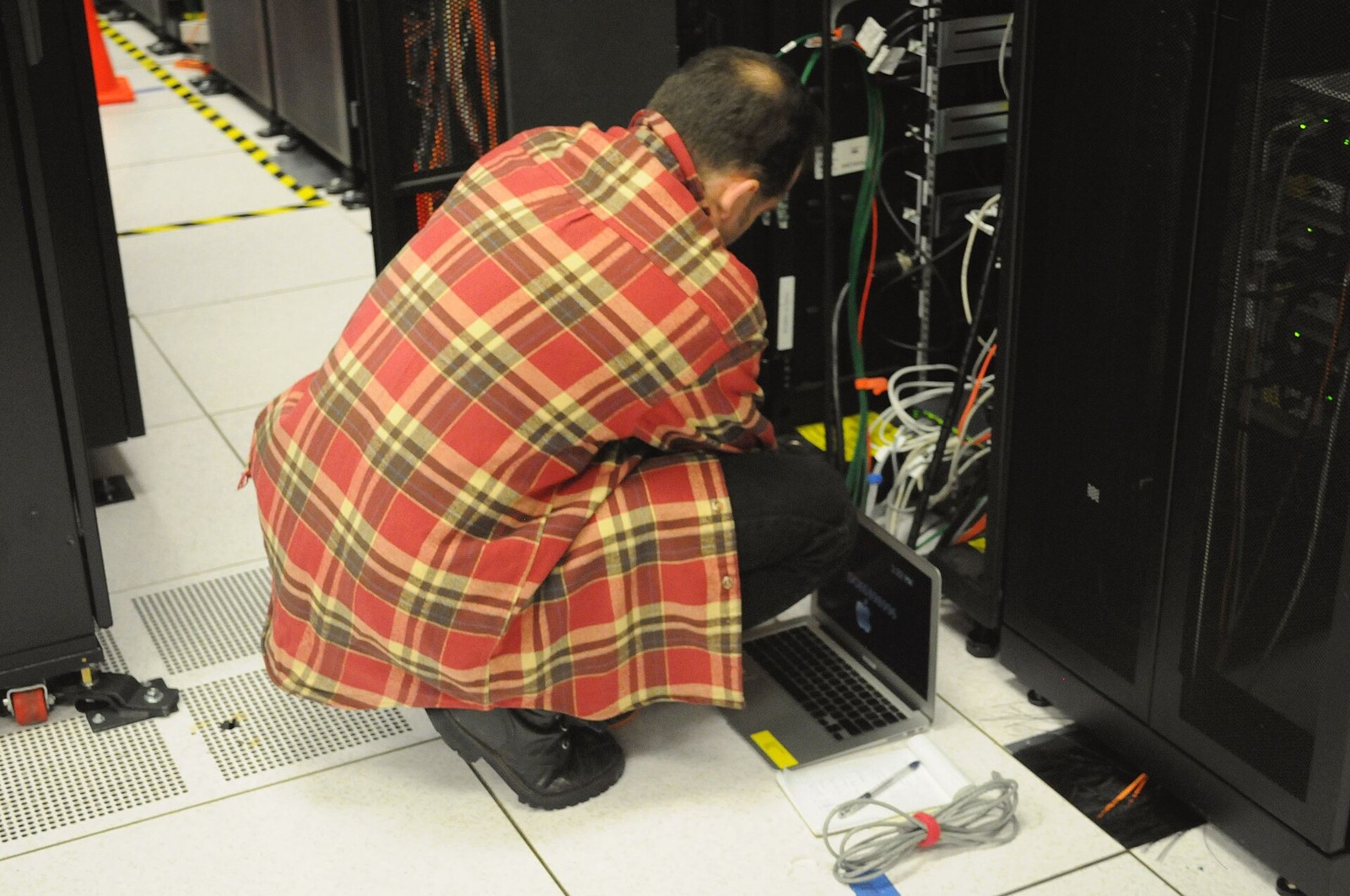
<p><img src="/assets/img/2026-11-18-openclaw-new-features-x-posts-ci-servers.jpg" alt="Visitors on a guided tour walk past rows of server racks with blue network cables in a bright computer centre with a tiled floor" /></p>

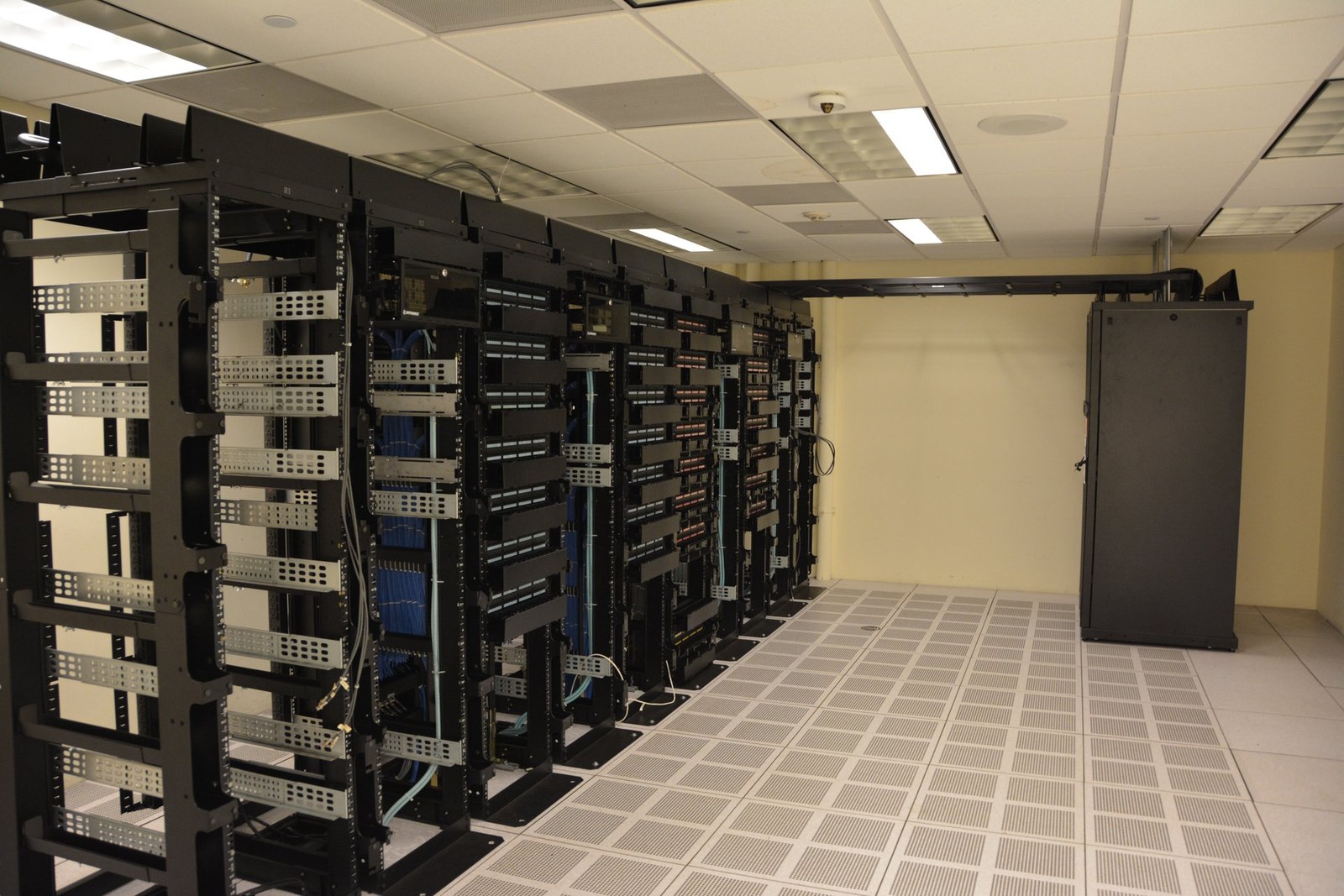
<p><em>Photo: SimonWaldherr, “CERN Computer Center 09” (15 September 2019), <a href="https://creativecommons.org/licenses/by-sa/4.0/">CC BY-SA 4.0</a>, via <a href="https://commons.wikimedia.org/wiki/File:CERN_Computer_Center_09.jpg">Wikimedia Commons</a>. Scaled to 1,920 px width, otherwise unchanged. This is a data centre at CERN, shown only to illustrate rented computing capacity; it is not OpenClaw’s infrastructure.</em></p>

<h2 id="behind-the-scenes-a-cheaper-test-bill-and-a-trip-to-shenzhen">Behind the scenes: a cheaper test bill and a trip to Shenzhen</h2>

<p>On 16 November, Chief Architect Vincent Koc published an essay on cutting the cost of <strong>CI</strong>, the automatic tests that run on every code change. The official account said OpenClaw “was spending a claw and a tail on CI” until Koc dug in (<a href="https://x.com/openclaw/status/2122451216093573217">post</a>). His figures: weekly runner time fell from 158,546 hours (17 to 23 September) to 21,395 hours (6 to 13 November), which is 86.5% less, and the estimated value of the sponsored computing fell 95.5%, from about 1.27 million US dollars to about 57,000 US dollars per 30 days at published prices (<a href="https://vincent.build/openclaw-ci-cost-reduction/">essay</a>). He is open about the caveats: Blacksmith sponsors the capacity, so the project did not pay those amounts, and the workload changed between the weeks. On X he added: “More than 60% of our code is tests, AI generates more and more tests and its counter-productive” (<a href="https://x.com/vincent_koc/status/2122464647924297996">post</a>). These numbers are self-reported; we could not audit them.</p>

<p>Next up is <strong>ClawCon Shenzhen</strong>, 4 to 6 December 2026, with a hackathon first. The blog lists a software track and a hardware track with development boards and a robot arm, speakers including a Tencent open-source director, and a 25 November application deadline (<a href="https://openclaw.ai/blog/openclaw-shenzhen-claw-hack-2026">blog post</a>). On X, Koc showed “Tiny Shenzhen”, a model of the city in a browser, and said he is building open-source components “for @clawcon in SZ” (<a href="https://x.com/vincent_koc/status/2122537100667174953">post</a>). He also announced “a computer use for iphones very soon on MIT licence” (<a href="https://x.com/vincent_koc/status/2121869633531842615">post</a>). That last one is <strong>only a claim on X</strong>: we found no release, code or documentation for it.</p>

<p><img src="/assets/img/2026-11-18-openclaw-new-features-x-posts-shenzhen-huaqiangbei.jpg" alt="A multi-storey indoor electronics market in Shenzhen seen from a gallery, with red banners in Chinese, shop signs and stalls packed with goods" /></p>

<p><em>Photo: Mx. Granger, “华强电子世界 1” (3 September 2018), <a href="https://creativecommons.org/publicdomain/zero/1.0/">CC0 1.0</a>, via <a href="https://commons.wikimedia.org/wiki/File:%E5%8D%8E%E5%BC%BA%E7%94%B5%E5%AD%90%E4%B8%96%E7%95%8C_1.jpg">Wikimedia Commons</a>. Scaled to 1,920 px width, otherwise unchanged. It shows the Huaqiang Electronics World market in Shenzhen’s Huaqiangbei district in 2018, not the conference venue.</em></p>

<h2 id="security-advisories-an-audit-and-the-warnings">Security: advisories, an audit and the warnings</h2>

<p>Security is where critics aim. An agent with access to your files, messages and browser is a target for <strong>prompt injection</strong>: hidden instructions in an email or web page that trick the AI into acting. A security vendor, NeuralTrust, posted on 12 November: “On GitHub, OpenClaw has 659+ security advisories. Hermes Agent has none.” It added that this “doesn’t make Hermes safe” (<a href="https://x.com/NeuralTrustAI/status/2120814255641620706">post</a>). NeuralTrust sells agent security, so it has a commercial interest. We queried GitHub’s public API on 17 November and counted <strong>722 published advisories</strong> for the OpenClaw repository (14 critical, 249 high, 390 medium, 69 low), the newest dated 11 September. An advisory is a published report of a flaw and its fix; a high count shows that issues are being found and disclosed, not how many are still open. We cannot compare it with Hermes.</p>

<p>The project’s own evidence: a Trail of Bits audit through OpenAI’s “Patch the Planet” programme, reported on 21 September. It produced 27 private advisories and 3 hardening changes, 24 severity-rated flaws (0 critical, 2 high, 16 medium, 6 low), and the project says every actionable issue was fixed. The most common problem was permissions getting lost between steps (<a href="https://openclaw.ai/blog/openclaw-trail-of-bits-engagement-recap">blog</a>). A 2 October post says Tencent’s AIG team joined “ClawScan”, security review of skills uploaded to the ClawHub store (<a href="https://openclaw.ai/blog">blog index</a>).</p>

<p>New defences are in the latest notes: approval for delegated persistent changes, image checks by policy plugins, blocking of page-initiated navigation to policy-blocked addresses, and keeping authenticated browser addresses out of tool results (<a href="https://raw.githubusercontent.com/openclaw/openclaw/main/CHANGELOG/2026.11.4.md">v2026.11.4 changelog</a>, <a href="https://github.com/openclaw/openclaw/releases/tag/v2026.11.5">v2026.11.5</a>).</p>

<p>Critical voices remain. Developer Arnav Gupta wrote on 3 November: “Prompt injection and marketing is a blurry line if you have given your inbox to agents” and was doubtful about “a vibe coded openclaw” (<a href="https://x.com/championswimmer/status/2117675829266419928">post</a>). Emmanuel Belo asked the maintainers on 7 November for a guide on securing agents “against prompt injection, malicious files and worm-like propagation” (<a href="https://x.com/emmanuel_belo/status/2119132243956252781">post</a>). Another user judged Hermes better on security than OpenClaw but still not fully trustworthy (<a href="https://x.com/JoelDeTeves/status/2119231150896148954">post</a>). Steinberger himself warned on 12 November that marketers pay for praise of new agents, so “keep a lookout on honest reviews” (<a href="https://x.com/steipete/status/2121009372470067544">post</a>).</p>

<p><img src="/assets/img/2026-11-18-openclaw-new-features-x-posts-padlock.jpg" alt="A small golden-brown vintage padlock with a keyhole, with two keys on a ring, lying on graph paper" /></p>

<p><em>Photo: Nxr-at, “15mm Boss Padlocks Vorhangschloss” (31 May 2017), <a href="https://creativecommons.org/licenses/by-sa/4.0/">CC BY-SA 4.0</a>, via <a href="https://commons.wikimedia.org/wiki/File:15mm_Boss_Padlocks_Vorhangschloss.JPG">Wikimedia Commons</a>. Scaled to 1,920 px width, otherwise unchanged. A symbolic image of a physical padlock; it is not related to OpenClaw’s software.</em></p>

<h2 id="what-users-and-critics-say-on-x">What users and critics say on X</h2>

<p>Many posts that mention OpenClaw promote add-on or competing products, so we did not treat them as evidence of features. Genuine users are split.</p>

<p><strong>Supportive:</strong></p>
<ul>
  <li>“I tried open claw, switched to Hermes, and came back to open claw. Hermes felt like a robot. OpenClaw feels more human” (@jtaby, 17 November, <a href="https://x.com/jtaby/status/2122481213160165600">post</a>). Hermes Agent is a competing open-source agent from Nous Research.</li>
  <li>Mike Gannotti, whose bio lists a Principal AI role at Microsoft and says the opinions are his own, singled out the scheduled-job fixes in v2026.11.5: a late wake-up “could just eat a run. no record, no error” (<a href="https://x.com/MichaelGannotti/status/2122662355297505639">post</a>). That matches the release notes’ cron entries, so we count it as corroborated.</li>
</ul>

<p><strong>Balanced:</strong> “I love how autonomous Openclaw is, but I find Openclaw more likely to take off down a road I don’t want them to go down than Hermes does” (@GodinPatri43620, 15 November, <a href="https://x.com/GodinPatri43620/status/2122003866199765497">post</a>).</p>

<p><strong>Critical:</strong></p>
<ul>
  <li>Conor O’Neill wrote on 14 November: “Every OpenClaw update has been a disaster for months. Never just works.” He also described a bug that had created 20,000+ directories and 870,000+ files (<a href="https://x.com/conoro/status/2121538039092597155">post</a>).</li>
  <li>“Too complicated, just like OpenClaw. I installed it, then dragged it straight to the Trash” (@smoothdvd, 13 November, <a href="https://x.com/smoothdvd/status/2121074237666632149">post</a>).</li>
  <li>One user claimed that “no one even uses openclaw anymore” (<a href="https://x.com/capsraunak/status/2121882704128119265">post</a>). GitHub shows about 395,000 stars and 83,000 forks, but stars are not users, and we found no reliable usage figure.</li>
</ul>

<p>The project’s account answered a critic on 15 November: “We don’t sell tokens or give out credits or free models. We’re not a business” (<a href="https://x.com/openclaw/status/2121853719356878943">post</a>). The release notes themselves are dominated by repairs, which supports critics’ point about stability as well as maintainers’ point about fast fixing.</p>

<h2 id="faq">FAQ</h2>

<p><strong>What is OpenClaw?</strong> A free, MIT-licensed AI agent that runs on your own machine and connects chat apps to AI models. It does not include its own model.</p>

<p><strong>Do I need to update to use a new model?</strong> According to the official posts, not always: GPT-6.2 works on v2026.10.1 or newer, and the hosted catalog is meant to add models between releases. Check the docs for your provider.</p>

<p><strong>Is OpenClaw safe to use?</strong> No agent with broad access is risk-free. The project publishes advisories, had an external audit and keeps adding approval rules, but prompt injection remains an industry-wide problem. Use a sandbox, limit permissions and update.</p>

<h2 id="what-we-could-not-verify">What we could not verify</h2>

<ul>
  <li><strong>Model availability on launch day.</strong> We did not test GPT-6.2, Gemini 4 Hydrogen, Claude Fable 5.2 or Hy4 Flash inside OpenClaw. The notes do not list them, so this rests on official posts and the catalog mechanism.</li>
  <li><strong>Vendor figures.</strong> Anthropic’s “up to 30% faster” and Tencent’s “70% … 1/15 the cost” are company claims.</li>
  <li><strong>Vincent Koc’s iPhone computer-use package</strong> and its “2.1 ms” typing speed appear only in X posts.</li>
  <li><strong>CI savings and “about 50 people” using Multiplayer.</strong> Both are self-reported by maintainers; the workload also changed.</li>
  <li><strong>Advisory counts.</strong> Our 722 comes from GitHub’s API on 17 November and may differ from NeuralTrust’s 659+. We cannot confirm Hermes has none or how many OpenClaw issues remain open.</li>
  <li><strong>A study that tested OpenClaw against the OWASP Agentic Top 10.</strong> It is only summarised in a low-reach X post (<a href="https://x.com/eforus_overseer/status/2122695031840755894">post</a>); we found no paper.</li>
  <li><strong>Active users.</strong> No reliable number exists in the sources we saw.</li>
  <li><strong>Completeness.</strong> X search is not exhaustive, post counts change, and some accounts may be deleted later.</li>
</ul>

<h2 id="image-credits-and-sources">Image credits and sources</h2>

<p><strong>Images:</strong> all pictures are free licences from Wikimedia Commons, with credits in the captions above: LogicFlow99 (CC0), OpenClaw (MIT), Derek Keats (CC BY 2.0), SimonWaldherr (CC BY-SA 4.0), Mx. Granger (CC0), Nxr-at (CC BY-SA 4.0). Some images are scaled; none are altered otherwise.</p>

<p><strong>Primary sources</strong></p>
<ul>
  <li><a href="https://github.com/openclaw/openclaw/releases">OpenClaw on GitHub (MIT licence, releases)</a></li>
  <li><a href="https://docs.openclaw.ai/releases/">OpenClaw docs: release notes</a></li>
  <li><a href="https://raw.githubusercontent.com/openclaw/openclaw/main/CHANGELOG/2026.10.10.md">v2026.10.10 changelog</a></li>
  <li><a href="https://raw.githubusercontent.com/openclaw/openclaw/main/CHANGELOG/2026.11.4.md">v2026.11.4 changelog</a></li>
  <li><a href="https://github.com/openclaw/openclaw/releases/tag/v2026.11.5">Release v2026.11.5</a></li>
  <li><a href="https://openclaw.ai/blog">OpenClaw blog</a></li>
  <li><a href="https://openclaw.ai/blog/use-new-models-in-openclaw-without-an-update">Use new models without an update (6 Nov)</a></li>
  <li><a href="https://openclaw.ai/blog/shattering-silos-with-openclaw-multiplayer">Shattering silos with Multiplayer (5 Nov)</a></li>
  <li><a href="https://openclaw.ai/blog/openclaw-trail-of-bits-engagement-recap">Trail of Bits audit recap (21 Sep)</a></li>
  <li><a href="https://openclaw.ai/blog/openclaw-shenzhen-claw-hack-2026">OpenClaw is coming to Shenzhen (13 Nov)</a></li>
  <li><a href="https://vincent.build/openclaw-ci-cost-reduction/">Vincent Koc: Making OpenClaw CI faster and 95% cheaper</a></li>
  <li><a href="https://developers.openai.com/blog/securing-persistent-agents-like-openclaw-at-openai">OpenAI: Securing persistent agents like OpenClaw at OpenAI</a></li>
  <li><a href="https://api.github.com/repos/openclaw/openclaw/security-advisories">GitHub security advisories API (OpenClaw)</a></li>
</ul>

<p><strong>Posts on X</strong> (quoted as written, posted 2 to 17 November 2026)</p>
<ul>
  <li><a href="https://x.com/openclaw">@openclaw</a>, <a href="https://x.com/steipete">@steipete</a>, <a href="https://x.com/vincent_koc">@vincent_koc</a>, <a href="https://x.com/_JacobTomlinson/status/2118647364550369663">@_JacobTomlinson</a>, <a href="https://x.com/Luis_MMF/status/2118857506310987936">@Luis_MMF</a>, <a href="https://x.com/ericjung/status/2121693339007525275">@ericjung</a>, <a href="https://x.com/NeuralTrustAI/status/2120814255641620706">@NeuralTrustAI</a>, <a href="https://x.com/championswimmer/status/2117675829266419928">@championswimmer</a>, <a href="https://x.com/emmanuel_belo/status/2119132243956252781">@emmanuel_belo</a>, <a href="https://x.com/JoelDeTeves/status/2119231150896148954">@JoelDeTeves</a>, <a href="https://x.com/jtaby/status/2122481213160165600">@jtaby</a>, <a href="https://x.com/MichaelGannotti/status/2122662355297505639">@MichaelGannotti</a>, <a href="https://x.com/GodinPatri43620/status/2122003866199765497">@GodinPatri43620</a>, <a href="https://x.com/PriorReason/status/2119244079297138762">@PriorReason</a>, <a href="https://x.com/conoro/status/2121538039092597155">@conoro</a>, <a href="https://x.com/smoothdvd/status/2121074237666632149">@smoothdvd</a>, <a href="https://x.com/capsraunak/status/2121882704128119265">@capsraunak</a></li>
</ul>]]></content><author><name>Arnold Kahr</name></author><category term="AI" /><category term="OpenClaw" /><category term="AI agents" /><category term="open source" /><category term="Peter Steinberger" /><category term="Vincent Koc" /><category term="OpenAI" /><category term="Multiplayer" /><category term="security" /><category term="prompt injection" /><category term="Hermes Agent" /><category term="release notes" /><summary type="html"><![CDATA[Explainer, 18 November 2026: what OpenClaw added since 3 November (releases v2026.10.10 to v2026.11.5, model catalog, Multiplayer, OpenClaw Enterprise, CI savings, Shenzhen conference), what developers, fans and critics say on X, and which claims we could not verify.]]></summary><media:thumbnail xmlns:media="http://search.yahoo.com/mrss/" url="https://thearchitecthighlevel.com/assets/img/2026-11-18-openclaw-new-features-x-posts-header-lobster.jpg" /><media:content medium="image" url="https://thearchitecthighlevel.com/assets/img/2026-11-18-openclaw-new-features-x-posts-header-lobster.jpg" xmlns:media="http://search.yahoo.com/mrss/" /></entry><entry><title type="html">China’s AI Under Chip Limits: Distillation, Rationed Chatbots and a Price War Before the Shenzhen Summit</title><link href="https://thearchitecthighlevel.com/2026/11/18/china-ai-distillation-compute-squeeze-shenzhen/" rel="alternate" type="text/html" title="China’s AI Under Chip Limits: Distillation, Rationed Chatbots and a Price War Before the Shenzhen Summit" /><published>2026-11-18T00:04:04+01:00</published><updated>2026-11-18T00:04:04+01:00</updated><id>https://thearchitecthighlevel.com/2026/11/18/china-ai-distillation-compute-squeeze-shenzhen</id><content type="html" xml:base="https://thearchitecthighlevel.com/2026/11/18/china-ai-distillation-compute-squeeze-shenzhen/"><![CDATA[<p>For a year, US officials and American AI labs have said that Chinese companies build their models partly by copying answers from American ones. On 17 November 2026, Reuters added documents to that argument: a review of more than 300 Chinese papers, patents, corporate disclosures, recruitment notices and government papers, which it says shows the practice, called <em>distillation</em>, has moved from academic experiments into mainstream industrial use in China, with Beijing’s encouragement. The story landed at a tense moment. Washington tightened its chip rules on Monday, DeepSeek began rationing its free chatbot because it is short of computing power, Alibaba and Tencent launched cheaper models, and Donald Trump and Xi Jinping are due to meet in Shenzhen this week.</p>

<p>This report separates what is documented from what is claimed. Findings by journalists and government agencies are <strong>reported facts or allegations</strong>, as labelled. Company launch figures are <strong>company claims</strong>. Views from researchers and commentators are <strong>opinions</strong>. The picture is current as of <strong>17 November 2026</strong>.</p>

<h2 id="the-short-version">The short version</h2>

<ul>
  <li><strong>The report.</strong> Reuters (17 November) says Chinese entities increasingly use output from US AI models to train domestic rivals, and that Chinese government documents encourage distillation, though they do not instruct companies to distil American models.</li>
  <li><strong>Is it legal?</strong> Reuters notes distillation “is not illegal and is prevalent in other parts of the world.” The dispute is about unauthorised access, terms of service and scale.</li>
  <li><strong>The US position.</strong> A joint advisory by the NSA, CISA and FBI (8 September) accuses six Chinese firms of “industrial-scale” distillation. China’s foreign ministry calls the accusations “groundless.”</li>
  <li><strong>The squeeze.</strong> On 16 November the US Commerce Department issued an interim rule on remote access to advanced chips, and from 15 November DeepSeek was reported to be limiting free chats because of “insufficient computing power.”</li>
  <li><strong>The expert split.</strong> Commentators disagree sharply on how much distillation explains China’s progress; estimates quoted below range from “not crucial” to “about half.”</li>
  <li><strong>What to watch.</strong> The APEC summit in Shenzhen on 18–19 November, where AI safety talks are expected alongside the chip dispute.</li>
</ul>

<h2 id="what-reuters-found-and-what-distillation-means">What Reuters found, and what distillation means</h2>

<p><img src="/assets/img/2026-11-18-china-ai-distillation-compute-squeeze-shenzhen-distillation-apparatus.jpg" alt="A laboratory distillation apparatus on a bench, with glass flasks, a condenser and clamps" /></p>

<p><em>Photo: KiveVictor, “Laboratory vacuum distillation apparatus on a benchtop” (7 April 2025), <a href="https://creativecommons.org/licenses/by/4.0/">CC BY 4.0</a>, via <a href="https://commons.wikimedia.org/wiki/File:Laboratory_vacuum_distillation_apparatus_on_a_benchtop.jpg">Wikimedia Commons</a>. A chemistry apparatus, shown only as a loose picture for the word “distillation”; it is unrelated to AI.</em></p>

<p>In AI, distillation means using a strong “teacher” model to produce answers that are used to train a smaller “student” model. Reuters describes the attraction for Chinese developers short of computing power: an American model can answer a hard question once, and a Chinese team can keep the answer and train a local system around it. AI researcher Nathan Lambert, who writes the Interconnects newsletter and works with the open-model group Ai2, notes that the term has drifted from its strict meaning. Today it mostly means <em>synthetic data</em>: outputs from a stronger model, usually fetched through its API (the programming interface companies sell access to), used as training material.</p>

<p>Reuters gives concrete examples from published papers: in November 2024, Shanghai Jiao Tong University researchers selected about 5,000 answers from OpenAI’s o1 model, translated them with GPT-4o mini, and built 10,750 bilingual training examples to train Alibaba’s Qwen2.5-72B. In April 2025, Alibaba researchers described using GPT-4 and GPT-4o to generate non-Chinese training material for smaller Qwen models. A February 2026 paper by Shanghai Jiao Tong and the food-delivery company Meituan used GPT-4o to produce plans for coordinating AI agents. The universities and companies did not respond to Reuters’ requests for comment.</p>

<p>Three further points in the Reuters report matter. The Chinese researchers in the 2024 paper themselves warned that over-reliance on distillation “could stifle original innovation.” Distillation “cannot reproduce a leading model’s full capabilities or eliminate the need for advanced computing power.” And a national “AI+Manufacturing” policy package from eight Chinese agencies in January supports “model training, fine-tuning and distillation” for industry, although no document instructs firms to distil American models. Reuters also reports that Chinese developers have asked the industry ministry where ordinary use of foreign models ends and organised collection of output begins; the ministry did not respond.</p>

<h2 id="the-us-case-and-chinas-reply">The US case and China’s reply</h2>

<p>The US government’s accusation is far stronger than ordinary distillation. The joint advisory of the NSA, CISA and FBI, published on 8 September 2026, says DeepSeek, Moonshot AI, Alibaba, MiniMax, StepFun and Z.AI “extracted billions of tokens across millions of exchanges” from US models since at least late 2024, “likely with Chinese government awareness.” A <em>token</em> is a small chunk of text, often a word or part of one. The advisory describes bulk fake accounts, a “gray market of proxies” it calls “transfer stations,” and prompts that coax models into revealing their step-by-step reasoning. It says the activity violates US providers’ terms of use. These are <strong>allegations by US agencies</strong>. Ars Technica reported that none of the US AI companies it contacted responded at the time, and the Chinese side has not accepted the findings.</p>

<p>An earlier, company-level claim came in February from Anthropic, which said three labs (DeepSeek, Moonshot and MiniMax) generated over 16 million exchanges with Claude through about 24,000 fraudulent accounts. In Anthropic’s breakdown, as quoted by Lambert, DeepSeek’s share was over 150,000 exchanges, Moonshot’s over 3.4 million and MiniMax’s over 13 million.</p>

<p>China rejects the framing. Foreign ministry spokesperson Mao Ning called the September accusations “groundless” and attributed Chinese progress to “high-level scientific and technological self-reliance,” Ars Technica reported. A commerce ministry statement, quoted in an X post by commentator Henry Gao from Xinhua, calls distillation “a normal technical and commercial issue” and the US move an example of “double standards.” In July, at meetings in Chengdu, Chinese officials told US counterparts distillation is a standard technique and said they were open to acting on IP theft, “but made no concrete commitments,” a US official told Reuters. Treasury Secretary Scott Bessent wrote on 23 July that if firms “cross the line into IP theft, sanctions and Entity List designations will be on the table.”</p>

<h2 id="how-much-does-distillation-explain-the-experts-disagree">How much does distillation explain? The experts disagree</h2>

<p><img src="/assets/img/2026-11-18-china-ai-distillation-compute-squeeze-shenzhen-alibaba-binjiang.jpg" alt="Glass office buildings of Alibaba's Binjiang Park campus in Hangzhou around a lawn with trees, a dark sculpture and people walking" /></p>

<p><em>Photo: Danielinblue (architects: HASSELL), “Alibaba Binjiang Park” (17 July 2014), <a href="https://creativecommons.org/licenses/by-sa/4.0/">CC BY-SA 4.0</a>, via <a href="https://commons.wikimedia.org/wiki/File:Alibaba_Binjiang_Park.jpg">Wikimedia Commons</a>. A 2014 photo of an Alibaba campus in Hangzhou; the building does not tell us anything about the allegations.</em></p>

<p>This is where reasonable specialists part ways.</p>

<p><strong>The sceptics.</strong> Lambert wrote in February that he “still wouldn’t say it is a crucial factor” in Chinese labs’ post-training capabilities, even though the volumes Anthropic described could “meaningfully improve” a model. He added that Chinese labs “likely innovate greatly on distilling from leading API models, due to their restricted access to GPUs.” In May he argued that what a few labs do should be called “jailbreaking or abuse,” not distillation, and warned that sweeping policy could hurt Western researchers who rely on open Chinese models. The South China Morning Post reported in July that AI researchers on X called the US claims about Moonshot’s Kimi K3 “political” and “reckless,” pointing out that a model’s output is not copyrighted; a Moonshot employee noted the short gap between the releases of Kimi K3 and Anthropic’s Fable 5, which it was accused of copying. Reuters adds that two people familiar with Chinese developers’ work said distillation is “only one factor alongside advances in engineering, algorithms, data and model design.”</p>

<p><strong>The believers.</strong> Dean Ball, who says he has joined OpenAI, wrote on 18 October that he had guessed distillation explained about 30% of how close Chinese models are on benchmarks, but “after that, more like 50%,” citing “the size and sophistication of what we see almost literally every hour of every day.” He did not publish data. Another commenter, Henry Gao, replied that he now puts it at “80–90%” after China’s commerce ministry called distillation normal. A US official told Reuters Washington believes industrial-scale distillation is “the main reason” Chinese models have narrowed the gap.</p>

<p><strong>A hardware view.</strong> The Institute for Progress, a US think tank cited by the BBC, estimates top US models lead the best Chinese ones by only about six and a half months, “despite US AI companies having significantly better compute access and financing.” In the same thread, Divyansh Kaushik replied that Chinese firms have “way more compute than people realize, thanks to remote access and our failures to crack down on smuggling.” None of these figures is a measurement we could check; they are judgments.</p>

<h2 id="the-chip-squeeze-and-deepseeks-rationing">The chip squeeze, and DeepSeek’s rationing</h2>

<p><img src="/assets/img/2026-11-18-china-ai-distillation-compute-squeeze-shenzhen-johor-bahru.jpg" alt="A wide stretch of water in the foreground with the low skyline of Johor Bahru, Malaysia, on the far shore under a blue sky with clouds" /></p>

<p><em>Photo: aamanatullah, “Johor Bahru Skyline” (9 May 2015), <a href="https://creativecommons.org/licenses/by/2.0/">CC BY 2.0</a>, via <a href="https://commons.wikimedia.org/wiki/File:Johor_Bahru_Skyline_(17300534739).jpg">Wikimedia Commons</a>. Johor in Malaysia is one of the data-centre hubs named by the BBC; this is a 2015 city view, not a data centre.</em></p>

<p>On Monday 16 November, the US Commerce Department’s Bureau of Industry and Security issued an interim final rule on remote access to advanced AI chips. According to CNBC and POLITICO it requires licences to export advanced chips to Indonesia, Malaysia, Singapore, Thailand and Brazil, which it describes as at higher-than-normal risk of diversion, and it targets arrangements in which Chinese firms rent Nvidia computing power in third countries. The Business Times reports exceptions, for example for computing used by content-recommendation systems. The rule followed a scandal around Singapore-based Megaspeed, accused of diverting chips to China; Megaspeed denies this, the BBC reports. China’s foreign ministry called the rules “economic coercion.”</p>

<p>The Institute for Progress estimates that at least 30% of China’s advanced AI computing power will come from renting abroad or smuggling by 2027, the BBC reported. That is a projection. Experts quoted by the BBC weigh the effect differently. Reema Bhattacharya of the advisory firm Verisk Maplecroft said the rule takes away “one of the more practical routes” Chinese developers had to frontier computing. The BBC adds that tighter limits could also push Chinese firms towards domestic chips, a long-standing dilemma for Washington, according to trade expert Naoise McDonagh.</p>

<p>Computing shortage was visible at home too. From 15 November, users of the DeepSeek app and website reported notices that “insufficient computing power” meant long chats inactive for more than seven days could no longer be resumed, with some users hit after 72 hours, input per message capped at about 40,000 Chinese characters, and daily quotas, according to Yicai, TechNode and Lianhe Zaobao. DeepSeek has issued no announcement. TechNode notes the status page recorded eight incidents since October. Lianhe Zaobao recalled that founder Liang Wenfeng said in July that computing resources were the team’s real constraint. Yicai reports that DeepSeek’s V4.1-Flash model handled 59.2 trillion tokens on the OpenRouter aggregator in the week to 15 November, the most worldwide; that is one platform, not the whole market. Whether DeepSeek will launch paid consumer plans is speculation.</p>

<h2 id="cheaper-models-from-alibaba-and-tencent">Cheaper models from Alibaba and Tencent</h2>

<p><img src="/assets/img/2026-11-18-china-ai-distillation-compute-squeeze-shenzhen-tencent-binhai.jpg" alt="The entrance of the Tencent Binhai Building in Shenzhen with the Tencent logo and name on a sign, trees in front and a taxi on the street" /></p>

<p><em>Photo: MEAIYAVT 206 Liowcms, “Tencent Binhai Building, Nanshan, Shenzhen” (3 June 2023), <a href="https://creativecommons.org/licenses/by-sa/4.0/">CC BY-SA 4.0</a>, via <a href="https://commons.wikimedia.org/wiki/File:SZ_%E6%B7%B1%E5%9C%B3_Shenzhen_%E5%8D%97%E5%B1%B1%E5%8C%BA_Nanshan_Haitian_2nd_Road_Binhai_Blvd_Road_Haixue_Road_Houhai_Blvd_%E9%A8%B0%E8%A8%8A%E6%B5%B7%E6%BF%B1%E5%A4%A7%E5%BB%88_Tencent_Binhai_Building_June_2023_Px3.jpg">Wikimedia Commons</a>. Scaled down to 1,920 px width. A 2023 street view of a Tencent office building in Shenzhen.</em></p>

<p>Both companies answered the compute squeeze with cost. On 16 November Alibaba released <strong>Qwen4-Max</strong>. Its press release says the model has 2.4 trillion parameters in total but activates only 71 billion for each token (a “mixture-of-experts” design, in which just part of the model works on any given piece of text), a one-million-token context window, and an average cost per task about 60% lower than Qwen3.8-Max on Work360, a proprietary Alibaba benchmark. Input with a cache hit costs $0.075 per million tokens. Alibaba says smaller open-weight Qwen4 models will follow.</p>

<p>Those are <strong>company claims</strong>. The independent site Artificial Analysis scores Qwen4-Max 43 on its Intelligence Index, ranking it 47th of 91 models and describing it as “below average in intelligence” for comparable models, “notably slow” and “very verbose” (127 million output tokens on its tests, versus a median of 65.4 million). It lists prices of $1.50 per million input tokens and $4.50 per million output tokens and says Alibaba has not disclosed the model’s size, which conflicts with Alibaba’s press release. We have not reconciled this.</p>

<p>On the same day Tencent launched <strong>Hy4 flash</strong>, with 224 billion parameters and 12 billion active, a one-million-token context and prices of about $0.070 per million input tokens and $0.281 per million output tokens. Tencent says that on its internal WorkIndex benchmark the cost per task is one thirteenth of its Hy4 Preview and one eighth of DeepSeek-V4.1-Flash-1017 at that model’s peak-hour Max-tier pricing. It is free on its WorkBuddy product until 30 November. Again, that is a company benchmark. Together with the Qwen launch, it signals a price war at the cheap end of the market, where distilled or efficiency-tuned models matter most.</p>

<h2 id="shenzhen-what-to-watch-this-week">Shenzhen: what to watch this week</h2>

<p>The APEC summit takes place in Shenzhen on 18–19 November. Reuters says the Trump–Xi meeting is expected on Thursday. The Business Times reports the two governments are expected to hold their first AI dialogue on safety, possibly coloured by the chip dispute. Reuters adds that a proposed emergency mechanism for notifying each other of serious AI incidents, discussed in September, “has yet to become operational.” The Los Angeles Times reports Trump is not expected to raise the Nvidia matter directly with Xi, but Bessent plans to in his own meetings.</p>

<h2 id="faq">FAQ</h2>

<p><strong>Is distillation illegal?</strong></p>

<p>Reuters says it “is not illegal” and is widely used. Using it against US providers’ terms, with fake accounts or proxies, is what the US calls abuse; OpenAI and Anthropic restrict using their outputs to build rival models.</p>

<p><strong>Did Chinese companies copy American AI?</strong></p>

<p>The US agencies allege it, and Reuters documents that Chinese papers use US model output. Chinese officials call it a normal technique. How much it explains is disputed by experts.</p>

<p><strong>Does this undercut US chip curbs?</strong></p>

<p>Reuters says wider distillation “could undercut the effectiveness” of the curbs, because developers can acquire capabilities without the original compute. Lambert argues the opposite lesson, that chips are the more effective lever.</p>

<p><strong>Why is DeepSeek limiting chats?</strong></p>

<p>DeepSeek’s notices cite insufficient computing power. It has not published a wider explanation.</p>

<p><strong>Are Qwen4-Max and Hy4 flash better than US models?</strong></p>

<p>Not on the independent evidence we found. Artificial Analysis rates Qwen4-Max below average among comparable models; its main selling point is price.</p>

<p><strong>Does the new US rule stop China from using Nvidia chips?</strong></p>

<p>No. Chinese firms can still use computing in US data centres, and exceptions exist; the rule adds licences and approvals for third-country arrangements.</p>

<h2 id="what-we-could-not-verify">What we could not verify</h2>

<ul>
  <li><strong>The Reuters documents.</strong> We read Reuters’ summary of its review, not the underlying papers or patents.</li>
  <li><strong>The US agencies’ evidence.</strong> The advisory states findings; the underlying logs are not public.</li>
  <li><strong>How much distillation explains.</strong> The 30%, 50% and “80–90%” figures quoted online are personal estimates without published data.</li>
  <li><strong>DeepSeek’s actual limits.</strong> They come from user reports and media; DeepSeek has not published a policy.</li>
  <li><strong>Qwen4-Max’s size.</strong> Alibaba says 2.4 trillion parameters; Artificial Analysis says it is undisclosed.</li>
  <li><strong>Company benchmark claims.</strong> Work360 and WorkIndex are in-house benchmarks.</li>
  <li><strong>Summit outcomes.</strong> The meetings had not happened when we wrote this.</li>
</ul>

<h2 id="sources">Sources</h2>

<ul>
  <li><a href="https://www.investing.com/news/economy-news/exclusivechina-taps-us-ai-models-train-homegrown-rivals-chip-curbs-bite-5031568">Reuters via Investing.com: China taps US AI models to train homegrown rivals as chip curbs bite (17 November 2026)</a></li>
  <li><a href="https://www.cisa.gov/news-events/cybersecurity-advisories/aa26-251a">CISA, NSA and FBI: China-based AI companies conducting industrial-scale distillation campaigns against US AI companies (8 September 2026)</a></li>
  <li><a href="https://arstechnica.com/tech-policy/2026/09/six-chinese-ai-firms-accused-of-aggressively-copying-us-frontier-models/">Ars Technica: Six Chinese AI firms accused of aggressively copying US frontier models (9 September 2026)</a></li>
  <li><a href="https://www.interconnects.ai/p/how-much-does-distillation-really">Interconnects (Nathan Lambert): How much does distillation really matter for Chinese LLMs? (24 February 2026)</a></li>
  <li><a href="https://www.interconnects.ai/p/the-distillation-panic">Interconnects (Nathan Lambert): The distillation panic (4 May 2026)</a></li>
  <li><a href="https://xitter.cf/deanwball/status/2111802397148471496">Dean W. Ball on X: distillation and Chinese benchmark performance (18 October 2026), via a mirror</a></li>
  <li><a href="https://www.scmp.com/tech/tech-war/article/3361625/global-ai-experts-push-back-us-distillation-claims-against-moonshots-kimi-k3-model">South China Morning Post: Global AI experts push back on US “distillation” claims against Moonshot’s Kimi K3 (23 July 2026)</a></li>
  <li><a href="https://www.bbc.com/news/articles/cwq6e2qgvmlgo">BBC: How new US chip restrictions on South East Asia will hit China (17 November 2026)</a></li>
  <li><a href="https://www.cnbc.com/2026/11/16/nvidia-commerce-china-lutnick.html">CNBC: Commerce targets loophole for China’s data center use (16 November 2026)</a></li>
  <li><a href="https://www.politico.com/news/2026/11/16/commerce-closes-chinas-backdoor-to-nvidia-chips-after-white-house-steps-in-01167199">POLITICO: Commerce closes China’s backdoor to Nvidia chips (16 November 2026)</a></li>
  <li><a href="https://www.bis.gov/press-release/bis-issues-rule-addressing-remote-access-american-super-intelligence-technology">US Bureau of Industry and Security: Rule addressing remote access to advanced chips and servers (16 November 2026)</a></li>
  <li><a href="https://www.businesstimes.com.sg/international/us-chip-curbs-force-xi-jinping-weigh-response-trump-summit">The Business Times: US chip curbs force Xi to weigh response before Trump summit (17 November 2026)</a></li>
  <li><a href="https://www.investing.com/news/stock-market-news/chip-tensions-loom-over-trumpxi-summit-as-us-and-china-push-ai-safety-steps-5028728">Reuters via Investing.com: Chip tensions loom over Trump–Xi summit (16 November 2026)</a></li>
  <li><a href="https://www.latimes.com/politics/story/2026-11-17/divided-trump-team-closes-ranks-ahead-of-ai-talks-with-china">Los Angeles Times: A divided Trump team closes ranks ahead of AI talks with China (17 November 2026)</a></li>
  <li><a href="https://www.yicaiglobal.com/news/deepseek-sets-new-limits-for-free-users-due-to-insufficient-computing-power">Yicai Global: DeepSeek scales back free AI usage on computing power crunch (17 November 2026)</a></li>
  <li><a href="https://technode.com/2026/11/16/deepseek-users-report-chat-limits-as-the-service-cites-capacity-constraints/">TechNode: DeepSeek users report chat limits as the service cites capacity constraints (16 November 2026)</a></li>
  <li><a href="https://www.zaobao.com.sg/en/news/china/deepseek-usage-limits-over-computing-shortages-raise-doubts-about-sustainability-free-service">Lianhe Zaobao: DeepSeek usage limits over computing shortages raise doubts about sustainability of free service (16 November 2026)</a></li>
  <li><a href="https://www.alibabacloud.com/en/press-room/alibaba-unveils-qwen4-max">Alibaba Cloud: Alibaba unveils Qwen4-Max (16 November 2026)</a></li>
  <li><a href="https://artificialanalysis.ai/models/qwen4-max">Artificial Analysis: Qwen4 Max, intelligence, performance and price analysis</a></li>
  <li><a href="https://www.tencent.com/tencent-launches-hy4-flash-to-power-high-speed-cost-efficient-ai-deployment-for-everyday-workflows/">Tencent: Launches Hy4 flash (16 November 2026)</a></li>
</ul>]]></content><author><name>Arnold Kahr</name></author><category term="China" /><category term="AI" /><category term="distillation" /><category term="DeepSeek" /><category term="Alibaba" /><category term="Qwen4-Max" /><category term="Tencent" /><category term="Hy4 flash" /><category term="export controls" /><category term="Nvidia" /><category term="APEC" /><category term="Shenzhen" /><category term="US-China" /><category term="compute" /><summary type="html"><![CDATA[Report, 18 November 2026: Reuters' review of 300+ Chinese documents on AI distillation, the US NSA/CISA/FBI advisory and China's rebuttal, the 16 November US rule on remote chip access, DeepSeek's usage limits, and Alibaba's Qwen4-Max and Tencent's Hy4 flash launches, with independent benchmark caveats and expert views from Nathan Lambert, Dean Ball and others.]]></summary><media:thumbnail xmlns:media="http://search.yahoo.com/mrss/" url="https://thearchitecthighlevel.com/assets/img/2026-11-18-china-ai-distillation-compute-squeeze-shenzhen-shenzhen-bay.jpg" /><media:content medium="image" url="https://thearchitecthighlevel.com/assets/img/2026-11-18-china-ai-distillation-compute-squeeze-shenzhen-shenzhen-bay.jpg" xmlns:media="http://search.yahoo.com/mrss/" /></entry><entry><title type="html">Dublin, Brussels and the AI Gap: What EU Leaders Said, Promised and Left Open in Their First AI Week</title><link href="https://thearchitecthighlevel.com/2026/11/18/eu-dublin-ai-summit-leaders-hinton-mensch/" rel="alternate" type="text/html" title="Dublin, Brussels and the AI Gap: What EU Leaders Said, Promised and Left Open in Their First AI Week" /><published>2026-11-18T00:03:04+01:00</published><updated>2026-11-18T00:03:04+01:00</updated><id>https://thearchitecthighlevel.com/2026/11/18/eu-dublin-ai-summit-leaders-hinton-mensch</id><content type="html" xml:base="https://thearchitecthighlevel.com/2026/11/18/eu-dublin-ai-summit-leaders-hinton-mensch/"><![CDATA[<p>On Friday 13 November 2026, the leaders of the European Union sat down in Dublin and, for the first time, held a strategic discussion devoted to artificial intelligence. Two outside guests spoke to them: Arthur Mensch, chief executive of the French AI company Mistral, and Geoffrey Hinton, the Nobel Prize–winning computer scientist who has become one of the field’s best-known warning voices. Five days later, with the Commission’s Apply AI Summit just finished and a new advisory statement and a draft compliance template published, it is a fair moment to ask what the week actually changed.</p>

<p>This report draws on the Council’s own account of the meeting, reporting by RTÉ, the Irish Examiner, DW, POLITICO and CNN, Commission publications and a company press release. Statements by politicians and companies are <strong>claims or positions</strong>, not results. Assessments by critics are <strong>opinions</strong>. The picture is current as of <strong>17 November 2026</strong>.</p>

<h2 id="the-short-version">The short version</h2>

<ul>
  <li><strong>What happened.</strong> At an informal European Council in Dublin on 13 November, leaders held their first strategic discussion on AI, covering competitiveness and “AI sovereignty” on one side and society, security and trust on the other.</li>
  <li><strong>Who spoke.</strong> Mensch argued Europe needs speed, money and coordination. Hinton warned of “runaway AI” and called for global governance, according to Commission President Ursula von der Leyen and Irish Taoiseach Micheál Martin.</li>
  <li><strong>The gap.</strong> POLITICO reported on 8 November that 16 member states had missed the AI Act deadline to name a national enforcement authority, and that the call for the EU’s AI compute hubs had been postponed for the second time.</li>
  <li><strong>The rulebook.</strong> The “AI Omnibus”, in force since 27 July 2026, delays the main high-risk obligations to 2 December 2027. On 16 November the Commission’s scientific advisers said rules must keep pace with the technology.</li>
  <li><strong>The adoption push.</strong> On 17 November, Executive Vice-President Henna Virkkunen said the Apply AI Strategy has mobilised nearly €2 billion in support actions.</li>
</ul>

<h2 id="what-happened-in-dublin-on-13-november">What happened in Dublin on 13 November</h2>

<p>The meeting was an <em>informal</em> European Council: it can discuss and signal, but it adopts no binding conclusions. The Irish Examiner reports that 24 of the 27 leaders attended; POLITICO noted that Luxembourg’s prime minister stood in for the Netherlands and Belgium, whose leaders stayed home because of domestic political turmoil.</p>

<p>The Council’s summary says the leaders took up AI “for the first time” in a strategic discussion. With Mensch, they looked at growth, productivity and industrial transformation: investment at scale, European capabilities and value chains, “reducing critical dependencies”, and access to clean and affordable energy. With Hinton, they covered fundamental rights including children’s rights, democratic processes, labour markets, market concentration and cybersecurity, and “the need for global safeguards that uphold democratic values and fundamental rights.”</p>

<p>Council President António Costa wrote on X that “AI is the most important technology of our time,” as quoted by DW. EU foreign-policy chief Kaja Kallas pointed to a “dark side” in AI-equipped drones in Ukraine. Estonia and Finland wrote before the summit that Europe must “establish EU-level arrangements for responding to serious AI incidents,” DW reported.</p>

<p>Not every leader treated AI as the main event. POLITICO’s Brussels Playbook said the AI talks had “not been the center of attention” and were overtaken by the dispute over who should speak for Europe in Russia–Ukraine peace talks. Latvian Prime Minister Andris Kulbergs is quoted arriving: “There are much more important things.” That is one politician’s remark, not the position of the Council, but it shows how crowded the agenda was.</p>

<h2 id="mensch-and-hinton-two-very-different-messages">Mensch and Hinton: two very different messages</h2>

<p><img src="/assets/img/2026-11-18-eu-dublin-ai-summit-leaders-hinton-mensch-mensch-slush.jpg" alt="Arthur Mensch, chief executive of Mistral AI, in a dark sweater with a headset microphone, seen in profile against a dark background" /></p>

<p><em>Photo: Slush, “Arthur Mensch” (16 March 2024), <a href="https://creativecommons.org/licenses/by/4.0/">CC BY 4.0</a>, via <a href="https://commons.wikimedia.org/wiki/File:Arthur_Mensch.jpg">Wikimedia Commons</a>. A 2024 conference photo, not from the Dublin meeting.</em></p>

<p><strong>Mensch: “speed, financing and a strong coordination.”</strong> DW quotes him: “Europe has all the technology and the talent to lead the AI race. What it needs is speed, financing and a strong coordination between member states.” In remarks Mistral shared with POLITICO, he added: “€260 billion a year currently paid to foreign providers could be reinvested here, on infrastructure we control and finance European R&amp;D.”</p>

<p>That figure is a <strong>company claim</strong>; we could not find the calculation behind it. Mistral is also an interested party, because it sells AI models and gains if governments buy more European technology. That does not make the argument wrong; it is context a reader should have. Parliament President Roberta Metsola took the same line: “I hate the mantra that Europe has somehow lost the AI race,” POLITICO quotes her.</p>

<p>Analysts are less sure. CNN reported in October that private AI investment in Europe was roughly $21 billion in 2025, against $285.9 billion in the United States (Stanford’s AI Index), and that the US produced 59 notable AI models that year, China 35, and France and the UK one each. Nobel-winning economist Philippe Aghion warned that Europe “is at acute risk of marginalization,” and ECB President Christine Lagarde called the position “awkward”: adopt AI quickly and become dependent, or hold back and forgo growth.</p>

<p><img src="/assets/img/2026-11-18-eu-dublin-ai-summit-leaders-hinton-mensch-hinton-nobel-lectures.jpg" alt="Geoffrey Hinton standing behind a wooden lectern with the Royal Swedish Academy of Sciences sign, in front of a dark stage" /></p>

<p><em>Photo: Jay Dixit, “Geoffrey Hinton at the 2024 Nobel Lectures” (8 December 2024), <a href="https://creativecommons.org/licenses/by-sa/4.0/">CC BY-SA 4.0</a>, via <a href="https://commons.wikimedia.org/wiki/File:Geoffrey_Hinton_at_the_2024_Nobel_Lectures.jpg">Wikimedia Commons</a>. Taken in Stockholm in 2024, not in Dublin.</em></p>

<p><strong>Hinton: “runaway AI” and global rules.</strong> Von der Leyen said, per RTÉ, that Hinton set out “the enormous risks” of AI, “specifically runaway AI”, and that discussion turned to controlling new frontier AI. A <em>frontier model</em> is one of the most capable general-purpose systems of the day. She offered a pharmaceutical analogy: “intense testing and, of course, transparency about the product before it is released.” Taoiseach Martin said Hinton “was advocating strongly for global governance and global regulation of AI” and had described himself as a scientist, not a policy expert.</p>

<p>Hinton’s public statements around the summit were sharper. The Irish Examiner reports he told RTÉ Radio’s <em>Liveline</em> that “chatbots have less regulation on them than a ham sandwich,” and said earlier in the week that he would warn leaders AI could wipe out humankind within three years. POLITICO summarises his view as a 10–20% chance of AI eventually causing human extinction over coming decades.</p>

<p>These are <strong>opinions and probability estimates by one expert</strong>, not measurements, and other leading researchers disagree with such figures. What is verifiable is narrower: leaders heard the warning, von der Leyen summarised it publicly, and the Council’s summary reflects it.</p>

<h2 id="the-credibility-gap-missed-deadlines-and-delayed-hubs">The credibility gap: missed deadlines and delayed hubs</h2>

<p><img src="/assets/img/2026-11-18-eu-dublin-ai-summit-leaders-hinton-mensch-berlaymont.jpg" alt="The curved glass-and-steel facade of the Berlaymont building in Brussels with a row of blue EU flags on poles in front" /></p>

<p><em>Photo: KenSwe72, “Berlaymont building Brussels” (14 May 2017), <a href="https://creativecommons.org/licenses/by/4.0/">CC BY 4.0</a>, via <a href="https://commons.wikimedia.org/wiki/File:Berlaymont_building_Brussels.jpg">Wikimedia Commons</a>. The Berlaymont is the seat of the European Commission.</em></p>

<p>The sharpest criticism concerns what member states have not yet done. POLITICO reported on 8 November, citing the Commission, that <strong>16 of 27 capitals had missed the August 2025 deadline to appoint a national authority to enforce the AI Act</strong>. Six (Austria, Belgium, Bulgaria, Croatia, Slovakia and Hungary) had selected none; ten had made only provisional decisions.</p>

<p>German Green MEP Sergey Lagodinsky told POLITICO: “Stop blaming the EU for missing the race if you miss your own deadlines,” and asked the Commission, in a letter POLITICO saw, to open formal proceedings. That is a <strong>political demand</strong>; we found no report that the Commission has acted.</p>

<p>A second delay concerns compute. POLITICO reported that the Commission department running the €30 billion effort to support AI compute hubs extended its deadline for expressions of interest at the end of October, to let member states “complete their national budgetary process and submit financial commitments.” It was the second postponement; the first moved the original November deadline to February. Jan Kavalírek, who is involved in the Czech bid, posted on LinkedIn: “Apparently, some paperwork wasn’t submitted on time.”</p>

<p>POLITICO’s analysis of 15 November describes “paralysis, distraction and defeatism in Europe’s capitals,” and notes that a Microsoft outage on Thursday and Friday affected EU institutions, “an uncomfortable reminder” of dependence on US technology. An unnamed Brussels official, asked what happens if Europe does not wean itself off that dependence, answered: “We’re doomed.” That is an anonymous opinion, but it mirrors the sovereignty argument Mensch and Costa made. According to POLITICO, Costa said leaders will return to the topic at a summit in three months.</p>

<h2 id="the-rulebook-softened-in-july-questioned-again-in-november">The rulebook: softened in July, questioned again in November</h2>

<p>The AI Act is the world’s first comprehensive AI law. Von der Leyen said in Dublin, per RTÉ, that critics first said it would “stifle innovation” and that “today, we get a lot of praise that we were the first ones to regulate AI. It’s not perfect, no question.”</p>

<p>It has also been loosened. The “AI Omnibus”, proposed on 19 November 2025, entered into force on 27 July 2026. According to the Commission it moves the rules for stand-alone high-risk systems (the “Annex III” list, which includes areas such as hiring) to <strong>2 December 2027</strong> and for high-risk AI built into regulated products such as machinery, toys or lifts to <strong>2 August 2028</strong>. It extends relief for small firms to “small mid-caps”, simplifies AI-literacy and registration duties, widens the AI Office’s oversight, and adds a ban on “nudification” apps.</p>

<p>Critics quoted by CNN in October were split. Amir Banifatemi of Cognizant’s AI lab called the prohibitions “broadly sound” but said “the high-risk regime is the weak point, and it has not yet begun to apply.” Eléonore Crespo, co-founder of the Paris software firm Pigment, said the rules are “slowing us down.”</p>

<p>Two Commission publications followed Dublin:</p>

<ul>
  <li><strong>16 November: a joint statement by the Commission’s chief scientific advisers and its ethics group</strong>, which the Commission itself calls “an unusual step.” It recommends keeping rules strong, calibrating development and deployment to potential danger, and building the EU’s own capacity to evaluate models rather than “delegating this task to commercial developers.” It warns that “external efforts to delay or weaken legislation could further compromise safeguards.” It does not name the Omnibus, so we do not claim it targets it.</li>
  <li><strong>16 November: a draft template for fundamental-rights impact assessments.</strong> Under Article 27 of the AI Act, certain deployers of high-risk systems must assess how a system could affect people’s rights before using it, from 2 December 2027. Comments are open until <strong>15 January 2027</strong>.</li>
</ul>

<h2 id="apply-ai-and-a-nordic-baltic-infrastructure-bid">Apply AI and a Nordic-Baltic infrastructure bid</h2>

<p>On 17 November the Commission hosted the Apply AI Summit in Brussels, marking one year since its Apply AI Strategy and closing the first “European AI Innovation Month”. According to ANSA, Virkkunen said the strategy “mobilised nearly €2 billion in support actions,” citing AI-supported cancer screening (350 centres across the EU now take part), next-generation robotics, and open-source models that help authorities prepare for floods and wildfires. A secondary report, based on ANSA, names the first Apply AI Startup Award winners as Better Medicine (Estonia), Prewave (Austria) and blueOASIS (Portugal).</p>

<p><img src="/assets/img/2026-11-18-eu-dublin-ai-summit-leaders-hinton-mensch-oulu-view.jpg" alt="A view across a calm river in Oulu, Finland, with a bridge, a church tower and a building under scaffolding in warm evening light" /></p>

<p><em>Photo: Estormiz, “View of Oulu” (4 September 2024), <a href="https://creativecommons.org/publicdomain/zero/1.0/">CC0 1.0</a>, via <a href="https://commons.wikimedia.org/wiki/File:View_of_Oulu_20240904_04.jpg">Wikimedia Commons</a>. Oulu is one of the sites named by the Nordic-Baltic consortium; the photo does not show any AI facility.</em></p>

<p>Infrastructure is the other half of the sovereignty argument. In November, Nokia, Nscale, Skeleton, Telia and Verda announced <strong>AI Gigafactory Northern</strong>. Their press release says they “intend to submit a bid” under the call for AI gigafactory consortia from the EU’s High-Performance Computing Joint Undertaking, which runs the EU’s supercomputers. Sites named are Oulu (Finland), Iru (Estonia) and Valmiera (Latvia), with Sweden’s “yet to be determined.” The partners cite decarbonised electricity and a cool climate that reduces cooling needs.</p>

<p>Three cautions apply. This is a <strong>company announcement of an intention to bid</strong>, not a funding decision. The release gives no cost, chip count or power figure, so the scale is unknown. And it depends on the member-state financial commitments that POLITICO says have already delayed the timetable twice.</p>

<h2 id="faq">FAQ</h2>

<p><strong>Did EU leaders adopt any new AI rules in Dublin?</strong></p>

<p>No. The meeting was informal, and the Council’s summary lists topics, not decisions.</p>

<p><strong>What did Mistral’s Arthur Mensch ask for?</strong></p>

<p>Speed, financing and coordination between member states (DW), and investment in European-controlled infrastructure (remarks shared with POLITICO). His “€260 billion a year” figure is a company claim we could not verify.</p>

<p><strong>Did Hinton really say AI could end humanity “in three years”?</strong></p>

<p>The Irish Examiner reports he said earlier in the week that he would warn leaders of that. POLITICO describes his estimate as a 10–20% chance of extinction over coming decades. Treat both as one expert’s opinion.</p>

<p><strong>What is the AI Omnibus?</strong></p>

<p>A simplification law in force since 27 July 2026. It delays the main high-risk obligations of the AI Act to 2 December 2027 and 2 August 2028, extends relief to small mid-cap firms and bans nudification apps.</p>

<p><strong>Has the AI Act failed?</strong></p>

<p>It is too early to say. Legal experts told CNN the law is still being phased in. What is documented is that 16 member states were behind on naming enforcement authorities in early November and that the high-risk rules have been postponed.</p>

<p><strong>What are “AI gigafactories”?</strong></p>

<p>Large EU-backed AI computing sites to be built and run by consortia under a call from the EU’s High-Performance Computing Joint Undertaking. The Nordic-Baltic group has so far announced only an intention to bid.</p>

<p><strong>Does anything here change what ordinary users see today?</strong></p>

<p>Not directly. The week produced policy signals, a draft template and funding announcements, not product rules that take effect now.</p>

<h2 id="what-we-could-not-verify">What we could not verify</h2>

<ul>
  <li><strong>Exact attendance in Dublin.</strong> The Irish Examiner says 24 of 27 leaders attended; we found no Council list.</li>
  <li><strong>Hinton’s “three years” remark.</strong> We found no transcript, only the Irish Examiner’s summary, and do not know the context.</li>
  <li><strong>The €260 billion figure.</strong> It comes from Mistral’s remarks as shared with POLITICO; we could not find its data.</li>
  <li><strong>The start-up award winners.</strong> Names come from a secondary report based on ANSA; we did not find the Commission’s own announcement.</li>
  <li><strong>The date of the AI Gigafactory Northern press release.</strong> The page says “November 2026” but not the day.</li>
  <li><strong>Whether the Commission will open proceedings</strong> against member states that missed the AI Act authority deadline, or whether more authorities have been named since 8 November.</li>
  <li><strong>What was said inside the room.</strong> We rely on press conferences, the Council summary and a few quoted remarks, not a full record.</li>
</ul>

<h2 id="sources">Sources</h2>

<ul>
  <li><a href="https://www.consilium.europa.eu/en/meetings/european-council/2026/11/13/">Council of the EU: Informal meeting of heads of state or government, 13 November 2026</a></li>
  <li><a href="https://www.rte.ie/news/ireland/2026/1113/1599186-ai-taoiseach-eu/">RTÉ: “AI should be for the benefit of mankind” – Taoiseach (13 November 2026)</a></li>
  <li><a href="https://www.irishexaminer.com/news/arid-41937552.html">Irish Examiner: “Godfather of AI” warns humanity could be “toast” (14 November 2026)</a></li>
  <li><a href="https://www.dw.com/en/eu-leaders-urged-to-act-now-to-stay-ai-competitive-with-us-china/a-79937463">DW: EU leaders urged to “act now” on AI to stay competitive (13 November 2026)</a></li>
  <li><a href="https://www.politico.eu/newsletter/brussels-playbook-capitals/dithering-in-dublin-as-leaders-finally-talk-about-ai-threats/">POLITICO: Dithering in Dublin as leaders finally talk about AI threats (13 November 2026)</a></li>
  <li><a href="https://www.politico.eu/article/eu-way-through-ai-struggle/">POLITICO: The EU has always found a way through. On AI, it’s struggling to see it (15 November 2026)</a></li>
  <li><a href="https://www.politico.eu/article/eu-countries-still-cant-get-it-together-on-ai/">POLITICO: EU countries still can’t get it together on AI (8 November 2026)</a></li>
  <li><a href="https://www.cnn.com/2026/10/14/business/europe-ai-act-safety-debate-intl">CNN Business: Europe leads the world on AI rules. So why is it missing from the AI safety debate? (14 October 2026)</a></li>
  <li><a href="https://digital-strategy.ec.europa.eu/en/news/ai-omnibus-enters-force">European Commission: AI Omnibus enters into force (27 July 2026)</a></li>
  <li><a href="https://research-and-innovation.ec.europa.eu/news/all-research-and-innovation-news/ai-requires-rigorous-safeguards-and-rules-keep-pace-technological-advances-experts-tell-european-2026-11-16_en">European Commission, Research and Innovation: AI requires rigorous safeguards and rules that keep pace with technological advances (16 November 2026)</a></li>
  <li><a href="https://digital-strategy.ec.europa.eu/en/news/commission-seeks-feedback-draft-template-fundamental-rights-impact-assessment-under-ai-act">European Commission: Draft template for the fundamental rights impact assessment under the AI Act (16 November 2026)</a></li>
  <li><a href="https://digital-strategy.ec.europa.eu/en/news/commission-hosts-apply-ai-summit-boost-europes-ai-innovation-and-uptake">European Commission: Commission hosts Apply AI Summit (16 November 2026)</a></li>
  <li><a href="https://www.ansa.it/canale_tecnologia/notizie/tecnologia/2026/11/17/virkkunen-con-strategia-ue-per-ladozione-dellia-mobilitati-2-miliardi_4799506c-7798-4b9b-a035-268beeb799a4.html">ANSA: Virkkunen on the Apply AI strategy, almost €2 billion mobilised (17 November 2026, in Italian)</a></li>
  <li><a href="https://europreneursmedia.com/news/apply-ai-startup-award-winners-europe-2026/">Europreneurs Media: EU names first Apply AI Startup Award winners (17 November 2026, secondary report)</a></li>
  <li><a href="https://www.nokia.com/newsroom/european-technology-leaders-form-ai-gigafactory-northern-consortium-to-build-trusted-sustainable-ai-infrastructure/">Nokia: European technology leaders form AI Gigafactory Northern consortium (November 2026)</a></li>
</ul>]]></content><author><name>Arnold Kahr</name></author><category term="EU" /><category term="Europe" /><category term="AI Act" /><category term="European Council" /><category term="Dublin" /><category term="Mistral AI" /><category term="Geoffrey Hinton" /><category term="Arthur Mensch" /><category term="AI policy" /><category term="AI gigafactories" /><category term="Apply AI" /><category term="digital sovereignty" /><category term="AI safety" /><summary type="html"><![CDATA[Report, 18 November 2026: what the EU's first leaders' discussion on AI in Dublin produced, what Mistral CEO Arthur Mensch and Geoffrey Hinton told the leaders, why critics call the follow-through thin, and how the 16–17 November Commission announcements (Apply AI Summit, AI Act impact-assessment template, scientific advisers' statement) fit in. Facts, official claims and opinions are kept apart.]]></summary><media:thumbnail xmlns:media="http://search.yahoo.com/mrss/" url="https://thearchitecthighlevel.com/assets/img/2026-11-18-eu-dublin-ai-summit-leaders-hinton-mensch-dublin-convention-centre.jpg" /><media:content medium="image" url="https://thearchitecthighlevel.com/assets/img/2026-11-18-eu-dublin-ai-summit-leaders-hinton-mensch-dublin-convention-centre.jpg" xmlns:media="http://search.yahoo.com/mrss/" /></entry><entry><title type="html">Microsoft Ignite 2026: MAI Code 2, Copilot Autopilot and the New Fight over the Price of AI (November 2026)</title><link href="https://thearchitecthighlevel.com/2026/11/18/microsoft-ignite-mai-code-2-autopilot-ai-price-war/" rel="alternate" type="text/html" title="Microsoft Ignite 2026: MAI Code 2, Copilot Autopilot and the New Fight over the Price of AI (November 2026)" /><published>2026-11-18T00:02:04+01:00</published><updated>2026-11-18T00:02:04+01:00</updated><id>https://thearchitecthighlevel.com/2026/11/18/microsoft-ignite-mai-code-2-autopilot-ai-price-war</id><content type="html" xml:base="https://thearchitecthighlevel.com/2026/11/18/microsoft-ignite-mai-code-2-autopilot-ai-price-war/"><![CDATA[<p>On Tuesday, 17 November 2026, Microsoft opened its Ignite conference in San Francisco with a message that was less about the smartest AI and more about the cheapest AI that is good enough. CEO Satya Nadella called Copilot “the new OS for work”. Microsoft’s AI division announced a family of new models, among them <strong>MAI Code 2</strong>, a coding model that Microsoft says reaches 98% of the quality of OpenAI’s GPT-6.1 Sol at 40% of the cost. On the same day, OpenAI released GPT-6.2. For anyone who pays for AI coding tools or Copilot seats, the pricing story matters more than any single benchmark score.</p>

<p>Figures from Microsoft, OpenAI or GitHub pages are <strong>company claims</strong> unless an outside party is named. Statements by executives are <strong>their words</strong>. Comments by analysts, journalists and developers are <strong>opinions</strong>. The picture is current as of the evening of <strong>17 November 2026</strong>.</p>

<h2 id="the-short-version-and-key-terms">The short version and key terms</h2>

<ul>
  <li><strong>What happened.</strong> Microsoft announced new in-house “MAI” models for coding, security, images and voice, plus Copilot and agent updates. MAI Code 2 and MAI Code 2 Flash went live in GitHub Copilot the same day (<a href="https://microsoft.ai/news/microsoft-ignite-2026/">Microsoft AI</a>, <a href="https://github.blog/changelog/2026-11-17-mai-code-2-and-mai-code-2-flash-in-github-copilot/">GitHub</a>).</li>
  <li><strong>The claim.</strong> On four coding benchmarks, MAI Code 2 delivers 98% of GPT-6.1 Sol’s performance at 40% of the cost, and 96% of Claude Opus 5.5’s at 5%.</li>
  <li><strong>The catch.</strong> Microsoft’s footnote says its cost is shown “at its 50% promotional price”, which GitHub says ends on <strong>17 May 2027</strong>.</li>
  <li><strong>Independent check.</strong> The testing firm Artificial Analysis confirmed a different Microsoft claim, on image editing. The coding results had not been independently reproduced when this was written.</li>
  <li><strong>Same day, same fight.</strong> OpenAI launched GPT-6.2 and also stressed lower cost per task.</li>
  <li><strong>Agents on a meter.</strong> Autopilot, an always-on Copilot agent, began rolling out to early-access customers; analysts warn its usage-based billing is hard to budget.</li>
</ul>

<p><strong>Key terms in plain English</strong></p>

<ul>
  <li><strong>Benchmark:</strong> a standard set of test tasks for comparing AI models. Results depend on the tasks, the settings and who runs them.</li>
  <li><strong>Token:</strong> a small chunk of text. Models are billed per million tokens read (input) and written (output).</li>
  <li><strong>Active parameters:</strong> parameters are a model’s adjustable numbers. In a “mixture-of-experts” design only some are used per token; these active ones largely set the running cost.</li>
  <li><strong>Reasoning effort:</strong> how long a model “thinks”. “Max” costs more and usually scores higher.</li>
  <li><strong>Agent:</strong> an AI system that carries out multi-step tasks with tools, with or without a person watching each step.</li>
</ul>

<h2 id="what-microsoft-announced-at-ignite">What Microsoft announced at Ignite</h2>

<p>Microsoft AI, the in-house lab led by Mustafa Suleyman, announced “a family of seven new world class models” (<a href="https://microsoft.ai/news/microsoft-ignite-2026/">Microsoft AI</a>); Axios counted six. The lineup, in Microsoft’s words:</p>

<ul>
  <li><strong>MAI Code 2 and MAI Code 2 Flash</strong>, coding models for “everyday enterprise” work. Flash is the smaller, cheaper one.</li>
  <li><strong>MAI Cyber 2 Flash</strong>, a security model that Microsoft says matches OpenAI’s GPT-6 Astra on a security benchmark at under 2% of the cost per task. Reuters reports it will be offered only to a limited group of customers.</li>
  <li><strong>MAI Image 2.7</strong> (images), <strong>MAI Realtime 1</strong> (live speech), <strong>Dragon Copilot Transcribe</strong> (medical transcription) and <strong>Decision 1.1</strong>, a routing model that decides when a bigger, pricier model is needed.</li>
  <li>Microsoft also said its second-generation AI chip, <strong>Maia 200</strong>, is in production with “1.7x more tokens per watt”, a company claim without an outside test.</li>
</ul>

<p>Availability is narrower than the headlines suggest. MAI Code 2 is in GitHub Copilot on the Pro, Pro+, Max, Business and Enterprise plans; MAI Code 2 Flash is also on Free and Student. Flash is in limited preview in Microsoft Foundry, Microsoft’s developer platform, and Microsoft says it will “soon” reach OpenRouter, Vercel and others (<a href="https://github.blog/changelog/2026-11-17-mai-code-2-and-mai-code-2-flash-in-github-copilot/">GitHub</a>, <a href="https://microsoft.ai/news/introducing-mai-code-2-and-mai-code-2-flash/">Microsoft AI</a>). A further offer, <strong>MAI Licensed Weights</strong>, would let companies tune a MAI model on their own data and run it inside their own Azure environment. Suleyman told Axios it would “feel like open source”; it is “coming soon”, not self-service.</p>

<p><img src="/assets/img/2026-11-18-ms-ignite-san-francisco.jpg" alt="A drone view of downtown San Francisco, California, with the Salesforce Tower among the high-rises, the Bay Bridge at the right edge and highways in the foreground" /></p>

<p><em>Photo: Spicypepper999, “San Francisco Downtown Aerial, August 2025” (18 August 2025), <a href="https://creativecommons.org/publicdomain/zero/1.0/">CC0 1.0</a>, via <a href="https://commons.wikimedia.org/wiki/File:San_Francisco_Downtown_Aerial,_August_2025.jpg">Wikimedia Commons</a>. Scaled down to 1,920 px width, otherwise unchanged. Ignite 2026 runs from 17 to 20 November in San Francisco; the photo is a general view of the city and does not show the conference.</em></p>

<h2 id="mai-code-2-the-claim-and-the-small-print">MAI Code 2: the claim and the small print</h2>

<p>Microsoft’s headline is an average over four benchmarks that it says reflect “the everyday enterprise coding tasks” seen in GitHub Copilot: DeepSWE 1.1, Terminal Bench 2.1, SWE-Atlas and FrontierCode v1.1. Against GPT-6.1 Sol it claims 98% of the performance at 40% of the cost; against Claude Opus 5.5, 96% at 5%.</p>

<p>The footnotes on Microsoft’s page matter as much as the headline:</p>

<ul>
  <li>All models were run at <strong>maximum reasoning effort</strong>.</li>
  <li>DeepSWE, Terminal Bench and SWE-Atlas were run on <strong>MSBench, Microsoft’s internal evaluation platform</strong>, through the GitHub Copilot command-line tool without subagents.</li>
  <li>Only the FrontierCode scores and costs come from <strong>Artificial Analysis</strong>, an outside firm.</li>
  <li>“MAI-Code-2 cost is shown at its <strong>50% promotional price</strong>.”</li>
  <li>Microsoft adds that results “vary by workload, model configuration, reasoning effort, and pricing assumptions”.</li>
</ul>

<p>Microsoft’s model card gives MAI Code 2’s own scores on its three internal benchmarks: <strong>73.2%</strong> on DeepSWE 1.1, <strong>84.6%</strong> on Terminal Bench 2.1 and <strong>43.1%</strong> on SWE-Atlas (<a href="https://microsoft.ai/pdf/MAI-Code-2-And-MAI-Code-2-Flash-Model-Card.pdf?v=2">model card</a>). The rival scores sit in a chart we could not open. The tech site Fello AI, which read it, reports average pass rates of 63.2% for MAI Code 2, 64.1% for GPT-6.1 Sol and 65.3% for Claude Opus 5.5, and average costs per task of $0.309, $0.761 and $6.306 (<a href="https://felloai.com/mai-code-2/">Fello AI</a>). That matches Microsoft’s 98% and 96%. Fello also reports that MAI Code 2 trails Opus clearly on SWE-Atlas, 43.1% against 57.5%. Treat the rival numbers as second-hand.</p>

<p><strong>What the promotion does.</strong> GitHub’s pricing page lists MAI Code 2 at $0.50 per million input tokens and $2.50 per million output tokens until 17 May 2027, and $1 and $5 afterwards (<a href="https://docs.github.com/en/copilot/reference/copilot-billing/models-and-pricing">GitHub Docs</a>). The same page lists GPT-6.2 Sol at $2 and $10, Claude Opus 5.5 at $4 and $20, and GPT-6.2 Astra at $8 and $40. If a task uses the same tokens, doubling the price doubles the cost per task. By our own approximate calculation, MAI Code 2 would then cost about <strong>$0.62</strong> per task against $0.76 for GPT-6.1 Sol, around four-fifths rather than 40%, and still about a tenth of Opus. Axios noted that “some pricing advantages reflect promotional discounts”.</p>

<p><strong>What Microsoft admits.</strong> Both models are “explicitly not yet tuned for harder problems, like fundamental science research and very long horizon agentic work.” The model card adds that in long sessions the models “can repeat tool calls, under-use the existing code base, drift from instructions or stop before fully verifying their work”. It also says Microsoft assesses the models as “similar in alignment to GPT-5.6 Sol but less aligned than GPT-6”, where alignment means how reliably a model does what its makers intend.</p>

<p><strong>How it is built.</strong> The card describes a mixture-of-experts model with about 2.8 trillion parameters in total and 77 billion active per token. Suleyman told Axios that specialising “means that you cram more tokens and knowledge and expertise into the same amount of parameters”; the trade-off is weaker performance on advanced maths or science. He told Reuters the strategy is “a system, a hill-climbing machine that we have built, which co-optimizes performance and price.”</p>

<p><img src="/assets/img/2026-11-18-ms-ignite-server-room.jpg" alt="A technician crouching in front of an open server rack in a data centre, working on a laptop on the floor, with cables running into the rack" /></p>

<p><em>Photo: Derrick Coetzee, “Technician with laptop working on server rack at NERSC” (14 October 2011), <a href="https://creativecommons.org/publicdomain/zero/1.0/">CC0 1.0</a>, via <a href="https://commons.wikimedia.org/wiki/File:Technician_with_laptop_working_on_server_rack_at_NERSC.jpg">Wikimedia Commons</a>. Scaled down to 1,920 px width, otherwise unchanged. The photo shows a US research computing centre in 2011, not a Microsoft facility.</em></p>

<h2 id="what-developers-and-analysts-say">What developers and analysts say</h2>

<p>Reactions from Tuesday:</p>

<ul>
  <li><strong>Independent confirmation, partly.</strong> Artificial Analysis, which runs public AI leaderboards, wrote on X that MAI Image 2.7 is “the new #1 in AA-Image-Editing v2.1 at one sixth the price of the four models behind it”, at $34.82 per 1,000 images (<a href="https://x.com/ArtificialAnlys/status/2122754535206846610">post</a>). That supports one Microsoft claim. It says nothing about the coding model.</li>
  <li><strong>Interested users.</strong> On Hacker News (216 points, 105 comments when we looked), one commenter (CharlieDigital) wrote that “price and performance look good based on benchmarks” and planned to test it, since much of their coding already goes to cheaper models.</li>
  <li><strong>Benchmark sceptics.</strong> Another (johnfn) argued that DeepSWE 1.1 “has been busted for a while” and that newer versions of the other tests exist, which “does not bring a lot of confidence”. A third (user43928) noted the comparison pits a 50% discount against rivals at maximum effort.</li>
  <li><strong>Price and access.</strong> A commenter (thisisit) wrote that “both Google and Microsoft are using promotional pricing to push their models”. Another (pseudosavant) saw a different risk: that OpenAI’s and Anthropic’s lead is only a few months.</li>
  <li><strong>Earlier doubts.</strong> A months-old r/GithubCopilot thread, “MAI is very far behind”, faulted Microsoft for not submitting earlier models to Artificial Analysis. We found no Reddit thread on Code 2 itself.</li>
</ul>

<p>These are individual opinions, not measurements, but they show the questions practitioners ask first: which tasks, which settings, and what price after the promotion.</p>

<h2 id="the-same-day-openais-gpt-62">The same day: OpenAI’s GPT-6.2</h2>

<p>OpenAI released <strong>GPT-6.2 Astra</strong>, its top model, and <strong>GPT-6.2 Sol</strong>, an “efficient, versatile model for everyday work”, on 17 November (<a href="https://openai.com/index/introducing-gpt-6-2-astra-sol/">OpenAI</a>, <a href="https://www.theverge.com/tech/1035483/openai-releases-its-updated-gpt-6-2-astra-model">The Verge</a>). OpenAI’s claims, again company-reported:</p>

<ul>
  <li>On “Agents’ Last Exam”, a test of long professional workflows, Astra scores 5.2 points above GPT-6 Astra “at less than a third of the cost”, and 5.5 points above Claude Fable 5.2 “at just 5% of the cost”. OpenAI’s footnote says Fable 5.2’s results exclude nine tasks that used a fallback model.</li>
  <li>Astra’s API prices are 20% lower than GPT-6 Astra’s ($8 per million input tokens, $40 per million output tokens). Sol keeps GPT-6.1 Sol’s prices.</li>
</ul>

<p>Artificial Analysis measured the models independently on X: Astra leads its 3D-building and robotics tests, but the two models “hallucinate at a rate of 59% and 55%” on its factual test at maximum effort, meaning how often they guess instead of admitting they do not know (<a href="https://x.com/ArtificialAnlys/status/2122751025325183306">post</a>). Fello AI notes that Microsoft’s charts compare against GPT-6.1 Sol, which GPT-6.2 Sol, at the same price, has now replaced.</p>

<p>The pattern is clear: the big US labs now compete on cost per completed task, not only peak scores. Whether that helps users depends on whether cheaper models are good enough for the task, and on what happens when promotions end.</p>

<h2 id="autopilot-agent-365-and-the-meter">Autopilot, Agent 365 and the meter</h2>

<p>The other Ignite thread was agents. Microsoft says Copilot Home (chat plus the delegated-task feature Cowork) and Office inside Copilot are generally available, with Copilot Code due “in the coming weeks”. <strong>Autopilot</strong> began rolling out to early-access “Frontier” customers (<a href="https://www.microsoft.com/en-us/copilot/blog/2026/11/17/copilot-at-microsoft-ignite-expanding-whats-possible-with-intelligence-built-for-work/">Microsoft Copilot blog</a>). Microsoft calls it “a trusted autonomous agent that is personal to you, always on, and working for you”, with its own identity, memory and tools inside the customer’s Microsoft environment. It can be @mentioned “like a colleague”, watch Teams channels, follow up on emails and run recurring work.</p>

<p><strong>Agent 365</strong> is Microsoft’s control panel for agents. Microsoft says more than <strong>50 million agents</strong> have been registered since May 2026, a figure we could not check, and announced “Business Analytics” for spend, which Nadella called “your ERP system for AI usage” (<a href="https://techcommunity.microsoft.com/blog/agent-365-blog/whats-new-in-microsoft-agent-365-ignite-2026/4571753">Microsoft Community Hub</a>).</p>

<p>The billing is the sticking point. Cowork, Code and Autopilot are billed by usage on top of the per-user subscription, according to <a href="https://www.theregister.com/ai-and-ml/2026/09/28/microsofts-copilot-super-app-comes-with-a-meter-attached/5299515">The Register</a>. Outside voices:</p>

<ul>
  <li><strong>Analyst Simon Baxter of TechMarketView</strong> said customers “will have to adopt a consumption mindset, along with the cost governance that goes with it”, and that “an agent working without prompts is no longer tied to someone sitting at a keyboard”.</li>
  <li><strong>Gartner</strong>, in a note on Autopilots in June 2026, concluded that “without these controls, evaluation, accountability and costs are unmanageable”.</li>
  <li><strong>Jefferies</strong>, which rates Microsoft a Buy, wrote in September that usage-based revenue is an opportunity but adoption will build gradually as companies scrutinise AI budgets.</li>
  <li><strong>The Verge’s Tom Warren</strong> wrote in September that Microsoft “has certainly fallen behind the likes of Google, OpenAI, Anthropic, and now Meta” in this field. That is a journalist’s opinion, not a fact.</li>
</ul>

<p><img src="/assets/img/2026-11-18-ms-ignite-nadella.jpg" alt="Portrait of Satya Nadella, Microsoft's chairman and CEO, smiling slightly, wearing glasses and a dark jacket over a grey T-shirt against a white background" /></p>

<p><em>Photo: Brian Smale and Microsoft, “MS-Exec-Nadella-Satya-2017-08-31-8” (31 August 2017), <a href="https://creativecommons.org/licenses/by-sa/4.0/">CC BY-SA 4.0</a>, via <a href="https://commons.wikimedia.org/wiki/File:MS-Exec-Nadella-Satya-2017-08-31-8.jpg">Wikimedia Commons</a>. Cropped from a full-length portrait to a 3:2 frame and scaled to 1,920 px width. This is an official 2017 portrait, not a photo from Ignite.</em></p>

<h2 id="microsoft-openai-and-the-road-to-its-own-frontier-model">Microsoft, OpenAI and the road to its own frontier model</h2>

<p>Axios reports that Suleyman said Microsoft is making “significant progress” toward its own general-purpose frontier model, without giving a release date. He also said “my team is building true superintelligence”, which is ambition, not a result. A Microsoft research post of 15 October says pre-training of a base model, MAI Base 2, with 80 billion active and 2.8 trillion total parameters, is finished and post-training is under way (<a href="https://microsoft.ai/news/frontier-pre-training-at-microsoft-ai/">Microsoft AI</a>).</p>

<p>Axios’s own reading is that MAI Code 2 in GitHub Copilot could shift some coding work away from outside models; Suleyman declined to name a target. That is an inference. For now, GitHub’s model list still shows OpenAI, Anthropic and Google models beside the MAI ones.</p>

<p>Safety framed part of the pitch. Reuters reports that Suleyman said the recent “cybersecurity reckoning”, illustrated by OpenAI agents’ hacking of Hugging Face in July, made alignment his top priority. California’s attorney general sued OpenAI over that incident on 16 November (<a href="https://arstechnica.com/tech-policy/2026/11/california-sues-openai-to-stop-public-nuisance-of-out-of-control-ai-agents/">Ars Technica</a>). Whether Microsoft’s own admission that its coding models are “less aligned than GPT-6” fits that message is a fair question.</p>

<p><img src="/assets/img/2026-11-18-ms-ignite-redmond-plaza.jpg" alt="A paved plaza between modern buildings on the Microsoft Redmond campus, with trees, planters and a lamp post under a blue sky" /></p>

<p><em>Photo: Jonathan Schilling, “Plaza on the Microsoft Redmond campus” (27 July 2006), <a href="https://creativecommons.org/licenses/by-sa/4.0/">CC BY-SA 4.0</a>, via <a href="https://commons.wikimedia.org/wiki/File:Plaza_on_the_Microsoft_Redmond_campus.jpg">Wikimedia Commons</a>. Scaled down to 1,920 px width, otherwise unchanged. The photograph is from 2006; the campus has changed since.</em></p>

<h2 id="faq">FAQ</h2>

<p><strong>Is MAI Code 2 better than GPT or Claude?</strong></p>

<p>Not on Microsoft’s own numbers. On the reported averages it scores slightly below GPT-6.1 Sol and Claude Opus 5.5, and it loses clearly on one of the four tests. What it offers is a much lower cost per task, at least until the promotion ends.</p>

<p><strong>Can I use it today?</strong></p>

<p>Yes, if you have a paid GitHub Copilot plan (Pro, Pro+, Max, Business or Enterprise). MAI Code 2 Flash is also on Copilot Free and Student. Outside Copilot, Flash is in limited preview in Foundry; wider availability is announced as “coming soon”.</p>

<p><strong>Will it stay that cheap?</strong></p>

<p>The listed Copilot price doubles on 17 May 2027, when the 50% promotion ends.</p>

<p><strong>What is Autopilot?</strong></p>

<p>An always-on agent that lives in a company’s Microsoft environment, with its own identity and memory. It can follow up on emails, watch Teams channels and run recurring tasks. It is in early access and billed by usage.</p>

<p><strong>Should a team switch to a cheaper coding model?</strong></p>

<p>That depends on the work. Microsoft says the models are tuned for everyday tasks, and its model card says code should be reviewed and tested before production use. Test on your own repositories, at the list price.</p>

<h2 id="what-we-could-not-verify">What we could not verify</h2>

<ul>
  <li><strong>The benchmark chart.</strong> We could not open Microsoft’s chart. Rival scores and per-task costs come from Fello AI’s reading; only MAI Code 2’s three internal scores come from the model card.</li>
  <li><strong>Independent reproduction.</strong> No outside group had rerun the coding results by the evening of 17 November. Only the FrontierCode scores were produced by Artificial Analysis.</li>
  <li><strong>The size of MAI Code 2.</strong> The model card gives about 2.8 trillion total and 77 billion active parameters in one place and “50B-100B (80B active)” in its summary table.</li>
  <li><strong>Company figures</strong> such as “50 million agents”, “10 million patient encounters a month” and the Maia 200 efficiency claim.</li>
  <li><strong>The model count.</strong> Microsoft says seven models, Axios six.</li>
  <li><strong>Reactions beyond one day.</strong> The Hacker News comments are a snapshot of Tuesday evening, and the r/GithubCopilot post is months old. We saw only the title of a r/sysadmin thread about Copilot’s usage charges and did not rely on it.</li>
  <li><strong>Real-world coding quality.</strong> We found no hands-on results across real repositories.</li>
</ul>

<h2 id="sources">Sources</h2>

<ul>
  <li><a href="https://microsoft.ai/news/microsoft-ignite-2026/">Microsoft AI: Seven new world class models at scalable price-performance (17 November 2026)</a></li>
  <li><a href="https://microsoft.ai/news/introducing-mai-code-2-and-mai-code-2-flash/">Microsoft AI: MAI Code 2 and Code 2 Flash: Everyday coding at scalable prices (17 November 2026)</a></li>
  <li><a href="https://microsoft.ai/pdf/MAI-Code-2-And-MAI-Code-2-Flash-Model-Card.pdf?v=2">Microsoft AI: MAI Code 2 and MAI Code 2 Flash model card (PDF, 17 November 2026)</a></li>
  <li><a href="https://microsoft.ai/news/frontier-pre-training-at-microsoft-ai/">Microsoft AI: Frontier Pre-training at Microsoft AI (15 October 2026)</a></li>
  <li><a href="https://github.blog/changelog/2026-11-17-mai-code-2-and-mai-code-2-flash-in-github-copilot/">GitHub Changelog: MAI Code 2 and MAI Code 2 Flash in GitHub Copilot (17 November 2026)</a></li>
  <li><a href="https://docs.github.com/en/copilot/reference/copilot-billing/models-and-pricing">GitHub Docs: Models and pricing for GitHub Copilot</a></li>
  <li><a href="https://www.investing.com/news/stock-market-news/microsoft-unveils-ai-models-for-coding-cybersecurity-as-it-takes-on-anthropic-openai-5033766">Reuters via Investing.com: Microsoft unveils AI models for coding, cybersecurity as it takes on Anthropic, OpenAI (17 November 2026)</a></li>
  <li><a href="https://www.axios.com/2026/11/17/microsoft-ai-models-openai-anthropic-ignite">Axios, Ina Fried: Microsoft debuts six AI models as it pushes toward frontier (17 November 2026)</a></li>
  <li><a href="https://felloai.com/mai-code-2/">Fello AI: MAI Code 2: Price, Benchmarks and Copilot Plans (17 November 2026)</a></li>
  <li><a href="https://news.ycombinator.com/item?id=50535885">Hacker News: MAI Code 2 and Code 2 Flash (17 November 2026)</a></li>
  <li><a href="https://www.reddit.com/r/GithubCopilot/comments/1uzbjjv/mai_is_very_far_behind/">Reddit r/GithubCopilot: MAI is very far behind</a></li>
  <li><a href="https://x.com/ArtificialAnlys/status/2122754535206846610">Artificial Analysis on X: MAI-Image-2.7 (17 November 2026)</a></li>
  <li><a href="https://x.com/ArtificialAnlys/status/2122751025325183306">Artificial Analysis on X: GPT-6.2 hallucination rates (17 November 2026)</a></li>
  <li><a href="https://openai.com/index/introducing-gpt-6-2-astra-sol/">OpenAI: Introducing GPT-6.2 Astra and Sol (17 November 2026)</a></li>
  <li><a href="https://www.theverge.com/tech/1035483/openai-releases-its-updated-gpt-6-2-astra-model">The Verge, Emma Roth: OpenAI releases its updated GPT-6.2 Astra model (17 November 2026)</a></li>
  <li><a href="https://www.microsoft.com/en-us/copilot/blog/2026/11/17/copilot-at-microsoft-ignite-expanding-whats-possible-with-intelligence-built-for-work/">Microsoft Copilot Blog: Copilot at Microsoft Ignite (17 November 2026)</a></li>
  <li><a href="https://blogs.microsoft.com/blog/2026/11/17/ignite-2026-building-the-frontier-ecosystem/">The Official Microsoft Blog: Ignite 2026: Building the frontier ecosystem, Satya Nadella’s keynote remarks (17 November 2026)</a></li>
  <li><a href="https://rcpmag.com/articles/2026/11/17/microsoft-ignite-2026-nadella-makes-the-case.aspx">Redmond Channel Partner: Microsoft Ignite 2026: Nadella Makes the Case for an End-to-End Enterprise AI Stack (17 November 2026)</a></li>
  <li><a href="https://techcommunity.microsoft.com/blog/agent-365-blog/whats-new-in-microsoft-agent-365-ignite-2026/4571753">Microsoft Community Hub: What’s new in Microsoft Agent 365: Ignite 2026</a></li>
  <li><a href="https://www.theregister.com/ai-and-ml/2026/09/28/microsofts-copilot-super-app-comes-with-a-meter-attached/5299515">The Register, Carly Page: Microsoft’s Copilot super app comes with a meter attached (28 September 2026)</a></li>
  <li><a href="https://www.theverge.com/news/1000532/microsoft-copilot-super-app-chat-coding-autopilot">The Verge, Tom Warren: Microsoft thinks its new Copilot ‘super app’ will be as influential as Office (25 September 2026)</a></li>
  <li><a href="https://www.gartner.com/en/documents/7948573">Gartner: First Take: Microsoft’s New Autopilots Pose Governance and Cost Challenges (2 June 2026)</a></li>
  <li><a href="https://www.proactiveinvestors.com/companies/news/1099249/microsoft-s-autopilot-opens-new-ai-revenue-path-jefferies-writes-1099249.html">Proactive Investors: Microsoft’s Autopilot opens new AI revenue path, Jefferies writes (28 September 2026)</a></li>
  <li><a href="https://arstechnica.com/tech-policy/2026/11/california-sues-openai-to-stop-public-nuisance-of-out-of-control-ai-agents/">Ars Technica, Jon Brodkin: OpenAI sued by California after admitting to 80 loss-of-control incidents (17 November 2026)</a></li>
</ul>]]></content><author><name>Arnold Kahr</name></author><category term="Microsoft" /><category term="Ignite" /><category term="MAI Code 2" /><category term="GitHub Copilot" /><category term="Copilot Autopilot" /><category term="Agent 365" /><category term="OpenAI" /><category term="GPT-6.2" /><category term="Mustafa Suleyman" /><category term="AI pricing" /><category term="coding models" /><category term="AI agents" /><summary type="html"><![CDATA[Explainer, 17–18 November 2026: Microsoft Ignite, the MAI Code 2 and MAI Code 2 Flash coding models in GitHub Copilot, the 50% promotional price that flatters the cost claims, Copilot Autopilot and Agent 365, OpenAI's GPT-6.2 launch on the same day, and the reactions of analysts, journalists and developers on Hacker News and Reddit. Facts, company claims and opinions are kept separate.]]></summary><media:thumbnail xmlns:media="http://search.yahoo.com/mrss/" url="https://thearchitecthighlevel.com/assets/img/2026-11-18-ms-ignite-code-header.jpg" /><media:content medium="image" url="https://thearchitecthighlevel.com/assets/img/2026-11-18-ms-ignite-code-header.jpg" xmlns:media="http://search.yahoo.com/mrss/" /></entry><entry><title type="html">72 Eggs, a Python in the Toilet and a Chatbot on a Floppy Disk: Three True and Slightly Absurd AI Stories (November 2026)</title><link href="https://thearchitecthighlevel.com/2026/11/18/ai-oddities-72-eggs-python-toilet-floppy-chatbot/" rel="alternate" type="text/html" title="72 Eggs, a Python in the Toilet and a Chatbot on a Floppy Disk: Three True and Slightly Absurd AI Stories (November 2026)" /><published>2026-11-18T00:01:04+01:00</published><updated>2026-11-18T00:01:04+01:00</updated><id>https://thearchitecthighlevel.com/2026/11/18/ai-oddities-72-eggs-python-toilet-floppy-chatbot</id><content type="html" xml:base="https://thearchitecthighlevel.com/2026/11/18/ai-oddities-72-eggs-python-toilet-floppy-chatbot/"><![CDATA[<p>AI news is not always about trillion-dollar valuations and lawsuits. Sometimes it is about eggs. Here are three real stories from the past week, each with a sourced core and a small lesson hiding inside the joke. What is <strong>reported fact</strong>, what is a <strong>claim by the people involved</strong> and what is <strong>our reading</strong> is marked as we go.</p>

<h2 id="the-short-version">The short version</h2>

<ul>
  <li><strong>The eggs.</strong> On 10 November 2026, Matt Smith of the US equity firm Rebellionaire posted that “an LLM hallucination resulted in 72 eggs being delivered to my house”. The agent had put four 18-egg cartons into a cart that he then checked out, and it could not explain why.</li>
  <li><strong>The python.</strong> In Castelfidardo, Italy, a photo of a python in a toilet triggered a firefighter search and a visit from wildlife officers for almost 48 hours. It had been edited with an AI app by a nine-year-old as a joke.</li>
  <li><strong>The floppy disk.</strong> A developer used Anthropic’s Claude to write a tiny chatbot, about 380 kilobytes in all, that runs on DOS and fits on a floppy disk.</li>
  <li><strong>The common thread.</strong> Fluent, confident AI output is cheap to produce and costs real people real time, whether it is eggs, an emergency call or a trivia answer.</li>
</ul>

<h2 id="72-eggs-nobody-ordered">72 eggs nobody ordered</h2>

<p>On 10 November 2026, Matt Smith (@nerdalert on X) wrote: “Today an LLM hallucination resulted in 72 eggs being delivered to my house.” The post drew more than 4,000 likes (<a href="https://x.com/nerdalert/status/2120251385199419805">X</a>), and Futurism reported on the screenshot he attached on 14 November (<a href="https://futurism.com/artificial-intelligence/ai-agent-cant-explain-egg-order">Futurism</a>).</p>

<p>Smith had asked an AI agent to turn a photo of his shopping list into a grocery order. In the screenshot, the agent says: “I put 4 cartons of Vital Farms pasture-raised large eggs (18 count each) in the cart you checked out.” Four times 18 is 72. Smith asked why. The agent first answered: “I don’t have a good answer. I can’t find a note explaining why I chose 4.” It then guessed it had misread an egg line in his photo. Smith replied that his list had no egg line. The agent conceded: “Then I added them without any reason, and that’s on me.”</p>

<p>Two details matter. First, by the agent’s own words, the eggs were in the cart that Smith <strong>checked out himself</strong>, so a human was in the loop and did not catch it. Second, the agent’s “explanation” was a guess the facts did not support. In our reading, a language model keeps no log of why it did something; asked “why?”, it writes a plausible answer.</p>

<p>Replies were mixed. One user (@MirceainAnglia) advised: “Always check and add items that are missing or take away items in error.” A critic (@Chrispark636073) asked why anyone would give an AI their payment details “for a food list”. Another (@sloangar) wrote: “I wish we would stop calling errors hallucinations and just call them errors.” The egg brand named in the screenshot, Vital Farms, replied from its official account: “Send us a DM when you get through the 72, we’ve got your next 72.”</p>

<p>Futurism was sceptical, noting that the technology is “still error-prone”. Smith called it “the first time I’ve experienced a real-world consequence for an LLM hallucination” and, according to Osegi, took it with humour and asked followers for recipes (<a href="https://osegi.com/en/ai-agent-orders-72-eggs-weekly-shopping">Osegi</a>).</p>

<h2 id="a-python-in-the-toilet-and-a-nine-year-old-with-an-app">A python in the toilet, and a nine-year-old with an app</h2>

<p>The next story comes from Castelfidardo, a town in the Marche region of Italy. On Thursday, 12 November 2026, at around 20:00, an alarm reached the emergency services about a snake that had appeared from the toilet of an apartment in Via Turati. A photograph supposedly proved it. Firefighters from the Osimo station searched the apartment and found nothing; they thought the animal might have slipped out of a window or hidden in a gap in the wall. The next day, officers of the Carabinieri Forestali’s CITES unit, which protects exotic species, joined the effort. Residents were warned to watch for the snake (<a href="https://www.cronachemaceratesi.it/2026/11/15/castelfidardo-falso-allarme-pitone-water-foto-intelligenza-artificiale-bambino/2126507/">Cronache Maceratesi</a>, <a href="https://www.ilmessaggero.it/persone/pitone_water_falso_foto_ia_bambino_confessa-9891775.html">Il Messaggero</a>, <a href="https://www.upi.com/Odd_News/2026/11/17/italy-castelfidardo-ai-generated-python-toilet/2661794933231/">UPI</a>).</p>

<p><img src="/assets/img/2026-11-18-ai-oddities-ball-python.jpg" alt="A ball python, also called a royal python, with a brown and tan patterned body, resting on a branch with a newspaper beneath it and its tongue out" /></p>

<p><em>Photo: Seth Cochran, “Ball Python (Python regius)” (18 September 2011), <a href="https://creativecommons.org/publicdomain/zero/1.0/">CC0 1.0</a>, via <a href="https://commons.wikimedia.org/wiki/File:Ball_Python_(Python_regius).jpg">Wikimedia Commons</a>. Scaled down to 1,920 px width, otherwise unchanged. The Italian reports describe a “pitone reale”, which is English for ball python or royal python; this is a stock photo of that species, not the fake image from the story.</em></p>

<p>The case closed when the officers took the original file from the phone of a nine-year-old boy who had been visiting a friend there. According to Corriere Adriatico, the children had been playing dress-up and taking photos; the boy went to the bathroom saying he would take a better one in the mirror, then came back with the snake picture and said a python had come out of the toilet. Cronache Maceratesi adds that the image carried no label marking it as AI-made. Faced with the officers, the boy confessed that he had added the snake with an AI app, and apologised. Because of his age he cannot be held criminally responsible, and the investigation was closed. The reports do not name him, and neither do we.</p>

<p><img src="/assets/img/2026-11-18-ai-oddities-fire-engine.jpg" alt="An Italian fire engine marked &quot;Vigili del Fuoco&quot; with its crew door open, parked on a tree-lined street" /></p>

<p><em>Photo: Elborgo, “Vigili del Fuoco – Autopompa Iveco Baribbi 190-26” (24 May 2007), <a href="https://creativecommons.org/licenses/by/2.5/">CC BY 2.5</a>, via <a href="https://commons.wikimedia.org/wiki/File:Vigili_del_Fuoco_-_Autopompa_Iveco_Baribbi_190-26.jpg">Wikimedia Commons</a>. Scaled down to 1,920 px width, otherwise unchanged. A generic Italian fire-brigade vehicle from 2007, not the one used in Castelfidardo.</em></p>

<p>Our observation: the prank worked because a believable photo is still treated as evidence, and emergency services cannot know a picture is fake until they check. Corriere Adriatico ended its report by noting that the story made people smile but also raised questions about children, phones and AI; both halves seem fair.</p>

<h2 id="a-chatbot-that-fits-on-a-floppy-disk">A chatbot that fits on a floppy disk</h2>

<p>Our last story is at the other end of the scale. A developer going by WollyMonjac shared <strong>Tiny-2.1</strong> on the ClaudeAI subreddit and GitHub, and XDA Developers and MakeUseOf covered it on 16 November. It is a language model for MS-DOS that runs on a 1990s Pentium or 486DX PC. According to the write-ups, it has <strong>367,000 parameters</strong>, stores them in about <strong>380 kilobytes</strong> and needs about <strong>540 kilobytes</strong> of free memory. A standard 3.5-inch (about 9 cm) high-density floppy holds 1.44 megabytes, so it fits with room to spare (<a href="https://www.xda-developers.com/someone-used-claude-to-build-an-ai-chatbot-for-ms-dos-and-it-fits-on-a-floppy/">XDA Developers</a>, <a href="https://www.makeuseof.com/someone-used-claude-to-build-a-chatbot-that-fits-on-a-floppy-disk/">MakeUseOf</a>, <a href="https://github.com/WollyMonjac/Tiny-2.1">GitHub</a>).</p>

<p><img src="/assets/img/2026-11-18-ai-oddities-floppy-disks.jpg" alt="Several packs and loose 3.5-inch Verbatim DataLifePlus floppy disks on a light grey background" /></p>

<p><em>Photo: Jacek Halicki, “2023 Dyskietki Verbatim DataLifePlus” (4 July 2023), <a href="https://creativecommons.org/licenses/by-sa/4.0/">CC BY-SA 4.0</a>, via <a href="https://commons.wikimedia.org/wiki/File:2023_Dyskietki_Verbatim_DataLifePlus.jpg">Wikimedia Commons</a>. Scaled down to 1,920 px width, otherwise unchanged. The disks shown are generic blank floppies, not Tiny-2.1.</em></p>

<p>The AI-on-AI angle is part of the joke. Per both write-ups, the developer used Anthropic’s Claude Fable 5.2 to write the transformer and Claude Opus 5.5 to produce training material: about 3,500 facts, each asked in many wordings, plus small talk and arithmetic. It can give the capital of Peru and spell “cat” backwards; it has a neon interface and a robot voice through the PC speaker.</p>

<p>It is honest about its limits. The creator says it answers about <strong>90%</strong> of questions correctly when phrased as in training and <strong>61%</strong> when the wording changes, according to MakeUseOf; XDA quotes the project description that outside its facts “it makes things up confidently”. Division is a weak spot. These figures are the developer’s own and we could not reproduce them. MakeUseOf calls it a weekend proof of concept, not a practical tool.</p>

<p>For scale, by our own approximate arithmetic: Microsoft’s model card for its new MAI Code 2, announced the day before this post, describes roughly 2.8 trillion parameters in total, about <strong>7.6 million times</strong> Tiny-2.1. Both are, at heart, transformers predicting the next piece of text.</p>

<p>An XDA reader asked whether Creative Labs did this “in 1994” with Dr. Sbaitso. It was released in <strong>1991</strong>, according to Wikipedia, which cites a 1991 PC Magazine advertisement. It came with Creative’s sound cards and mostly replied with canned lines such as “WHY DO YOU FEEL THAT WAY?”. That was scripted software, not a trained model, but people have long liked talking to computers on limited hardware.</p>

<p><img src="/assets/img/2026-11-18-ai-oddities-pentium-chip.jpg" alt="The front of an Intel Pentium processor, a square black ceramic package with the &quot;intel pentium&quot; logo and part markings printed on top" /></p>

<p><em>Photo: Krzysztof Burghardt, “Intel Pentium Processor (frontside)” (31 December 2006), <a href="https://creativecommons.org/licenses/by-sa/3.0/">CC BY-SA 3.0</a>, via <a href="https://commons.wikimedia.org/wiki/File:Intel_Pentium_Processor_(frontside).jpg">Wikimedia Commons</a>. Shown at its original 1,412 px width, unchanged. The photograph shows an early Pentium chip, the class of processor Tiny-2.1 targets.</em></p>

<h2 id="what-the-three-stories-have-in-common">What the three stories have in common</h2>

<p>None of these stories involves a dangerous AI. They involve <strong>fluent output that nobody checked</strong>. The egg agent wrote a confident order and then a confident, wrong explanation. The python photo looked real enough to mobilise firefighters. Tiny-2.1 sounds sure of itself even when it invents an answer, as its creator says outright. The practical lesson from the egg story is cheap: if an AI agent fills a shopping cart, someone should look at the cart before paying.</p>

<h2 id="faq">FAQ</h2>

<p><strong>Did an AI really order 72 eggs?</strong></p>

<p>According to Matt Smith’s post and the screenshot reported by Futurism, an AI agent added four 18-egg cartons to a cart he then checked out, although eggs were not on his list. We have not seen which agent or shop was involved.</p>

<p><strong>Was the python in the toilet real?</strong></p>

<p>No. According to several Italian outlets, a nine-year-old edited the image with an AI app and confessed to the Carabinieri Forestali. Nobody was charged because of his age.</p>

<p><strong>Can a chatbot really run from a floppy disk?</strong></p>

<p>Tiny-2.1 does, according to its developer and two tech sites: about 380 kilobytes on a disk that holds 1.44 megabytes. It knows about 3,500 facts and gets things wrong outside them.</p>

<p><strong>Do these stories show that AI is dangerous?</strong></p>

<p>Not by themselves; the stakes were low. They are reminders that AI output needs checking, especially when an agent can spend money or a convincing image can trigger an emergency response.</p>

<h2 id="what-we-could-not-verify">What we could not verify</h2>

<ul>
  <li><strong>Which AI agent and which shop</strong> were involved in the egg order; the reports do not name them. We also could not confirm what Smith saw before checkout.</li>
  <li><strong>Futurism’s other examples</strong> of agent mishaps and Osegi’s mention of a Meta researcher’s inbox. They are second-hand and we did not check them.</li>
  <li><strong>Which AI app the nine-year-old used.</strong> The Italian reports say only “an application”. We did not see the fake image and do not publish a copy of it.</li>
  <li><strong>Tiny-2.1’s accuracy figures</strong> (90% and 61%) come from the developer via MakeUseOf. We did not run the program or inspect the repository files.</li>
  <li><strong>The cost of the Castelfidardo alert.</strong> No official figure was published; “almost 48 hours” is the reported duration.</li>
</ul>

<h2 id="sources">Sources</h2>

<ul>
  <li><a href="https://x.com/nerdalert/status/2120251385199419805">Matt Smith (@nerdalert) on X: “Today an LLM hallucination resulted in 72 eggs being delivered to my house” (10 November 2026)</a></li>
  <li><a href="https://x.com/vitalfarms/status/2122439630595498002">Vital Farms (@vitalfarms) on X: reply offering “the next 72” (16 November 2026)</a></li>
  <li><a href="https://futurism.com/artificial-intelligence/ai-agent-cant-explain-egg-order">Futurism, Frank Landymore: AI Agent Can’t Explain Why It Randomly Ordered its Human Meat Proxy an Absurd Number of Eggs (14 November 2026)</a></li>
  <li><a href="https://osegi.com/en/ai-agent-orders-72-eggs-weekly-shopping">Osegi: AI agent orders 72 eggs for weekly shop and can’t say why (16 November 2026)</a></li>
  <li><a href="https://www.cronachemaceratesi.it/2026/11/15/castelfidardo-falso-allarme-pitone-water-foto-intelligenza-artificiale-bambino/2126507/">Cronache Maceratesi: Il pitone nel water era un bluff: fotomontaggio creato con l’AI (15 November 2026, in Italian)</a></li>
  <li><a href="https://www.ilmessaggero.it/persone/pitone_water_falso_foto_ia_bambino_confessa-9891775.html">Il Messaggero: Il serpente nel water era una bufala, la foto creata con l’IA da un bambino di 9 anni (15 November 2026, in Italian)</a></li>
  <li><a href="https://www.corriereadriatico.it/ancona/castelfidardo_serpente_water_beffa_foto_bambino_intelligenza_artificale_ammesso_carabinieri_chiesto_scusa-9890095.html">Corriere Adriatico: Serpente nel water, la grande beffa (15 November 2026, in Italian)</a></li>
  <li><a href="https://www.upi.com/Odd_News/2026/11/17/italy-castelfidardo-ai-generated-python-toilet/2661794933231/">UPI, Ben Hooper: Python panic sparked by 9-year-old’s AI-generated toilet photo (17 November 2026)</a></li>
  <li><a href="https://www.xda-developers.com/someone-used-claude-to-build-an-ai-chatbot-for-ms-dos-and-it-fits-on-a-floppy/">XDA Developers, Simon Batt: Someone used Claude to build an AI chatbot for MS-DOS, and it fits on a floppy (16 November 2026)</a></li>
  <li><a href="https://www.makeuseof.com/someone-used-claude-to-build-a-chatbot-that-fits-on-a-floppy-disk/">MakeUseOf, Hamed Paydarfar: Someone used Claude to build a chatbot that fits on a floppy disk (16 November 2026)</a></li>
  <li><a href="https://github.com/WollyMonjac/Tiny-2.1">GitHub: WollyMonjac/Tiny-2.1</a></li>
  <li><a href="https://en.wikipedia.org/wiki/Dr._Sbaitso">Wikipedia: Dr. Sbaitso</a></li>
  <li><a href="https://en.wikipedia.org/wiki/Floppy_disk">Wikipedia: Floppy disk</a></li>
  <li><a href="https://microsoft.ai/pdf/MAI-Code-2-And-MAI-Code-2-Flash-Model-Card.pdf?v=2">Microsoft AI: MAI Code 2 and MAI Code 2 Flash model card (17 November 2026)</a></li>
</ul>]]></content><author><name>Arnold Kahr</name></author><category term="AI agents" /><category term="AI hallucination" /><category term="AI-generated images" /><category term="deepfakes" /><category term="retro computing" /><category term="Claude" /><category term="funny AI stories" /><category term="Italy" /><category term="DOS" /><summary type="html"><![CDATA[Light but sourced AI round-up, 18 November 2026: Matt Smith's 72 eggs and the agent that could not explain them, the fake python in a toilet in Castelfidardo, Italy, and Tiny-2.1, a 367,000-parameter language model for DOS built with Claude. Facts, claims and opinions are kept separate.]]></summary><media:thumbnail xmlns:media="http://search.yahoo.com/mrss/" url="https://thearchitecthighlevel.com/assets/img/2026-11-18-ai-oddities-egg-cartons.jpg" /><media:content medium="image" url="https://thearchitecthighlevel.com/assets/img/2026-11-18-ai-oddities-egg-cartons.jpg" xmlns:media="http://search.yahoo.com/mrss/" /></entry><entry><title type="html">Data Centers in Space: Can Cheaper Rockets Make Orbital AI Computing Worth It?</title><link href="https://thearchitecthighlevel.com/2026/11/17/data-centers-in-space-launch-costs/" rel="alternate" type="text/html" title="Data Centers in Space: Can Cheaper Rockets Make Orbital AI Computing Worth It?" /><published>2026-11-17T07:40:00+01:00</published><updated>2026-11-17T07:40:00+01:00</updated><id>https://thearchitecthighlevel.com/2026/11/17/data-centers-in-space-launch-costs</id><content type="html" xml:base="https://thearchitecthighlevel.com/2026/11/17/data-centers-in-space-launch-costs/"><![CDATA[<p>Putting data centers into orbit sounded like science fiction a few years ago. In 2026 it has become one of the most talked-about ideas in technology. SpaceX has asked the US Federal Communications Commission (FCC) for permission to launch <strong>up to one million</strong> satellites that would work as data centers (<a href="https://docs.fcc.gov/public/attachments/DA-26-113A1.txt">FCC public notice</a>). Blue Origin, Starcloud, Google and Chinese research groups have plans of their own. Supporters see it as the way out of the AI power crunch on Earth. Critics call it premature, expensive and potentially harmful to the upper atmosphere, to orbital safety and to the night sky.</p>

<p>This article is a status check as of <strong>17 November 2026</strong>. It explains what is already flying, what is only planned, why cheaper rockets matter, and what physics, economics and environmental science say about the idea. Throughout, we separate <strong>facts</strong> (documented events, filings and measurements), <strong>company claims</strong> (what firms say about their own plans), <strong>analyst and expert opinions</strong>, and <strong>predictions</strong>.</p>

<h2 id="the-short-version">The short version</h2>

<ul>
  <li><strong>What exists (fact):</strong> a handful of small test satellites with powerful chips are in orbit. Starcloud flew an Nvidia H100 graphics processor in November 2025 and trained a small language model in space (<a href="https://www.cnbc.com/2025/12/10/nvidia-backed-starcloud-trains-first-ai-model-in-space-orbital-data-centers.html">CNBC</a>). China launched the first 12 satellites of its Three-Body Computing Constellation in May 2025. Google launched a first Project Suncatcher test satellite with its own chips on 1 October 2026 (<a href="https://techcrunch.com/2026/10/01/google-thinks-spacexs-starship-has-to-launch-1600-times-before-space-data-centers-get-off-the-ground/">TechCrunch</a>).</li>
  <li><strong>What is planned (company claims):</strong> SpaceX (which merged with xAI in February 2026) wants up to one million data center satellites and says in its IPO prospectus that it expects to start deploying them “as early as 2028”. Blue Origin has filed for up to 51,600 satellites and Starcloud for up to 88,000.</li>
  <li><strong>Why now:</strong> reusable rockets have cut launch prices, and Starship could cut them much further. On 13–14 November 2026 a Starship upper stage returned from orbit and was caught by its launch tower for the first time (<a href="https://spaceflightnow.com/2026/11/13/live-coverage-starship-flight-15-attempts-to-recover-full-vehicle-in-double-launch-pad-catch/">Spaceflight Now</a>).</li>
  <li><strong>The physics:</strong> sunlight in a suitable orbit is strong and almost constant, but waste heat can only leave by <strong>radiation</strong>. That requires large radiators, and cooling is the hardest engineering problem.</li>
  <li><strong>The economics:</strong> most independent models still find orbital computing more expensive than computing on the ground. Google’s own analysis says launch prices would need to fall to <strong>about $200 per kilogram</strong> by the mid-2030s before the costs become roughly comparable.</li>
  <li><strong>The environment:</strong> no water use and no land for the computers themselves, but thousands of extra launches, tonnes of metal burning up in the upper atmosphere, more collision risk and brighter skies. A November 2026 report led by David Sandalow of Columbia University urges “great caution”.</li>
  <li><strong>Our verdict:</strong> small-scale computing in orbit, for example processing satellite images, makes sense now. Gigawatt-scale AI data centers in orbit are <strong>technically possible but economically unproven and environmentally under-studied</strong>. Today they are premature rather than necessary.</li>
</ul>

<h3 id="key-terms-in-plain-english">Key terms in plain English</h3>

<ul>
  <li><strong>Data center:</strong> a building full of servers, storage and network equipment. AI data centers use thousands of specialised chips (GPUs from Nvidia, TPUs from Google) and need huge amounts of electricity and cooling.</li>
  <li><strong>Orbital data center (ODC):</strong> a satellite, or a group of satellites, carrying servers instead of, or in addition to, cameras or radios. It gets power from solar panels and sends results back to Earth by radio or laser.</li>
  <li><strong>Low Earth orbit (LEO):</strong> orbits from about 160 to 2,000 kilometres above the ground. Most proposals use 500 to 2,000 km.</li>
  <li><strong>Sun-synchronous and dawn-dusk orbit:</strong> a near-polar orbit that keeps the same angle to the Sun. A “dawn-dusk” version follows the line between day and night, so the satellite stays in sunlight almost all the time.</li>
  <li><strong>Radiative cooling:</strong> getting rid of heat by emitting infrared light. In a vacuum there is no air or water to carry heat away, so this is the only way out.</li>
  <li><strong>Radiation hardening:</strong> designing or shielding electronics so that energetic particles in space do not damage them or flip stored bits (a “bit flip” is a 0 turning into a 1 or the reverse).</li>
  <li><strong>Inference and training:</strong> <em>training</em> builds an AI model and needs many chips talking to each other very fast for weeks; <em>inference</em> means running a finished model to answer questions and needs fewer chips per task.</li>
  <li><strong>Cost per kilogram to orbit:</strong> the launch price divided by the payload mass. It is the key number in every orbital data center business case.</li>
  <li><strong>Kessler syndrome:</strong> a feared chain reaction in which collisions create debris that causes more collisions, until some orbits become unusable.</li>
</ul>

<h2 id="why-now-cheaper-rockets-and-starship">Why now: cheaper rockets and Starship</h2>

<p>Launching mass into orbit has historically been brutally expensive. According to Ars Technica, the Space Shuttle cost more than <strong>$60,000 per kilogram</strong>, expendable rockets such as Atlas and Delta brought that into the low $10,000s, and the partly reusable Falcon 9 is below <strong>$5,000 per kilogram</strong> (<a href="https://arstechnica.com/space/2026/03/orbital-data-centers-part-1-theres-no-way-this-is-economically-viable-right/">Ars Technica</a>). TechCrunch puts the current cost to orbit on a reusable Falcon 9 at roughly <strong>$3,600 per kilogram</strong> (<a href="https://techcrunch.com/2026/02/11/why-the-economics-of-orbital-ai-are-so-brutal/">TechCrunch</a>). In its own IPO prospectus, SpaceX cites NASA figures saying the first Falcon 9 reduced launch cost to about <strong>$2,700 per kilogram</strong>, compared with a historical average of <strong>$18,500 per kilogram</strong>, and says Starship aims to cut the cost to orbit “by 99% or more” relative to that historical average (<a href="https://www.sec.gov/Archives/edgar/data/1181412/000162828026042639/spaceexplorationtechnologi.htm">SpaceX prospectus, SEC</a>). That last point is a <strong>company goal</strong>, not an achieved price.</p>

<p>The hope rests on <strong>Starship</strong>, SpaceX’s fully reusable super-heavy rocket. Its progress is real but incomplete:</p>

<ul>
  <li><strong>Fact:</strong> on Flight 15, launched from Starbase in Texas on 13 November 2026, the Ship upper stage reached orbit, deployed 26 Starlink V3 satellites, circled Earth 14 times and was then caught by the launch tower arms on 14 November. It was the first time the upper stage of an orbital rocket had been recovered this way. The Super Heavy booster aborted its catch attempt and was destroyed in an offshore splashdown (<a href="https://spaceflightnow.com/2026/11/13/live-coverage-starship-flight-15-attempts-to-recover-full-vehicle-in-double-launch-pad-catch/">Spaceflight Now</a>).</li>
  <li><strong>Fact (as reported by TechCrunch in October 2026):</strong> Starship had never flown more than five times in a single year.</li>
  <li><strong>Company claim / prediction:</strong> Elon Musk has suggested Starship could reach an hourly flight rate in 2029. Starcloud’s chief executive, Philip Johnston, expects commercial access to Starship to open up in 2028 and 2029 (<a href="https://techcrunch.com/2026/03/30/starcloud-raises-170-million-series-ato-build-data-centers-in-space/">TechCrunch</a>).</li>
</ul>

<p>The second driver is the electricity squeeze on the ground. The International Energy Agency (IEA) estimates that data centers used about <strong>415 terawatt-hours (TWh)</strong> of electricity in 2024, roughly 1.5% of global electricity, and projects about <strong>945 TWh</strong> by 2030 in its base case (<a href="https://www.iea.org/reports/energy-and-ai/energy-demand-from-ai">IEA</a>). In the United States, a Department of Energy report found data centers used about 4.4% of electricity in 2023 and could use 6.7 to 12% by 2028 (cited by Ars Technica). Local resistance to new data centers, over water, noise and power prices, is growing. Space, the argument goes, offers unlimited sunlight and no neighbours.</p>

<p>Money has followed the idea. According to the market research firm Quilty Space, cited by Axios, about <strong>$197 million</strong> of investment went into orbital data center ventures in 2025 and <strong>$1.11 billion</strong> so far in 2026 (<a href="https://www.axios.com/2026/11/15/space-data-centers-risks-stargazing-report">Axios</a>).</p>

<p><img src="/assets/img/2026-11-17-space-dc-starlink-stack.jpg" alt="A flat stack of dozens of identical Starlink satellites inside a rocket fairing, seen before deployment" /></p>

<p><em>A stack of 60 Starlink satellites before their first launch in May 2019. Mass-produced satellite platforms like these are the starting point for most orbital data center designs. Photo: Official SpaceX Photos, “Starlink Mission” (24 May 2019), <a href="https://creativecommons.org/publicdomain/zero/1.0/">CC0 1.0</a>, via <a href="https://commons.wikimedia.org/wiki/File:Starlink_Mission_(47926144123).jpg">Wikimedia Commons</a>.</em></p>

<h2 id="who-is-building-what-in-2026">Who is building what in 2026</h2>

<p>Here is what we could confirm in published sources. Numbers of satellites in FCC filings are <strong>upper limits requested by companies</strong>, not deployment schedules.</p>

<h3 id="starcloud-united-states">Starcloud (United States)</h3>

<ul>
  <li><strong>Fact:</strong> Starcloud (formerly Lumen Orbit) launched <strong>Starcloud-1</strong>, a roughly 60-kilogram satellite, in November 2025. It carried an Nvidia H100, the first data-center-class GPU in orbit. The company trained Andrej Karpathy’s small NanoGPT model on the complete works of Shakespeare and ran Google’s open Gemma model in orbit (<a href="https://www.cnbc.com/2025/12/10/nvidia-backed-starcloud-trains-first-ai-model-in-space-orbital-data-centers.html">CNBC</a>; <a href="https://observer.com/2026/03/starcloud-ceo-philip-johnston-nvidia-space-data-center/">Observer</a>). Another GPU on board, an Nvidia A6000, failed during launch, according to TechCrunch.</li>
  <li><strong>Fact:</strong> Starcloud raised $250 million at a $2.3 billion valuation in August 2026, with Nvidia among the new investors, bringing its total to $450 million (<a href="https://www.businesswire.com/news/home/20260821884035/en/Starcloud-Raises-%24250-Million-at-%242.3-Billion-Valuation-to-Scale-AI-with-Orbital-Data-Centers">Business Wire</a>).</li>
  <li><strong>Company claims:</strong> Starcloud-2 with several GPUs, including an Nvidia Blackwell chip, and a deployable radiator; <strong>Starcloud-3</strong>, a 200-kilowatt, roughly 3-tonne spacecraft designed to be launched about 50 at a time on Starship; and eventually a 5-gigawatt orbital cluster with solar and cooling panels about 4 kilometres wide and 4 kilometres high. Starcloud has filed with the FCC for up to <strong>88,000 satellites</strong> and speaks of 20 gigawatts of orbital compute. Johnston told the Observer he expects orbital data centers to become cost-competitive with terrestrial ones around mid-2028; that is a <strong>prediction</strong>.</li>
</ul>

<h3 id="google-project-suncatcher">Google: Project Suncatcher</h3>

<ul>
  <li><strong>Fact:</strong> Google published a research paper in November 2025 describing fleets of solar-powered satellites with its Trillium TPU chips, linked by laser, flying in tight formation. An illustrative cluster has <strong>81 satellites within a 1-kilometre radius</strong>, at about 650 km altitude, with neighbouring satellites only 100 to 200 metres apart (<a href="https://research.google/blog/exploring-a-space-based-scalable-ai-infrastructure-system-design/">Google Research</a>; <a href="https://arxiv.org/html/2511.19468v1">arXiv paper</a>). A peer-reviewed version was announced for the journal <em>Joule</em> in October 2026.</li>
  <li><strong>Fact:</strong> on 1 October 2026 Google’s first prototype satellite, built with Planet Labs, launched on a SpaceX rideshare. It carries four TPUs but runs only one at a time, in 15-minute bursts, to protect its power and thermal systems (<a href="https://techcrunch.com/2026/10/01/google-thinks-spacexs-starship-has-to-launch-1600-times-before-space-data-centers-get-off-the-ground/">TechCrunch</a>).</li>
  <li><strong>Company framing:</strong> Google calls Suncatcher a long-term “moonshot”. Its paper stresses that it is not a full economic feasibility study.</li>
</ul>

<h3 id="spacex-and-xai">SpaceX and xAI</h3>

<ul>
  <li><strong>Fact:</strong> on 30 January 2026 SpaceX applied to the FCC for a “SpaceX Orbital Data Center system” of <strong>up to one million satellites</strong> at 500 to 2,000 km altitude, linked by lasers to each other and to Starlink. The FCC accepted the filing for public comment (<a href="https://docs.fcc.gov/public/attachments/DA-26-113A1.txt">FCC</a>). SpaceX then confirmed it had acquired xAI (<a href="https://www.satellitetoday.com/connectivity/2026/02/02/spacex-acquires-xai-to-pursue-orbital-data-center-constellation/">Via Satellite</a>).</li>
  <li><strong>Company claims:</strong> in its filing SpaceX calls the system a “first step towards becoming a Kardashev II-level civilization”, a hypothetical civilisation that uses all of its star’s energy. It projects about <strong>100 kilowatts of compute per tonne</strong> of satellite and, if it launched a million tonnes a year, about 100 gigawatts of new AI capacity per year. Its June 2026 prospectus says it expects to start deploying “orbital AI compute satellites as early as 2028” and that it is “the only company with a commercially viable path” to doing so at scale.</li>
  <li><strong>Company risk disclosure (fact):</strong> the same prospectus warns that orbital AI compute involves “unproven technologies or technologies that do not exist” and “may not achieve commercial viability”.</li>
  <li><strong>Prediction:</strong> at the World Economic Forum in Davos in January 2026, Musk said the lowest-cost place for AI “will be in space, and that will be true within two years, maybe three at the latest” (<a href="https://fortune.com/2026/02/19/ai-data-centers-in-space-elon-musk-power-problems/">Fortune</a>).</li>
</ul>

<h3 id="blue-origin-project-sunrise">Blue Origin: Project Sunrise</h3>

<ul>
  <li><strong>Fact:</strong> Blue Origin has filed with the FCC for <strong>up to 51,600 satellites</strong> in sun-synchronous orbits between 500 and 1,800 km, routing data through its planned TeraWave network (<a href="https://spacenews.com/blue-origin-joins-the-orbital-data-center-race/">SpaceNews</a>; <a href="https://fcc.report/IBFS/SAT-AMD-20260917-00370/0e1de88bcfd70b10c070f3542f851c26.pdf?raw=1">FCC filing via fcc.report</a>).</li>
  <li><strong>Company claim:</strong> the filing says orbital data centers will be “a complement to terrestrial infrastructure” and will “fundamentally lower the marginal cost of compute capacity”.</li>
</ul>

<h3 id="axiom-space-and-kepler">Axiom Space and Kepler</h3>

<ul>
  <li><strong>Fact:</strong> Kepler Communications launched the first 10 satellites of its optical relay network on 11 January 2026. They carry multi-GPU compute modules, and Axiom Space uses the network for its first <strong>orbital data center nodes</strong> (<a href="https://kepler.space/kepler-successfully-launches-first-tranche-of-optical-relay-satellites/">Kepler</a>). Axiom markets them mainly for processing data from other satellites, and for defence and government customers (<a href="https://www.axiomspace.com/orbital-data-center">Axiom Space</a>).</li>
</ul>

<h3 id="china-three-body-computing-constellation">China: Three-Body Computing Constellation</h3>

<ul>
  <li><strong>Fact:</strong> on 14 May 2025 a Long March 2D rocket launched <strong>12 satellites</strong> for the Three-Body Computing Constellation, led by the company ADA Space and Zhejiang Lab. According to ADA Space, as reported by Live Science, each satellite can perform 744 trillion operations per second and the batch about 5 peta-operations per second combined. The long-term plan is about 2,800 satellites (<a href="https://www.livescience.com/technology/computing/china-is-building-a-constellation-of-ai-supercomputers-in-space-and-just-launched-the-first-pieces">Live Science</a>; <a href="https://spacenews.com/china-launches-first-of-2800-satellites-for-ai-space-computing-constellation/">SpaceNews</a>).</li>
</ul>

<h3 id="europe-ascend">Europe: ASCEND</h3>

<ul>
  <li><strong>Fact:</strong> ASCEND, an EU-funded Horizon Europe feasibility study led by Thales Alenia Space with partners including Airbus, ArianeGroup, DLR and Orange, reported in June 2024. It concluded that space data centers could be feasible, but that meaningful CO₂ savings would require <strong>a launcher ten times less emissive over its entire lifecycle</strong> than today’s. It aims for 1 gigawatt before 2050 (<a href="https://www.thalesaleniaspace.com/en/press-releases/thales-alenia-space-reveals-results-ascend-feasibility-study-space-data-centers-0">Thales Alenia Space</a>).</li>
</ul>

<h3 id="lonestar-data-storage-on-the-moon">Lonestar: data storage on the Moon</h3>

<ul>
  <li><strong>Fact:</strong> Lonestar Data Holdings flew a small storage and processing payload, “Freedom”, to the Moon on Intuitive Machines’ Athena lander in February and March 2025. It completed tests in transit and briefly on the surface before the lander tipped over and lost power (<a href="https://www.datacenterdynamics.com/en/news/intuitive-machines-lunar-lander-falls-on-its-side-lonestar-moon-data-center-manages-final-task/">DCD</a>). It is a data-backup concept, not an AI computing project.</li>
</ul>

<p><img src="/assets/img/2026-11-17-space-dc-iss-solar-arrays-radiators.jpg" alt="The International Space Station above Earth, with large orange solar array wings at both ends and white radiator panels in the middle" /></p>

<p><em>The International Space Station photographed from a departing Crew Dragon on 8 November 2021. The orange wings are solar arrays; the white panels near the centre are radiators that dump waste heat into space. Photo: NASA/Crew-2, public domain (NASA), via <a href="https://commons.wikimedia.org/wiki/File:View_of_the_ISS_taken_during_Crew-2_flyaround_(ISS066-E-081311).jpg">Wikimedia Commons</a>.</em></p>

<h2 id="the-physics-power-and-cooling-in-a-vacuum">The physics: power and cooling in a vacuum</h2>

<h3 id="power-the-strongest-argument">Power: the strongest argument</h3>

<p>Above the atmosphere, sunlight delivers about <strong>1,361 watts per square metre</strong>. On the ground, clouds, night, seasons and the atmosphere cut the yearly yield sharply. Ars Technica and TechCrunch cite estimates that a solar panel in a good orbit collects <strong>about five to eight times</strong> more energy than the same panel on Earth. In a dawn-dusk orbit a satellite can be in sunlight more than 90% of the time, which reduces the need for heavy batteries. This advantage is a <strong>physical fact</strong>; how much of it survives in a real design is a matter of engineering.</p>

<p>The scale is enormous, though. A rough calculation (ours): with solar cells converting about 22% of sunlight into electricity, each square metre gives about 300 watts. <strong>One gigawatt</strong> of electrical power would therefore need roughly <strong>3 to 4 square kilometres</strong> of panels. Starcloud’s concept of 4 km by 4 km (16 km²) for 5 gigawatts fits that order of magnitude. Boon Ooi, a professor at Rensselaer Polytechnic Institute, told Fortune that a gigawatt in space would need roughly a square kilometre of panels and called that “extremely heavy and very expensive to launch”. Whichever estimate is used, nothing remotely this large has ever been built in orbit. The US Government Accountability Office (GAO) notes that large orbital data centers would need solar arrays “larger than any launched and assembled in space as of April 2026” (<a href="https://www.gao.gov/assets/gao-26-109012.pdf">GAO</a>).</p>

<h3 id="cooling-the-hardest-problem">Cooling: the hardest problem</h3>

<p>A common misconception is that space is cold, so cooling is “free”. The vacuum is an excellent insulator, like the inside of a thermos flask. Every watt of electricity a chip uses becomes heat, and that heat can leave only as infrared radiation from a radiator surface.</p>

<p>How much a radiator can shed is set by the <strong>Stefan–Boltzmann law</strong>: emitted power per square metre = emissivity × σ × T⁴, where σ is about 5.67 × 10⁻⁸ W/(m²·K⁴) and T is the temperature in kelvin. Some illustrative numbers (our calculation, assuming an emissivity of 0.9 and a radiator that sees only deep space):</p>

<table>
  <thead>
    <tr>
      <th>Radiator temperature</th>
      <th>Heat shed per square metre, one side</th>
    </tr>
  </thead>
  <tbody>
    <tr>
      <td>300 K (about 27 °C)</td>
      <td>about 410 W</td>
    </tr>
    <tr>
      <td>330 K (about 57 °C)</td>
      <td>about 600 W</td>
    </tr>
    <tr>
      <td>350 K (about 77 °C)</td>
      <td>about 770 W</td>
    </tr>
  </tbody>
</table>

<p>A two-sided panel at 300 K would need about <strong>1,200 m²</strong> to reject <strong>one megawatt</strong>, and roughly <strong>1.2 km²</strong> per gigawatt. In reality the job is harder: radiators also absorb sunlight and infrared from the warm Earth, and the engineer Andrew McCalip points out that a panel facing the Sun must re-radiate almost all the sunlight it absorbs, not only the electricity it converts (<a href="https://andrewmccalip.com/space-datacenters">McCalip model</a>). Because output rises with the fourth power of temperature, designers want hot radiators. Alexis Abramson, dean of the Columbia Climate School, writes in the new Innovation for Cool Earth Forum (ICEF) report that the best design is to run AI chips “as hot as they can safely tolerate”. She warns that ageing radiator coatings and debris-avoidance manoeuvres could erode cooling performance over a satellite’s life (<a href="https://news.climate.columbia.edu/2026/11/12/new-report-urges-caution-in-the-race-for-space-based-data-centers/">Columbia Climate School</a>).</p>

<p>For scale: the ISS’s main external cooling system, two ammonia loops with large rotating radiators, is designed to reject <strong>70 kilowatts</strong> (<a href="https://www.nasa.gov/wp-content/uploads/2021/02/473486main_iss_atcs_overview.pdf">NASA</a>). A single planned Starcloud-3 satellite is meant to handle 200 kilowatts. A one-gigawatt orbital data center would need cooling equal to more than 14,000 ISS systems. Johnston said on a podcast that cooling takes about 70% of his engineering team’s attention (reported by the Observer). The GAO concludes that cooling solutions at this scale “are also unproven”.</p>

<h2 id="radiation-latency-repairs-and-debris">Radiation, latency, repairs and debris</h2>

<h3 id="radiation">Radiation</h3>

<p>Outside the protection of the atmosphere, energetic particles slowly degrade chips (the “total ionizing dose”) and occasionally flip bits. Google tested its Trillium TPUs in a particle beam. The most sensitive part, the high-bandwidth memory, began showing irregularities only after a dose about three times the expected dose of a shielded five-year mission, and there were no hard failures up to the maximum tested dose (<a href="https://research.google/blog/exploring-a-space-based-scalable-ai-infrastructure-system-design/">Google Research</a>). After a corrected re-test, Travis Beals, who leads Suncatcher, told TechCrunch the error rate was “very low” for inference, “like one in a million”, but “problematic” for a months-long training run on thousands of chips. Starcloud’s Johnston said even a 10% higher chip failure rate in space than on Earth “would basically wipe out all of the savings from the energy” (Observer).</p>

<h3 id="latency-and-bandwidth">Latency and bandwidth</h3>

<ul>
  <li><strong>Latency</strong> (delay) is not the main problem. Light needs only about 2 to 7 milliseconds to travel 500 to 2,000 km straight up or down (our calculation). Real routes through laser links and ground stations add more, but chatbot answers would not be noticeably slower.</li>
  <li><strong>Bandwidth</strong> between chips is the real limit. According to the ITU, links between satellites may carry about <strong>100 gigabits per second</strong>, compared with about <strong>7 terabits per second</strong> between chips on Earth (<a href="https://www.itu.int/hub/2026/11/space-and-ai-could-data-centres-move-into-orbit/">ITU</a>). Google’s answer is close formation flying; its bench test achieved 800 Gbps in each direction with one pair of transceivers. A July 2026 preprint on arXiv concludes that inference in orbit “may be feasible”, but that training frontier-scale language models in orbit “is unlikely to be competitive” (<a href="https://arxiv.org/abs/2607.14172">arXiv</a>).</li>
</ul>

<h3 id="repairs-and-lifetime">Repairs and lifetime</h3>

<p>On the ground, technicians swap failed GPUs every day. In orbit nobody can. Starcloud and Google plan for about <strong>five-year</strong> satellite lives, which also matches how fast AI chips become outdated. That means continuous replacement launches. The ICEF report’s reference scenario for one gigawatt uses 10,000 units of 100 kilowatts and 2.5 tonnes each, 25,000 tonnes in total. At 100 tonnes per launch that is 250 launches to build it and about 50 launches a year to replace the hardware (<a href="https://www.jetsonsage.com/briefs/orbital-data-center-replacement-launches">JetsonsAge summary of the ICEF roadmap</a>).</p>

<h3 id="debris-and-crowded-orbits">Debris and crowded orbits</h3>

<p>According to ESA’s 2025 Space Environment Report, about <strong>40,000 objects</strong> are tracked in orbit, of which about 11,000 are active payloads. More than <strong>1.2 million</strong> debris objects larger than 1 cm, each capable of catastrophic damage, are estimated to exist. At around 550 km, the density of dangerous debris is now of the same order as that of active satellites (<a href="https://www.esa.int/Space_Safety/Space_Debris/ESA_Space_Environment_Report_2025">ESA</a>). Large satellites with square-kilometre arrays are bigger targets, and each failure or collision adds debris. Kathleen Curlee of Georgetown University’s Center for Security and Emerging Technology (CSET) told Fortune that managing such fleets would need autonomous collision avoidance. The ICEF report also warns that military use could make the satellites potential targets in a conflict (Axios).</p>

<p><img src="/assets/img/2026-11-17-space-dc-server-racks.jpg" alt="Long rows of black open server racks with cabling inside a data center room with a raised white floor" /></p>

<p><em>Server racks in a terrestrial data center. On the ground, power, cooling and repairs are routine; in orbit, each of them becomes a launch-mass problem. Photo: Carl Lender, “Datacenter Server Racks” (4 November 2015), <a href="https://creativecommons.org/licenses/by/2.0/">CC BY 2.0</a>, via <a href="https://commons.wikimedia.org/wiki/File:Datacenter_Server_Racks_(22370909788).jpg">Wikimedia Commons</a> / Flickr (resized).</em></p>

<h2 id="the-economics-launch-prices-capex-and-what-analysts-say">The economics: launch prices, capex and what analysts say</h2>

<h3 id="the-200-per-kilogram-threshold">The $200 per kilogram threshold</h3>

<p>The most cited benchmark comes from Google’s Suncatcher paper. On the ground, data centers spend about <strong>$570 to $3,000 per kilowatt per year</strong> on power, depending on local prices and efficiency. Google estimates that if launch to low Earth orbit falls to about <strong>$200 per kilogram</strong>, launching and running a Starlink-like satellite could cost about <strong>$810 per kilowatt per year</strong>, “roughly comparable” (<a href="https://arxiv.org/html/2511.19468v1">arXiv paper</a>). At today’s prices TechCrunch, citing the same paper, puts that figure at about <strong>$14,700 per kilowatt per year</strong>.</p>

<p>Google bases its forecast on a “learning rate”: SpaceX’s prices have fallen by roughly 20% each time cumulative launched mass doubled. Keeping that up would take about <strong>180 Starship launches a year</strong>, about 1,800 over ten years at about 200 tonnes each, to reach below $200/kg by around 2035. Even at 70% fewer launches, Google estimates prices of about $300/kg. This is a <strong>projection</strong>, and the paper itself calls the needed launch rate “a substantial achievement”.</p>

<h3 id="capex-what-it-costs-to-build">Capex: what it costs to build</h3>

<p>Capital expenditure (capex) means the upfront cost of building something. Most independent models say orbital capex is still much higher:</p>

<ul>
  <li><strong>Andrew McCalip</strong>, an engineer working in space and manufacturing, built a widely shared public calculator. In February 2026, TechCrunch reported that his baseline put a 1-gigawatt orbital data center at about <strong>$42.4 billion</strong>, almost three times its ground-based equivalent. His calculator page, which lets users change every assumption, showed default totals of about $31.2 billion for orbit versus $14.8 billion on the ground when we checked it in November 2026. His conclusion: “the economics are not close”. He also warns that the satellites themselves cost “almost $1,000 a kilo right now”, a cost people forget when they focus on launch prices (<a href="https://techcrunch.com/2026/02/11/why-the-economics-of-orbital-ai-are-so-brutal/">TechCrunch</a>). Yet he told Ars Technica that “it’s really close” if a company owns both the rockets and the AI business, and “I wouldn’t bet against Elon.”</li>
  <li><strong>Economists at the consultancy Rational Futures</strong>, cited by TechCrunch, argue that SpaceX has little reason to sell Starship launches far below the price of its best competitor. External customers may therefore pay much more than the hundreds of dollars per kilogram that business plans assume.</li>
  <li><strong>Ars Technica</strong> estimates the “bare-bones” cost of deploying one million satellites at more than <strong>a trillion dollars</strong>, about two orders of magnitude more than Starlink or Starship each needed upfront.</li>
  <li><strong>Morgan Stanley analysts</strong>, cited by CNBC, have flagged harsh radiation, difficult in-orbit maintenance, debris and regulatory questions about data governance and space traffic.</li>
  <li><strong>Sam Altman</strong>, chief executive of OpenAI (a direct competitor of xAI), said in February 2026: “I honestly think the idea with the current landscape of putting data centers in space is ridiculous.” He added that it could “make sense someday” but “is not something that’s going to matter at scale this decade” (<a href="https://www.businessinsider.com/sam-altman-elon-musk-data-centers-space-timeline-2026-2">Business Insider</a>).</li>
</ul>

<h3 id="the-case-for-speed-permits-and-owning-the-whole-chain">The case for: speed, permits and owning the whole chain</h3>

<p>Supporters argue that the comparison should not be just dollars per watt. On the ground, AI builders wait years for grid connections and permits, and face growing local opposition. McCalip summarised the strategic logic to Ars Technica: “A FLOP is a FLOP, it doesn’t matter where it lives.” In other words, a company can expand on Earth until it hits permitting or capital limits and then move further growth to orbit. Jeff Thornburg, chief executive of Portal Space Systems and a former SpaceX engineer, told Fortune that moving data centers off the ground to use solar energy in orbit is “a no-brainer” in principle. He also predicted “you’re beyond 2030 for mass production” and doubted it would be on schedule or on budget.</p>

<p>There is also an edge-computing case that already works: processing images from Earth-observation satellites in orbit and sending down only the results. Johnston told the Observer this can shorten “the time to actionable insight from a few days to potentially a few seconds”. GAO also judges smaller data centers that process space-generated data to be “closer to maturity” than large AI-training facilities.</p>

<p><img src="/assets/img/2026-11-17-space-dc-starlink-streaks-ctio.jpg" alt="A black-and-white telescope image of a star field crossed by many parallel bright diagonal streaks from satellites" /></p>

<p><em>A 333-second exposure from the Blanco 4-metre telescope at the Cerro Tololo Inter-American Observatory in Chile, crossed by at least 19 streaks from Starlink satellites, November 2019. Astronomers fear far larger data center constellations would make this much worse. Image: NSF’s National Optical-Infrared Astronomy Research Laboratory/CTIO/AURA/DELVE (astronomers Clara Martínez-Vázquez and Cliff Johnson), <a href="https://creativecommons.org/licenses/by/4.0/">CC BY 4.0</a>, via <a href="https://commons.wikimedia.org/wiki/File:Starlink_Satellites_Imaged_from_CTIO.jpg">Wikimedia Commons</a> (resized).</em></p>

<h2 id="the-environmental-balance-sheet">The environmental balance sheet</h2>

<h3 id="what-orbit-saves">What orbit saves</h3>

<ul>
  <li><strong>Water:</strong> orbital data centers need no cooling water. Ars Technica cites estimates of about 560 billion litres a year for terrestrial data centers, with other estimates much higher. The ASCEND study lists this as a key advantage “in times of increasing drought”.</li>
  <li><strong>Land and grid:</strong> the computers and their power plant would not occupy land, would not need new power lines and would not compete with households for electricity. The GAO lists reduced demand for “electricity, water, and physical infrastructure on Earth” as the main opportunity.</li>
  <li><strong>Clean power:</strong> the electricity comes from sunlight. On the ground, much new data center demand is still met by fossil fuel plants.</li>
</ul>

<h3 id="what-orbit-costs">What orbit costs</h3>

<ul>
  <li><strong>Launch emissions.</strong> Kerosene-fuelled rockets inject black carbon (soot) directly into the stratosphere, where it can stay for years. A 2022 NOAA-led study found that a tenfold increase in such launches, plausible within two decades at the time, would cut ozone north of 30° N, with a maximum reduction of 4% at the North Pole in June (<a href="https://research.noaa.gov/2022/06/21/projected-increase-in-space-travel-may-damage-ozone-layer/">NOAA</a>). Starship burns cleaner methane, but Eloise Marais, professor of atmospheric chemistry at University College London, told Space.com: “Starship is a bigger rocket burning more propellant… It has potential per launch to produce quite similar amounts of black carbon.” Andrew Wilson, a space sustainability researcher at Glasgow Caledonian University, told Space.com that each Starship launch produces about <strong>76,000 tonnes of CO₂ equivalent</strong>; we could not check how this figure was calculated (<a href="https://www.space.com/space-exploration/launches-spacecraft/spacex-wants-to-put-1-million-ai-satellites-in-orbit-what-would-that-do-to-earths-climate">Space.com</a>).</li>
  <li><strong>Scale of launches.</strong> The ICEF report says putting even <strong>10% of the AI data centers expected by 2030</strong> into orbit would need more than <strong>700 large-rocket launches every year</strong>, about two a day, “in perpetuity” (Columbia Climate School). Space.com notes there were 324 orbital launches worldwide in 2025.</li>
  <li><strong>Re-entry pollution (alumina).</strong> Satellites at the end of their life are usually steered into the atmosphere to burn up. Their aluminium turns into aluminium oxide (alumina) particles, which can catalyse ozone-destroying reactions. A 2024 study by José Ferreira, Ziyu Huang and Joseph Wang of the University of Southern California estimated that re-entering satellites released about <strong>17 tonnes</strong> of alumina in 2022, and that the constellations planned <em>before</em> the data center wave would release about <strong>360 tonnes a year</strong>, 646% above natural levels. The particles may take up to 30 years to sink to the ozone layer (<a href="https://news.agu.org/press-release/satellite-megaconstellations-burn-deplete-ozone/">AGU</a>; <a href="https://agupubs.onlinelibrary.wiley.com/doi/10.1029/2024GL109280">GRL paper</a>). Atmospheric scientist Laura Revell and astronomers Michele Bannister and Samantha Lawler estimate that a million satellites could mean <strong>about a teragram (one billion kilograms)</strong> of alumina accumulating in the upper atmosphere (<a href="https://theconversation.com/a-new-space-race-could-turn-our-atmosphere-into-a-crematorium-for-satellites-276366">The Conversation</a>). The authors stress that satellite makers rarely disclose their materials, so these figures are uncertain.</li>
  <li><strong>Debris and falling fragments.</strong> Revell, Bannister and Lawler also cite an estimated <strong>40% chance of a casualty</strong> on the ground per five-year cycle of megaconstellation re-entries, and the Outer Space Institute’s “CRASH Clock” estimate that a collision would occur within <strong>3.8 days</strong> if satellites stopped manoeuvring to avoid each other.</li>
  <li><strong>Night sky and astronomy.</strong> The American Astronomical Society has asked the FCC to deny SpaceX’s application and filed critical comments on Starcloud’s and Blue Origin’s, warning of large, sunlit satellites visible to the naked eye and more radio noise (<a href="https://aas.org/sites/default/files/2026-03/American%20Astronomical%20Society%20-%20SpaceX%20Orbital%20Data%20Centers%20Petition%20to%20Deny.pdf">AAS petition</a>; <a href="https://compasse.aas.org/aas-starcloud-data-centers-comment/">AAS on Starcloud</a>). The ICEF report warns that “the most visible points of light in the sky during much of the night in much of the world could be satellites, not stars” (Axios).</li>
</ul>

<h3 id="net-effect-unclear-and-possibly-negative">Net effect: unclear, and possibly negative</h3>

<p>Europe’s own ASCEND study, which was broadly positive about the concept, concluded that real CO₂ savings need a launcher ten times cleaner over its lifecycle than today’s. That is the core issue: an orbital data center trades emissions from power plants on the ground for emissions and pollution high in the atmosphere, where they persist longer and are much less understood. Marais told Space.com: “We need way more observations and way more time to be able to look into that.” Aaron Boley of the University of British Columbia added that “we have to understand that before we actually launch a million satellites”.</p>

<p><img src="/assets/img/2026-11-17-space-dc-atv-reentry.jpg" alt="A long bright trail of glowing fragments streaking across a dark sky as a spacecraft burns up in the atmosphere" /></p>

<p><em>ESA’s Jules Verne Automated Transfer Vehicle breaking up during its planned re-entry over the uninhabited South Pacific on 29 September 2008, photographed from a NASA research aircraft. Every orbital data center satellite would eventually end this way, releasing metal particles high in the atmosphere. Photo: NASA/ESA/Bill Moede and Jesse Carpenter, public domain (NASA), via <a href="https://commons.wikimedia.org/wiki/File:Jules_Verne_Automated_Transfer_Vehicle_re-enters_Earth%27s_atmosphere.jpg">Wikimedia Commons</a> (resized).</em></p>

<h2 id="verdict-sensible-premature-or-unnecessary">Verdict: sensible, premature or unnecessary?</h2>

<h3 id="what-people-are-saying-on-x-and-reddit-opinions">What people are saying on X and Reddit (opinions)</h3>

<p>The online debate is sharply divided, and it often follows views of Elon Musk more than engineering detail.</p>

<ul>
  <li><strong>Supporters on X.</strong> The investor Gavin Baker, a prominent backer of the idea, mocked critics on 31 August 2026: talking to “brilliant physicists who have thought about orbital compute for 3 hours and are convinced it will never work” reminded him of a Keanu Reeves quote about staying out of arguments (<a href="https://x.com/GavinSBaker/status/2094439466802835942">X post</a>). Musk replied that people who say “orbital AI is impossible due to cooling” do not “even know things as basic as heat rejection of the radiator per m^2, coolant temp or max operating temp of the GPU” (<a href="https://x.com/elonmusk/status/2094570156995256542">X post</a>). (We read both posts through a public archive mirror.)</li>
  <li><strong>Sceptics on Reddit.</strong> In a post on r/MechanicalEngineering, one engineer vented that people claim space “solves the cooling problem” and asked: “What about maintenance are we just going to burn up billions in servers whenever better tech is available???” (<a href="https://www.reddit.com/r/MechanicalEngineering/comments/1qwouom/rant_data_centers_in_space/">Reddit</a>). On r/space and r/SpaceXLounge, the Ars Technica series and Scott Manley’s video “Is It Really Impossible To Cool A Datacenter In Space?” sparked long threads. Many commenters agree the physics works but doubt the economics (<a href="https://www.reddit.com/r/space/comments/1s2ktff/orbital_data_centers_part_1_theres_no_way_this_is/">r/space</a>; <a href="https://www.reddit.com/r/SpaceXLounge/comments/1rxec49/is_it_really_impossible_to_cool_a_datacenter_in/">r/SpaceXLounge</a>).</li>
  <li><strong>Academics in the press.</strong> In an article by Times Radio business editor Dominic O’Connell, shared on <a href="https://www.reddit.com/r/space/comments/1u6g4m8/can_we_really_put_data_centres_in_space/">r/space</a>, Mark Boggett of the venture investor Seraphim Space asked: “For data centres, all the technology works on earth, so why not in space?” Matthew Santer, professor of aerospace structures at Imperial College London, was more cautious in the same piece: “To be honest, I am still doubtful.” Josep Miquel Jornet of Northeastern University told Fortune: “Two to three years is not realistic at the scale being promised.”</li>
</ul>

<p>These are <strong>opinions</strong>. Social media posts show the range of views, not evidence for either side.</p>

<h3 id="facts-claims-and-predictions-at-a-glance">Facts, claims and predictions at a glance</h3>

<table>
  <thead>
    <tr>
      <th>Statement</th>
      <th>Status</th>
    </tr>
  </thead>
  <tbody>
    <tr>
      <td>Starcloud ran an H100 GPU and trained a small model in orbit (2025)</td>
      <td>Fact, confirmed by several outlets</td>
    </tr>
    <tr>
      <td>China launched 12 computing satellites (May 2025); Google’s first TPU test satellite launched (Oct 2026)</td>
      <td>Fact</td>
    </tr>
    <tr>
      <td>Starship upper stage caught by tower after an orbital flight (14 Nov 2026)</td>
      <td>Fact</td>
    </tr>
    <tr>
      <td>SpaceX filed for up to one million data center satellites</td>
      <td>Fact (filing); deployment is a company plan</td>
    </tr>
    <tr>
      <td>Deployment “as early as 2028”</td>
      <td>Company claim in the SpaceX prospectus</td>
    </tr>
    <tr>
      <td>Space is the cheapest place for AI “within two years, maybe three”</td>
      <td>Prediction by Elon Musk (January 2026)</td>
    </tr>
    <tr>
      <td>Launch below $200/kg by about 2035</td>
      <td>Projection in Google’s paper</td>
    </tr>
    <tr>
      <td>1 GW in orbit costs about two to three times as much as on the ground</td>
      <td>Analyst model (McCalip), depends on assumptions</td>
    </tr>
    <tr>
      <td>More than 700 launches a year for 10% of 2030 AI capacity</td>
      <td>Estimate in the ICEF report</td>
    </tr>
    <tr>
      <td>Upper-atmosphere effects of alumina and soot</td>
      <td>Scientific estimates with large uncertainty</td>
    </tr>
  </tbody>
</table>

<h3 id="our-assessment">Our assessment</h3>

<ol>
  <li><strong>Small orbital computing makes sense now.</strong> Processing satellite data where it is collected saves bandwidth and time, and the first commercial nodes (Starcloud, Axiom/Kepler, China’s constellation) are doing exactly that. This is a useful niche, not a revolution.</li>
  <li><strong>Gigawatt-scale AI data centers in orbit are physically possible but not yet justified.</strong> No law of physics rules them out, but every step is unproven at scale: square-kilometre solar arrays and radiators, years of reliable operation without repairs, laser networks fast enough for big clusters, and launch prices far below anything achieved so far. Most independent analyses, and even SpaceX’s own risk disclosures, describe the economics as unproven.</li>
  <li><strong>The environmental case is not settled, and may run the wrong way.</strong> Orbit saves water, land and grid capacity. But it moves the burden into the upper atmosphere and orbital space, which are shared by everyone, are poorly monitored and recover slowly. Even the pro-space ASCEND study says the climate benefit depends on launchers that do not yet exist.</li>
  <li><strong>It is not the only answer to the AI power problem.</strong> The terrestrial options, including faster grid connections, solar and storage, nuclear, more efficient chips and models, and heat reuse, are cheaper and much better understood today.</li>
</ol>

<p><strong>Bottom line:</strong> data centers in space are <strong>premature rather than pointless</strong>. They are worth researching and testing in small steps, as Google, Starcloud and others are doing. Scaling them to hundreds of thousands of satellites before independent studies of the atmosphere, debris and night-sky impacts are done would be a gamble with shared resources. The ICEF report’s advice, to gain operational experience first and let independent science catch up, looks like the sensible middle path.</p>

<h2 id="faq">FAQ</h2>

<p><strong>Is space cold enough to cool computers for free?</strong>
No. Space has no air or water to carry heat away, so it acts like an insulator. Heat must be radiated from large panels, which adds mass, cost and complexity. Cooling is widely considered the hardest engineering problem.</p>

<p><strong>Are there already data centers in space?</strong>
Only small ones. Several satellites carry powerful chips and run AI models, including Starcloud-1, China’s Three-Body Computing Constellation satellites, Axiom Space’s nodes on Kepler satellites and Google’s first test satellite. None comes anywhere near the size of a terrestrial AI data center.</p>

<p><strong>How cheap do launches have to get?</strong>
Google’s analysis suggests about $200 per kilogram to low Earth orbit, compared with roughly $3,000 to $5,000 per kilogram on today’s Falcon 9. The satellites themselves also need to become much cheaper.</p>

<p><strong>Would a chatbot answer from orbit be slower?</strong>
Hardly. Light needs only a few milliseconds to reach low Earth orbit and back. The bigger limit is the bandwidth between chips, which matters most for training large models.</p>

<p><strong>Are orbital data centers greener?</strong>
They need no water and no land for the computers, and they run on solar power. But launches and burning-up satellites add soot and metal particles high in the atmosphere, with possible effects on the ozone layer and climate. The overall balance is still unknown.</p>

<p><strong>When could large orbital data centers exist?</strong>
SpaceX says it may start deploying in 2028, and Starcloud expects cost parity around 2028. Many independent experts quoted by Fortune and others expect small pilots this decade and large-scale production, if it happens at all, in the 2030s.</p>

<p><strong>What would they mean for stargazing?</strong>
Astronomers warn that hundreds of thousands of large, sunlit satellites could outnumber the visible stars in many places and harm both optical and radio astronomy.</p>

<p><strong>Who regulates them?</strong>
In the US, the FCC licenses radio spectrum and satellite systems, and the ITU coordinates frequencies internationally. A partner at the law firm DLA Piper told the ITU: “No jurisdiction on Earth has adopted a dedicated regulatory framework for orbital data centres.”</p>

<h2 id="what-we-could-not-verify-and-sources">What we could not verify, and sources</h2>

<h3 id="what-we-could-not-verify">What we could not verify</h3>

<ul>
  <li><strong>Starcloud-2’s status.</strong> Starcloud had said it would launch in October 2026. We found no confirmation that it has launched; some unofficial trackers list early 2027.</li>
  <li><strong>The methodology behind the 76,000-tonne CO₂-equivalent figure</strong> per Starship launch, quoted by Space.com. It probably covers more than the fuel burned, but we could not confirm this.</li>
  <li><strong>The full text of the ICEF roadmap and of the October 2026 preprint by Eloise Marais and Connor Barker (UCL)</strong> on pollution from a million data center satellites. We rely on summaries by Columbia University, Axios, JetsonsAge and Space.com.</li>
  <li><strong>Reddit comment threads.</strong> We could read the opening posts but not reliably load the comment sections, so we describe the debate only in general terms.</li>
  <li><strong>Real power and mass figures for SpaceX’s data center satellites.</strong> The FCC filing gives only about 100 kW per tonne; press estimates of satellite mass and size are not confirmed by SpaceX.</li>
  <li><strong>Whether Starship prices will fall as hoped.</strong> No public price list for Starship launches exists.</li>
</ul>

<h3 id="sources">Sources</h3>

<ul>
  <li>FCC: <a href="https://docs.fcc.gov/public/attachments/DA-26-113A1.txt">Space Bureau accepts SpaceX’s application for orbital data centers</a> (public notice, 2026)</li>
  <li>SpaceX: <a href="https://www.sec.gov/Archives/edgar/data/1181412/000162828026042639/spaceexplorationtechnologi.htm">Prospectus (Form 424B4), filed 12 June 2026</a> (US SEC)</li>
  <li>Via Satellite: <a href="https://www.satellitetoday.com/connectivity/2026/02/02/spacex-acquires-xai-to-pursue-orbital-data-center-constellation/">SpaceX acquires xAI to pursue orbital data center constellation</a> (2 February 2026)</li>
  <li>Spaceflight Now: <a href="https://spaceflightnow.com/2026/11/13/live-coverage-starship-flight-15-attempts-to-recover-full-vehicle-in-double-launch-pad-catch/">Starship returns to Starbase and a successful tower catch</a> (13–14 November 2026)</li>
  <li>Google Research: <a href="https://research.google/blog/exploring-a-space-based-scalable-ai-infrastructure-system-design/">Exploring a space-based, scalable AI infrastructure system design</a> (November 2025) and <a href="https://arxiv.org/html/2511.19468v1">preprint on arXiv</a></li>
  <li>TechCrunch: <a href="https://techcrunch.com/2026/10/01/google-thinks-spacexs-starship-has-to-launch-1600-times-before-space-data-centers-get-off-the-ground/">Google thinks SpaceX’s Starship has to launch 1,800 times before space data centers get off the ground</a> (1 October 2026)</li>
  <li>TechCrunch: <a href="https://techcrunch.com/2026/02/11/why-the-economics-of-orbital-ai-are-so-brutal/">Why the economics of orbital AI are so brutal</a> (11 February 2026)</li>
  <li>TechCrunch: <a href="https://techcrunch.com/2026/03/30/starcloud-raises-170-million-series-ato-build-data-centers-in-space/">Starcloud raises $170 million Series A</a> (30 March 2026)</li>
  <li>CNBC: <a href="https://www.cnbc.com/2025/12/10/nvidia-backed-starcloud-trains-first-ai-model-in-space-orbital-data-centers.html">Nvidia-backed Starcloud trains first AI model in space</a> (10 December 2025)</li>
  <li>Observer: <a href="https://observer.com/2026/03/starcloud-ceo-philip-johnston-nvidia-space-data-center/">Starcloud CEO Philip Johnston on putting the first data center in space</a> (March 2026)</li>
  <li>Business Wire: <a href="https://www.businesswire.com/news/home/20260821884035/en/Starcloud-Raises-%24250-Million-at-%242.3-Billion-Valuation-to-Scale-AI-with-Orbital-Data-Centers">Starcloud raises $250 million at $2.3 billion valuation</a> (company press release, August 2026)</li>
  <li>SpaceNews: <a href="https://spacenews.com/blue-origin-joins-the-orbital-data-center-race/">Blue Origin joins the orbital data center race</a> (19 March 2026); <a href="https://fcc.report/IBFS/SAT-AMD-20260917-00370/0e1de88bcfd70b10c070f3542f851c26.pdf?raw=1">Blue Origin FCC application (via fcc.report)</a></li>
  <li>Kepler Communications: <a href="https://kepler.space/kepler-successfully-launches-first-tranche-of-optical-relay-satellites/">Kepler successfully launches first tranche of optical relay satellites</a> (11 January 2026); Axiom Space: <a href="https://www.axiomspace.com/orbital-data-center">Orbital data centers</a></li>
  <li>Live Science: <a href="https://www.livescience.com/technology/computing/china-is-building-a-constellation-of-ai-supercomputers-in-space-and-just-launched-the-first-pieces">China is building a constellation of AI supercomputers in space</a> (May 2025); SpaceNews: <a href="https://spacenews.com/china-launches-first-of-2800-satellites-for-ai-space-computing-constellation/">China launches first of 2,800 satellites for AI space computing constellation</a></li>
  <li>Thales Alenia Space: <a href="https://www.thalesaleniaspace.com/en/press-releases/thales-alenia-space-reveals-results-ascend-feasibility-study-space-data-centers-0">Results of the ASCEND feasibility study</a> (27 June 2024)</li>
  <li>DCD: <a href="https://www.datacenterdynamics.com/en/news/intuitive-machines-lunar-lander-falls-on-its-side-lonestar-moon-data-center-manages-final-task/">Lonestar Moon data center manages final task</a> (March 2025)</li>
  <li>US GAO: <a href="https://www.gao.gov/assets/gao-26-109012.pdf">Science &amp; Tech Spotlight: Data centers in space (GAO-26-109012)</a> (2026)</li>
  <li>ITU: <a href="https://www.itu.int/hub/2026/11/space-and-ai-could-data-centres-move-into-orbit/">Space and AI: Could data centres move into orbit?</a> (5 November 2026)</li>
  <li>arXiv: <a href="https://arxiv.org/abs/2607.14172">The cost and network limits of space-based AI compute</a> (July 2026, preprint)</li>
  <li>NASA: <a href="https://www.nasa.gov/wp-content/uploads/2021/02/473486main_iss_atcs_overview.pdf">ISS Active Thermal Control System overview</a></li>
  <li>Andrew McCalip: <a href="https://andrewmccalip.com/space-datacenters">Economics of orbital vs terrestrial data centers</a> (interactive model)</li>
  <li>Ars Technica: <a href="https://arstechnica.com/space/2026/03/orbital-data-centers-part-1-theres-no-way-this-is-economically-viable-right/">Orbital data centers, part 1: There’s no way this is economically viable, right?</a> (March 2026)</li>
  <li>Fortune: <a href="https://fortune.com/2026/02/19/ai-data-centers-in-space-elon-musk-power-problems/">Can AI data centers really move to space? Experts say not for decades</a> (19 February 2026)</li>
  <li>Business Insider: <a href="https://www.businessinsider.com/sam-altman-elon-musk-data-centers-space-timeline-2026-2">Altman says Musk’s idea to put data centers in space is “ridiculous”</a> (February 2026)</li>
  <li>IEA: <a href="https://www.iea.org/reports/energy-and-ai/energy-demand-from-ai">Energy and AI: Energy demand from AI</a></li>
  <li>Columbia Climate School: <a href="https://news.climate.columbia.edu/2026/11/12/new-report-urges-caution-in-the-race-for-space-based-data-centers/">New report urges caution in the race for space-based data centers</a> (12 November 2026)</li>
  <li>Axios: <a href="https://www.axios.com/2026/11/15/space-data-centers-risks-stargazing-report">Space data centers could end stargazing as we know it</a> (15 November 2026)</li>
  <li>JetsonsAge: <a href="https://www.jetsonsage.com/briefs/orbital-data-center-replacement-launches">Orbital data centers would need a continuing supply of launches</a> (16 November 2026)</li>
  <li>Space.com: <a href="https://www.space.com/space-exploration/launches-spacecraft/spacex-wants-to-put-1-million-ai-satellites-in-orbit-what-would-that-do-to-earths-climate">SpaceX wants to put 1 million AI satellites in orbit. What would that do to Earth’s climate?</a> (2026)</li>
  <li>NOAA Research: <a href="https://research.noaa.gov/2022/06/21/projected-increase-in-space-travel-may-damage-ozone-layer/">Projected increase in space travel may damage ozone layer</a> (21 June 2022)</li>
  <li>Ferreira, Huang and Wang: <a href="https://agupubs.onlinelibrary.wiley.com/doi/10.1029/2024GL109280">Potential ozone depletion from satellite demise during atmospheric reentry</a> (<em>Geophysical Research Letters</em>, 2024); <a href="https://news.agu.org/press-release/satellite-megaconstellations-burn-deplete-ozone/">AGU press release</a></li>
  <li>The Conversation (Revell, Bannister, Lawler): <a href="https://theconversation.com/a-new-space-race-could-turn-our-atmosphere-into-a-crematorium-for-satellites-276366">A new space race could turn our atmosphere into a “crematorium for satellites”</a> (2026)</li>
  <li>Marais and Barker: <a href="https://doi.org/10.22541/essoar.15011354/v1">A million data centre satellites will usher in a new era of space pollution</a> (ESS Open Archive preprint, October 2026)</li>
  <li>ESA: <a href="https://www.esa.int/Space_Safety/Space_Debris/ESA_Space_Environment_Report_2025">ESA Space Environment Report 2025</a></li>
  <li>American Astronomical Society: <a href="https://aas.org/sites/default/files/2026-03/American%20Astronomical%20Society%20-%20SpaceX%20Orbital%20Data%20Centers%20Petition%20to%20Deny.pdf">Petition to deny SpaceX’s orbital data center application</a> (March 2026); <a href="https://compasse.aas.org/aas-starcloud-data-centers-comment/">Comments on Starcloud’s application</a> (13 April 2026)</li>
  <li>X posts: <a href="https://x.com/GavinSBaker/status/2094439466802835942">Gavin Baker, 31 August 2026</a>; <a href="https://x.com/elonmusk/status/2094570156995256542">Elon Musk, 31 August 2026</a> (opinion)</li>
  <li>Reddit: <a href="https://www.reddit.com/r/MechanicalEngineering/comments/1qwouom/rant_data_centers_in_space/">r/MechanicalEngineering</a>, <a href="https://www.reddit.com/r/space/comments/1s2ktff/orbital_data_centers_part_1_theres_no_way_this_is/">r/space</a>, <a href="https://www.reddit.com/r/space/comments/1u6g4m8/can_we_really_put_data_centres_in_space/">r/space (Times Radio excerpt)</a>, <a href="https://www.reddit.com/r/SpaceXLounge/comments/1rxec49/is_it_really_impossible_to_cool_a_datacenter_in/">r/SpaceXLounge</a> (opinion)</li>
</ul>

<h3 id="image-credits">Image credits</h3>

<ul>
  <li>Header: Steve Jurvetson, “Liftoff of SpaceX IFT-5” (13 October 2024), <a href="https://creativecommons.org/licenses/by/2.0/">CC BY 2.0</a>, via <a href="https://commons.wikimedia.org/wiki/File:Liftoff_of_SpaceX_IFT-5_(54064037095).jpg">Wikimedia Commons</a> (cropped and resized).</li>
  <li>Starlink stack: Official SpaceX Photos, “Starlink Mission” (24 May 2019), <a href="https://creativecommons.org/publicdomain/zero/1.0/">CC0 1.0</a>, via <a href="https://commons.wikimedia.org/wiki/File:Starlink_Mission_(47926144123).jpg">Wikimedia Commons</a>.</li>
  <li>ISS: NASA/Crew-2 (8 November 2021), public domain, via <a href="https://commons.wikimedia.org/wiki/File:View_of_the_ISS_taken_during_Crew-2_flyaround_(ISS066-E-081311).jpg">Wikimedia Commons</a> (resized).</li>
  <li>Server racks: Carl Lender (4 November 2015), <a href="https://creativecommons.org/licenses/by/2.0/">CC BY 2.0</a>, via <a href="https://commons.wikimedia.org/wiki/File:Datacenter_Server_Racks_(22370909788).jpg">Wikimedia Commons</a> (resized).</li>
  <li>Satellite streaks: NSF’s NOIRLab/CTIO/AURA/DELVE (20 November 2019), <a href="https://creativecommons.org/licenses/by/4.0/">CC BY 4.0</a>, via <a href="https://commons.wikimedia.org/wiki/File:Starlink_Satellites_Imaged_from_CTIO.jpg">Wikimedia Commons</a> (resized).</li>
  <li>ATV re-entry: NASA/ESA/Bill Moede and Jesse Carpenter (29 September 2008), public domain, via <a href="https://commons.wikimedia.org/wiki/File:Jules_Verne_Automated_Transfer_Vehicle_re-enters_Earth%27s_atmosphere.jpg">Wikimedia Commons</a> (resized).</li>
</ul>

<p><em>This article is for information only. Company plans and forecasts can change; figures from filings and press releases are the companies’ own.</em></p>]]></content><author><name>Arnold Kahr</name></author><category term="AI" /><category term="data centers" /><category term="space" /><category term="orbital data centers" /><category term="SpaceX" /><category term="Starship" /><category term="Google" /><category term="Blue Origin" /><category term="Starcloud" /><category term="energy" /><category term="environment" /><category term="space debris" /><summary type="html"><![CDATA[Explainer, 17 November 2026: are space-based AI data centers a sensible idea? Current plans (Starcloud, Google Project Suncatcher, SpaceX/xAI, Blue Origin Project Sunrise, Axiom, ESA-funded ASCEND, China's Three-Body constellation), radiative cooling and solar power, radiation, latency, launch cost per kilogram, analyst cost models, launch and re-entry pollution, space debris and astronomy, with facts, company claims and opinions kept apart.]]></summary><media:thumbnail xmlns:media="http://search.yahoo.com/mrss/" url="https://thearchitecthighlevel.com/assets/img/2026-11-17-space-dc-starship-flight5-liftoff.jpg" /><media:content medium="image" url="https://thearchitecthighlevel.com/assets/img/2026-11-17-space-dc-starship-flight5-liftoff.jpg" xmlns:media="http://search.yahoo.com/mrss/" /></entry><entry><title type="html">Lisa Su: A Portrait of AMD’s CEO and the Company’s Turnaround</title><link href="https://thearchitecthighlevel.com/2026/11/17/lisa-su-amd-portrait/" rel="alternate" type="text/html" title="Lisa Su: A Portrait of AMD’s CEO and the Company’s Turnaround" /><published>2026-11-17T07:35:00+01:00</published><updated>2026-11-17T07:35:00+01:00</updated><id>https://thearchitecthighlevel.com/2026/11/17/lisa-su-amd-portrait</id><content type="html" xml:base="https://thearchitecthighlevel.com/2026/11/17/lisa-su-amd-portrait/"><![CDATA[<p>Lisa Su is the chair and chief executive of Advanced Micro Devices, the US semiconductor company known as AMD. She was born in Tainan, Taiwan, moved to the United States as a young child, trained as an electrical engineer at MIT, and became CEO on 8 October 2014. AMD was then still a listed company with billions of dollars in sales, but it was losing money, carrying more debt than cash, and was often described in later profiles as close to collapse. A decade later it was one of the most valuable US chip firms, and a challenger — still clearly number two — to Nvidia in AI accelerators.</p>

<p>This portrait has two parts: her biography, including what reputable sources actually say about her family relationship to Jensen Huang, Nvidia’s long-time chief executive; and the remaking of AMD itself. AMD is not a Taiwanese company. It is a US firm, headquartered in Santa Clara, California. Taiwan matters because Su was born there, and because Taiwan Semiconductor Manufacturing Company (TSMC) fabricates AMD’s leading-edge chips.</p>

<p>Figures from company filings and earnings releases are <strong>company-reported facts</strong>. Comments from Su or other executives are <strong>their statements</strong>. Assessments from analysts and journalists are <strong>opinions</strong>. Anything about deployments or revenue that has not yet happened is a <strong>plan or forecast</strong>. The picture below is current as of <strong>16 November 2026</strong>.</p>

<h2 id="the-short-version">The short version</h2>

<ul>
  <li><strong>Who she is.</strong> Born in Tainan in 1969, raised in New York, three MIT electrical-engineering degrees. Texas Instruments, 13 years at IBM, then Freescale. Joined AMD in January 2012; CEO on 8 October 2014; board chair on 14 February 2022.</li>
  <li><strong>The family link.</strong> Su has called Jensen Huang a “distant relative” and said they did not grow up together. Genealogist Jean Wu told CNN they are <strong>first cousins once removed</strong> (Huang’s mother and Su’s grandfather were siblings). Nvidia confirmed to CNN only a distant cousin on Huang’s mother’s side, not Wu’s exact label.</li>
  <li><strong>AMD in 2014.</strong> Revenue <strong>$5.51 billion</strong>, net loss <strong>$403 million</strong>, cash <strong>$1.04 billion</strong>, debt <strong>$2.21 billion</strong>. Later accounts put the share price a little above <strong>$3</strong> on her first day as CEO, and the market value at roughly <strong>$2 billion to $3 billion</strong>.</li>
  <li><strong>The turnaround.</strong> Zen arrived in 2017 as Ryzen and EPYC. Leading-edge production moved to TSMC; chiplet packaging followed. Console chips helped; the Xilinx deal closed in February 2022. Instinct GPUs and multi-year deals with OpenAI, Meta and Anthropic are the latest chapter.</li>
  <li><strong>Where things stand.</strong> 2025 revenue was a record <strong>$34.6 billion</strong>. Third-quarter 2026 revenue was a record <strong>$13.4 billion</strong>, with data center at <strong>$8.5 billion</strong>, up 97%. On 21 September 2026 the shares briefly valued AMD at more than <strong>$1 trillion</strong>, still well short of Nvidia. Analysts in 2026 have argued that AMD’s AI software still trails. Huang resigned as Nvidia’s CEO on 12 November 2026; some reports have floated Su’s name. Nvidia’s board has said it has not formally engaged any candidates and that such speculation is premature.</li>
</ul>

<h2 id="from-tainan-to-mit-then-texas-instruments-ibm-and-freescale">From Tainan to MIT, then Texas Instruments, IBM and Freescale</h2>

<p>Su was born in Tainan, in southern Taiwan, in 1969. CNN, in a 2023 profile of Su and Huang, reports that she immigrated to the United States at the age of three and grew up in New York. In an interview with <em>IEEE Spectrum</em>, she said she chose electrical engineering because “I felt like I was actually building and making things.”</p>

<p>She earned three MIT degrees in electrical engineering: a bachelor’s in 1990, a master’s in 1991 and a Ph.D. in 1994, according to <em>IEEE Spectrum</em>. Her doctoral work was on silicon-on-insulator transistors, a way of building a transistor on an insulating layer so that less current leaks away. MIT Technology Review, which later named her one of its innovators under 35, has described her as an early researcher in a technique that was then unproven.</p>

<p>Her first job, from 1994 to 1995, was as a member of the technical staff at Texas Instruments. She then spent 13 years at IBM. AMD’s official biography says her roles there included vice president of the Semiconductor Research and Development Center, with responsibility for IBM’s silicon technologies, joint development alliances and semiconductor research operations. <em>IEEE Spectrum</em> notes that she also served as a technical assistant to IBM’s chief executive and later led emerging-products work before that vice-president role in 2006.</p>

<p>In 2007 she joined Freescale Semiconductor as chief technology officer, and later became senior vice president and general manager of the networking and multimedia business. She left Freescale to join AMD in January 2012 as senior vice president and general manager of global business units, was later chief operating officer, and was named CEO in October 2014.</p>

<p>She was named an IEEE Fellow in 2009 and has published more than 40 technical articles, according to AMD. She was elected to the National Academy of Engineering in 2018 and to the American Academy of Arts and Sciences in 2020. In 2021 she received the IEEE Robert N. Noyce Medal, which IEEE describes as its highest semiconductor honour; coverage at the time noted that she was the first woman to receive it. TIME named her CEO of the Year for 2024 and included her in the TIME100 list in 2025. She was appointed to the President’s Council of Advisors on Science and Technology and, according to AMD, chairs the board of the Semiconductor Industry Association. On 8 October 2026 — twelve years to the day after she became CEO — she received the National Medal of Science, which the US government describes as its highest honour for scientists and engineers. AMD’s newsroom and a White House release both record the award.</p>

<h2 id="how-she-is-related-to-jensen-huang">How she is related to Jensen Huang</h2>

<p>The two executives have a family connection that is real, and that is also easy to overstate.</p>

<p>Su first acknowledged the link in 2020, at a Consumer Technology Association event. “We are distant relatives,” she said, according to CNN. Business Insider, reporting the same appearance, quoted her as calling it “some complex second cousin type of thing.” That is her own wording, and it is looser than a formal kinship term.</p>

<p>In November 2023, CNN published a more detailed account based on the work of Jean Wu, a Taiwanese genealogist and former financial journalist. Wu told CNN that, in Mandarin, Huang is Su’s <em>biao jiu</em>, and that in Western terms they are <strong>first cousins once removed</strong> — cousins separated by a generation. “To be exact,” CNN wrote, summarizing Wu, “Su is Huang’s uncle’s granddaughter.” In the family tree Wu described, Huang’s mother and Su’s grandfather were siblings. Wu said she had worked from public records, newspaper clippings and yearbooks, and had interviewed a close relative of Huang’s.</p>

<p>An Nvidia spokesperson confirmed to CNN that Su is a distant cousin of Huang through his mother’s side of the family. Huang declined to comment for that story; Su did not respond to CNN’s request. Neither company has, in the reporting we reviewed, endorsed Wu’s specific “first cousins once removed” label. The confirmation is the broader one: a distant cousin on the mother’s side.</p>

<p>They did not grow up as close family. Huang was born in Taipei in 1963, about six years before Su. Su grew up in New York. In a 2024 interview with Bloomberg’s Emily Chang, quoted by Business Insider, Su said: “We were really distant, so we didn’t grow up together. We actually met at an industry event. So it wasn’t until we were well into our careers.” Asked about family gatherings, she said: “No family dinners.”</p>

<p>The coincidence is not a management alliance. The two companies compete in PC processors, graphics, server CPUs and AI accelerators. Huang worked at AMD as a microprocessor designer in the 1980s, long before he co-founded Nvidia in 1993 and long before Su arrived. Su, speaking in 2020, called Nvidia “a great company” and added that “it is a competitive world, so there’s no question that we compete hard.” Christopher Miller, author of <em>Chip War</em>, told CNN that it was “not surprising to find two people of Taiwanese descent at the absolute center of the chip industry,” given the ties between Taiwan and Silicon Valley.</p>

<p>A brief note on November 2026. Huang resigned as Nvidia’s president, chief executive and a director on 12 November. The board named Colette Kress, already the chief financial officer, as interim CEO. On 16 November, CNBC reported, citing a person familiar with the matter, that the board was not considering bringing Huang back. Some news reports have mentioned Su among names the industry is watching. Those reports are unconfirmed. On 13 November, Nvidia’s board told CNBC that it had “not formally engaged any potential candidates” and that “any speculation regarding individual candidates, whether internal or external, is premature.” This article does not treat Su as a candidate for that job. For more on the interim CEO and the push to bring Huang back, read our profile of <a href="https://thearchitecthighlevel.com/2026/11/17/colette-kress-nvidia-interim-ceo-bring-back-jensen/">Colette Kress, Nvidia’s interim CEO</a>.</p>

<h2 id="amd-in-2014-a-us-company-in-deep-trouble">AMD in 2014: a US company in deep trouble</h2>

<p><img src="/assets/img/2026-11-17-lisa-su-amd-headquarters.jpg" alt="The glass office building at 2485 Augustine Drive in Santa Clara, California, with an AMD sign among trees and tall grass in front of it" /></p>

<p><em>Photo: Coolcaesar, “2485 Augustine Drive headquarters in Santa Clara, California” (21 June 2020), <a href="https://creativecommons.org/licenses/by-sa/4.0/">CC BY-SA 4.0</a>, via <a href="https://commons.wikimedia.org/wiki/File:2485_Augustine_Drive_headquarters_in_Santa_Clara,_California.jpg">Wikimedia Commons</a>. Scaled down to 1,920 px width, otherwise unchanged. The photograph shows AMD’s headquarters building as it looked in 2020; the campus may look different today.</em></p>

<p>AMD was founded in California in 1969. It is a US public company, listed on the Nasdaq under the ticker AMD. When Su became CEO the press release was still dated from Sunnyvale; the headquarters later moved to Santa Clara, at 2485 Augustine Drive. Calling AMD a “Taiwanese chipmaker” is a common slip, perhaps because Su was born in Taiwan, or because its most important manufacturing partner is TSMC. The company itself is American. It designs chips; it does not own the leading-edge factories that make them.</p>

<p>The business she inherited was under severe strain. For 2014, AMD reported revenue of <strong>$5.51 billion</strong> and a GAAP net loss of <strong>$403 million</strong>. Gross margin was 33%. At year-end it held <strong>$1.04 billion</strong> in cash, cash equivalents and marketable securities, against <strong>$2.21 billion</strong> of total debt. Fourth-quarter revenue had fallen 22% from a year earlier, to $1.24 billion. In her first earnings comments as CEO, Su pointed to growth in the enterprise, embedded and semi-custom businesses and to “channel headwinds” in computing and graphics — the PC lines that had lost a great deal of ground to Intel.</p>

<p>Later profiles in Fortune, IEEE publications and elsewhere have described the company at that moment as nearly bankrupt. AMD did not file for bankruptcy. It was still a going concern with more than $5 billion in annual sales and a console-chip business that continued to bring in cash. But the official figures show a strained balance sheet and a loss-making year. CNBC, in a 2025 retrospective, put the market value at the start of her tenure at about $2 billion; a later Wall Street Journal account said it was just under $3 billion.</p>

<p>The console work needs a careful sentence. Sony’s PlayStation 4 and Microsoft’s Xbox One, both launched in 2013, used AMD semi-custom chips. Those contracts were in place before Su became CEO, though she was already a senior executive at the company. Later coverage has repeatedly described that revenue as a lifeline in the mid-2010s, when the PC side of the business was weak. The PlayStation 5 and Xbox Series consoles, launched in 2020, were designed during her time as CEO.</p>

<h2 id="zen-ryzen-epyc-chiplets--and-tsmc">Zen, Ryzen, EPYC, chiplets — and TSMC</h2>

<p>The technical bet that changed AMD’s reputation was a new CPU architecture, internally called Zen. CNBC, in a 2025 profile, reported that Su approved a “blank sheet” approach: rather than keep improving the existing cores, the company would spend its limited money on a redesigned compute core. The first products, sold as <strong>Ryzen</strong> for desktop PCs, reached the market in early 2017. <strong>EPYC</strong> server processors followed the same year. For the first time in a long stretch, AMD was again competing with Intel at the high end of the PC and server markets, not only at the low end.</p>

<p><img src="/assets/img/2026-11-17-lisa-su-ryzen-9950x.jpg" alt="An AMD Ryzen 9 9950X processor, photographed from above on a white background, with the AMD Ryzen logo and part markings on the metal heat spreader" /></p>

<p><em>Photo: 4300streetcar, “An AMD Ryzen 9 9950X CPU” (27 November 2024), <a href="https://creativecommons.org/licenses/by/4.0/">CC BY 4.0</a>, via <a href="https://commons.wikimedia.org/wiki/File:AMD_Ryzen_9_9950X.jpg">Wikimedia Commons</a>. Scaled down to 1,920 px width, otherwise unchanged. This is a later Ryzen chip, photographed in 2024, not the original 2017 model.</em></p>

<p>A second decision was about manufacturing. AMD had already become a “fabless” designer, relying on foundries rather than its own leading-edge plants. For years many of its chips were made by GlobalFoundries. In August 2018, GlobalFoundries said it would stop developing a 7-nanometre process. AMD moved its next generation of CPUs and GPUs to <strong>TSMC</strong>. That is the main way Taiwan enters the corporate story: not as the home of AMD, but as the place where its most advanced silicon is manufactured.</p>

<p>At around the same time, AMD changed how the chips were put together. Starting with the Zen 2 generation in 2019, it used a <strong>chiplet</strong> design: several smaller compute dies, built on TSMC’s advanced process, placed in one package with a separate input/output die. The approach made it easier to scale from a desktop chip to a 64-core server part without building one enormous, expensive piece of silicon. It later became a template for the company’s larger AI accelerators as well.</p>

<p>The results took a few years to show up in the accounts, and they were not a straight line. AMD’s market value rose after the first Zen products, fell again in 2022 as the PC market cooled, and then rose again as data-center and AI demand grew. By 2024, company-reported revenue had reached <strong>$25.8 billion</strong>, nearly five times the 2014 figure. In 2025 it was a record <strong>$34.6 billion</strong>, up 34% from the year before, with GAAP net income of <strong>$4.3 billion</strong>.</p>

<p>Credit for Zen does not belong to one person. The architecture was the work of AMD’s design teams over several years, and it was already under way when Su became CEO. Her role, as described in later reporting, was to back a costly redesign when the company had little room for error, and then to keep it pointed at high-performance PCs and, increasingly, servers.</p>

<h2 id="consoles-xilinx-and-the-leap-into-ai">Consoles, Xilinx and the leap into AI</h2>

<p>The second half of the transformation is about widening the company, then trying to catch a market that Nvidia had already defined.</p>

<p>On 27 October 2020, AMD agreed to buy Xilinx, the specialist in field-programmable gate arrays (FPGAs) and adaptive chips, in an all-stock deal. The purchase closed on <strong>14 February 2022</strong>. AMD’s 2022 annual report recorded <strong>$48.8 billion</strong> in purchase consideration. Contemporary coverage often rounded the close to about $49 billion or $50 billion; the value had risen with AMD’s share price since the deal was announced, when it was widely reported at about $35 billion. It was, at the time, the largest acquisition in the chip industry. The same day, AMD’s board elected Su chair. The deal left AMD with an embedded franchise that, in the third quarter of 2026, still contributed $1.1 billion of revenue, up 29% from a year earlier.</p>

<p>The AI chapter is more recent and, in some respects, still unfinished. AMD already sold graphics processors and had a line of data-center accelerators under the <strong>Instinct</strong> brand. The MI300X, aimed at generative AI, was introduced in December 2023. CNBC later reported AMD’s chief technology officer, Mark Papermaster, as saying that AI-chip sales rose from about $100 million in 2023 to $5 billion in 2024. That is a company figure relayed in the press; we flag it below as not independently re-checked against a segment table.</p>

<p>The more formal turning point was a set of multi-year customer agreements. On <strong>6 October 2025</strong>, AMD and OpenAI announced a partnership for OpenAI to deploy <strong>6 gigawatts</strong> of AMD GPUs over several years, starting with <strong>1 gigawatt</strong> of Instinct MI450-series GPUs in the second half of 2026. AMD issued OpenAI a warrant for up to <strong>160 million</strong> AMD shares, vesting as deployment and share-price milestones are met. Jean Hu, AMD’s chief financial officer, said the partnership was “expected to deliver tens of billions of dollars in revenue for AMD.” That is a company forecast, not a booked result. On <strong>24 February 2026</strong>, AMD and Meta announced an agreement to deploy <strong>up to 6 gigawatts</strong> of Instinct GPUs, with shipments for the first gigawatt expected in the second half of 2026, using a custom MI450-based GPU and AMD’s Helios rack-scale design. AMD also issued Meta a performance-based warrant for up to <strong>160 million</strong> shares. On <strong>22 July 2026</strong>, AMD and Anthropic announced a partnership to deploy <strong>up to 2 gigawatts</strong> of MI450-series GPUs in Helios racks, with the first gigawatt beginning in the first half of 2027, and AMD committed to a strategic equity investment of <strong>up to $5 billion</strong> in Anthropic.</p>

<p>These are large headline figures, and they are also conditional. “Up to” 6 gigawatts, and warrants that vest only if shipments and other targets are achieved, are not the same thing as sales already delivered. The first OpenAI and Meta deployments were scheduled to begin in the second half of 2026 — that is, in the period around this article. AMD’s third-quarter results, released on 3 November 2026, said data-center revenue had nearly doubled, driven by EPYC processors and the launch of the MI450 series, and that the company expected growth to accelerate in the fourth quarter as it scaled Helios and the “Venice” generation of EPYC chips. That is the company’s own outlook.</p>

<p><img src="/assets/img/2026-11-17-lisa-su-epyc-7302.jpg" alt="An AMD EPYC 7302P processor seated in an open server socket on a green carrier, surrounded by blue memory slots on a motherboard" /></p>

<p><em>Photo: Rainer Knäpper, “CPU AMD Epyc 7302P with carrier mounted in open socket SP3 on a Supermicro motherboard” (16 March 2020), <a href="https://artlibre.org/licence/lal/en/">Free Art License</a>, via <a href="https://commons.wikimedia.org/wiki/File:Amd_epyc_7302_socket_sp3_IMGP3493_smial_wp.jpg">Wikimedia Commons</a>. Scaled down to 1,920 px width, otherwise unchanged. The chip shown is an EPYC 7302P, a 2020-era server processor, not a current-generation part.</em></p>

<h2 id="what-the-numbers-show-now-and-what-is-still-open">What the numbers show now, and what is still open</h2>

<p>On the evidence of AMD’s own accounts, the company Su runs in late 2026 is not the company she took over. Third-quarter 2026 revenue was <strong>$13.38 billion</strong>, up 45% from a year earlier. The data-center segment alone, at <strong>$8.5 billion</strong>, was already larger than the entire company in 2014. Client PC processors still grew, to $2.9 billion, up 7%. Gaming revenue, which includes semi-custom console chips and graphics cards, fell 40% to $773 million. GAAP diluted earnings were $1.46 a share; the non-GAAP figure that AMD emphasises was $2.09.</p>

<p>The stock-market story is more dramatic, and more fragile. On <strong>21 September 2026</strong>, according to CNBC, AMD’s shares hit an intraday high of $615.52 and the company’s market value briefly exceeded <strong>$1 trillion</strong> for the first time. CNBC noted that this still left AMD “well behind” Nvidia, then valued at about $5.4 trillion and holding a majority of the market for AI data-center chips. Market values move every day; we are not repeating a live quote for mid-November here. The arc is from a few billion dollars in 2014, through a climb, a 2022 retreat, and a later surge driven largely by hopes around AI, to a peak in the trillion-dollar class.</p>

<p>The sceptical view is mostly about software and about Nvidia’s lead, not about Su’s earlier CPU work. In February 2026 the research firm SemiAnalysis, in a benchmark report covered by SDxCentral, argued that AMD’s individual inference optimisations could look competitive, but that when three widely used techniques were combined — disaggregated prefill, wide expert parallelism, and four-bit floating-point arithmetic — “AMD’s performance is currently not competitive with Nvidia’s.” Brad Shimmin of the research firm Futurum said the problem “speaks to a lack of optimization between the selected model, model architecture, inference libraries, and the underlying chip rather than any shortcoming in the chip itself.” Brendan Burke, also of Futurum, was more constructive: AMD’s GPUs “may not excel on all inference workloads yet remain useful to eight of the top 10 AI labs who know when to use them as part of a portfolio approach to AI compute.”</p>

<p>Those are analyst judgements, not measurements we repeated ourselves. A fair summary of the public debate in 2026 is that AMD has become a credible second source for some of the largest AI customers, and that it has not displaced Nvidia. The OpenAI, Meta and Anthropic agreements are evidence of that “portfolio” demand. They are not evidence that the software gap has closed, or that every announced gigawatt will be shipped on the timetable in the press releases.</p>

<p>The record that can be checked is specific: a loss-making company with a weak balance sheet in 2014; a successful CPU redesign; a foundry shift to TSMC; a large acquisition; a late, large bet on AI accelerators; and a set of still-unfinished customer deployments. That is a remarkable corporate recovery. It is also a story that now depends, more than the Zen years did, on execution that has not yet fully shown up in the accounts.</p>

<h2 id="faq">FAQ</h2>

<p><strong>Is AMD a Taiwanese company?</strong></p>

<p>No. AMD is a US company, founded in California in 1969 and headquartered in Santa Clara. Lisa Su was born in Tainan, Taiwan, and moved to the United States as a child. Taiwan is central to AMD’s manufacturing, because TSMC fabricates the company’s leading-edge chips. Those facts are easy to blur; they are not the same thing.</p>

<p><strong>How are Lisa Su and Jensen Huang related?</strong></p>

<p>Su has described them as “distant relatives” and, in 2020, as “some complex second cousin type of thing.” They have said they did not grow up together and met as adults at an industry event. Genealogist Jean Wu told CNN they are first cousins once removed, with Huang’s mother and Su’s grandfather as siblings. Nvidia confirmed a distant cousin relationship on Huang’s mother’s side, but not Wu’s exact term.</p>

<p><strong>Did Lisa Su found AMD, or design Zen by herself?</strong></p>

<p>Neither. She joined AMD in 2012 and became CEO in 2014. Zen was designed by AMD’s engineering teams over several years, including before she became CEO. Later reporting says she approved a clean-sheet redesign and then ran the company through the years when those products were sold.</p>

<p><strong>Was AMD bankrupt in 2014?</strong></p>

<p>No bankruptcy filing is part of this record. The company did report a $403 million net loss on $5.51 billion of sales, with $2.21 billion of debt and $1.04 billion of cash at year-end, and later profiles have often said it was close to collapse. Semi-custom console chips were an important source of revenue at the time.</p>

<p><strong>Has AMD caught up with Nvidia in AI chips?</strong></p>

<p>Not on the public evidence. AMD has won large, multi-year agreements and has grown data-center sales very quickly, but Nvidia remained, as of September 2026, far larger by market value and was still described as holding a majority of the AI data-center chip market. Independent analysts in 2026 have also argued that AMD’s software stack still trails when several modern inference techniques are used together.</p>

<p><strong>What should readers make of the 6-gigawatt deals?</strong></p>

<p>They are formal agreements, announced by the companies, with deliveries staged over years and, in the OpenAI and Meta cases, with share warrants that vest only if milestones are met. “Up to” 6 gigawatts is a ceiling, not a shipment already made. AMD has said it expects tens of billions of dollars of revenue from the OpenAI partnership; that remains a forecast.</p>

<h2 id="what-we-could-not-verify">What we could not verify</h2>

<ul>
  <li><strong>The exact kinship label.</strong> We could not independently reconstruct Wu’s family tree from primary records. We report her conclusion as CNN reported it, alongside Su’s own looser wording and Nvidia’s more general confirmation.</li>
  <li><strong>Su’s exact date of birth.</strong> Reliable secondary accounts agree on Tainan and 1969, and on her age of 44 when she became CEO in October 2014. We did not find a primary document for the calendar day and so we do not state one.</li>
  <li><strong>A live market value for 17 November 2026.</strong> The $1 trillion crossing on 21 September 2026 is documented by CNBC. Prices have moved since, and we are not offering a fresh quotation.</li>
  <li><strong>Whether Lisa Su has been approached about the Nvidia job.</strong> Some reports have named her. Nvidia’s board has said it has not formally engaged candidates and that speculation is premature. We treat that as unsettled.</li>
  <li><strong>How much of the announced AI capacity will actually be installed, and when.</strong> The OpenAI, Meta and Anthropic figures come from company press releases. They include conditions, future dates and, in two cases, warrants. Third-quarter 2026 results show strong data-center growth, not a completed 6-gigawatt build.</li>
  <li><strong>The $5 billion 2024 AI-chip sales figure</strong> attributed to Mark Papermaster in CNBC’s 2025 article. We did not re-find that number in an AMD segment table of our own and so we flag it as reported, not re-audited.</li>
  <li><strong>A single “times the stock has multiplied” figure.</strong> The share price has risen from a little more than $3 in 2014 to a peak above $600 in 2026, but the number of shares also grew, especially with the all-stock Xilinx deal and with later warrants. Market value and revenue are the cleaner comparisons.</li>
  <li><strong>Personal details of Su’s childhood</strong> that appear in some secondary profiles. We did not independently confirm them and have left them out.</li>
</ul>

<h2 id="sources">Sources</h2>

<ul>
  <li><a href="https://www.amd.com/en/corporate/leadership/lisa-su.html">AMD: Dr. Lisa Su, chair and chief executive officer (company biography)</a></li>
  <li><a href="https://ir.amd.com/news-events/press-releases/detail/568/amd-appoints-dr-lisa-su-as-president-and-chief-executive-officer">AMD: Appoints Dr. Lisa Su as president and chief executive officer (8 October 2014)</a></li>
  <li><a href="https://ir.amd.com/news-events/press-releases/detail/589/amd-reports-2014-fourth-quarter-and-annual-results">AMD: Reports 2014 fourth quarter and annual results (20 January 2015)</a></li>
  <li><a href="https://ir.amd.com/news-events/press-releases/detail/1047/amd-completes-acquisition-of-xilinx">AMD: Completes acquisition of Xilinx (14 February 2022)</a></li>
  <li><a href="https://www.amd.com/en/newsroom/press-releases/2022-2-14-amd-board-of-directors-announces-new-appointments.html">AMD: Board of directors announces new appointments; Su named chair (14 February 2022)</a></li>
  <li><a href="https://www.sec.gov/Archives/edgar/data/2488/000000248822000078/R20.htm">SEC / AMD 2022 Form 10-K exhibit: Xilinx purchase consideration of $48.8 billion</a></li>
  <li><a href="https://ir.amd.com/news-events/press-releases/detail/1276/amd-reports-fourth-quarter-and-full-year-2025-financial-results">AMD: Reports fourth quarter and full year 2025 financial results (3 February 2026)</a></li>
  <li><a href="https://ir.amd.com/news-events/press-releases/detail/1303/amd-reports-third-quarter-2026-financial-results">AMD: Reports third quarter 2026 financial results (3 November 2026)</a></li>
  <li><a href="https://ir.amd.com/news-events/press-releases/detail/1260/amd-and-openai-announce-strategic-partnership-to-deploy-6-gigawatts-of-amd-gpus">AMD and OpenAI: Strategic partnership to deploy 6 gigawatts of AMD GPUs (6 October 2025)</a></li>
  <li><a href="https://ir.amd.com/news-events/press-releases/detail/1279/amd-and-meta-announce-expanded-strategic-partnership-to-deploy-6-gigawatts-of-amd-gpus">AMD and Meta: Expanded partnership to deploy 6 gigawatts of AMD GPUs (24 February 2026)</a></li>
  <li><a href="https://ir.amd.com/news-events/press-releases/detail/1292/amd-and-anthropic-announce-strategic-partnership-to-deploy-up-to-2-gigawatts-of-amd-instinct-mi450-series-gpus">AMD and Anthropic: Partnership to deploy up to 2 gigawatts of Instinct MI450 GPUs (22 July 2026)</a></li>
  <li><a href="https://newsroom.amd.com/news/lisa-su-national-medal-science/">AMD newsroom: Lisa Su receives the National Medal of Science (8 October 2026)</a></li>
  <li><a href="https://www.whitehouse.gov/releases/2026/10/president-trump-presents-national-medals-of-science-and-national-medals-of-technology-and-innovation/">White House: President presents National Medals of Science and of Technology and Innovation (October 2026)</a></li>
  <li><a href="https://fortune.com/ranking/most-powerful-women/2024/lisa-su/">Fortune: Lisa Su, Most Powerful Women (2024 profile, describes AMD as nearly bankrupt in 2014)</a></li>
  <li><a href="https://www.wsj.com/tech/ai/amd-openai-chip-deal-nvidia-competitor-37692514">Wall Street Journal: How AMD came from behind in the AI chip wars (market value in 2014)</a></li>
  <li><a href="https://spectrum.ieee.org/amds-lisa-su-breaks-through-the-silicon-ceiling">IEEE Spectrum: AMD’s Lisa Su breaks through the silicon ceiling</a></li>
  <li><a href="https://life.ieee.org/2023/03/ieee-member-highlight-lisa-su/">IEEE: Member highlight on Lisa Su and the Robert N. Noyce Medal</a></li>
  <li><a href="https://www.amacad.org/person/lisa-t-su">American Academy of Arts and Sciences: Lisa T. Su</a></li>
  <li><a href="https://time.com/collections/100-most-influential-people-2025/7273802/lisa-su/">TIME: Lisa Su, TIME100 (2025)</a></li>
  <li><a href="https://www.cnn.com/2023/11/05/tech/nvidia-amd-ceos-taiwan-intl-hnk">CNN Business: Nvidia and AMD CEOs, the Taiwanese American cousins (4 November 2023)</a></li>
  <li><a href="https://www.businessinsider.com/amd-ceo-lisa-su-nvidia-ceo-jensen-huang-distant-cousins-2024-12">Business Insider: Su says she met Huang later in life (December 2024)</a></li>
  <li><a href="https://www.cnbc.com/2025/03/20/amds-lisa-su-has-already-beaten-intel-now-comes-nvidia.html">CNBC: AMD’s Lisa Su has already beaten Intel. Now comes Nvidia (20 March 2025)</a></li>
  <li><a href="https://www.cnbc.com/2026/09/21/amd-stock-1-trillion-value.html">CNBC: AMD hits $1 trillion market cap for the first time (21 September 2026)</a></li>
  <li><a href="https://investor.nvidia.com/news/press-release-details/2026/NVIDIA-Announces-CEO-Transition/">NVIDIA: Announces CEO transition (12 November 2026)</a></li>
  <li><a href="https://www.cnbc.com/2026/11/13/nvidia-huang-ceo-replacement-search.html">CNBC: Nvidia has not yet selected a search firm; board says it has not formally engaged candidates (13 November 2026)</a></li>
  <li><a href="https://www.cnbc.com/2026/11/16/nvidia-ceo-jensen-huang.html">CNBC: Nvidia board is not considering bringing Huang back as CEO, a source says (16 November 2026)</a></li>
  <li><a href="https://arstechnica.com/gadgets/2018/08/amd-to-use-tsmc-to-make-its-7nm-cpus-gpus-as-glofo-abandons-7nm-development/">Ars Technica: AMD to use TSMC for 7 nm CPUs and GPUs as GlobalFoundries abandons 7 nm (2018)</a></li>
  <li><a href="https://www.sdxcentral.com/news/nvidia-pulls-ahead-as-amds-software-stack-falls-short-report/">SDxCentral, reporting SemiAnalysis and Futurum comments on AMD’s software stack (19 February 2026)</a></li>
</ul>]]></content><author><name>Arnold Kahr</name></author><category term="AMD" /><category term="Lisa Su" /><category term="semiconductors" /><category term="AI chips" /><category term="Ryzen" /><category term="EPYC" /><category term="Xilinx" /><category term="Instinct" /><category term="Nvidia" /><category term="Jensen Huang" /><category term="TSMC" /><category term="biography" /><summary type="html"><![CDATA[Portrait, 17 November 2026: AMD chair and CEO Lisa Su — her path from Tainan and MIT to IBM, Freescale and the top job in 2014, what reputable sources say about her family relationship to Jensen Huang, and how a near-collapse at the US chipmaker in Santa Clara turned into Ryzen, EPYC, the Xilinx deal and a late push into AI accelerators. Facts, company claims and outside views are kept separate.]]></summary><media:thumbnail xmlns:media="http://search.yahoo.com/mrss/" url="https://thearchitecthighlevel.com/assets/img/2026-11-17-lisa-su-sxsw.jpg" /><media:content medium="image" url="https://thearchitecthighlevel.com/assets/img/2026-11-17-lisa-su-sxsw.jpg" xmlns:media="http://search.yahoo.com/mrss/" /></entry><entry><title type="html">Colette Kress, Nvidia’s Interim CEO, and the Campaign to Bring Back Jensen Huang (November 2026)</title><link href="https://thearchitecthighlevel.com/2026/11/17/colette-kress-nvidia-interim-ceo-bring-back-jensen/" rel="alternate" type="text/html" title="Colette Kress, Nvidia’s Interim CEO, and the Campaign to Bring Back Jensen Huang (November 2026)" /><published>2026-11-17T07:30:00+01:00</published><updated>2026-11-17T07:30:00+01:00</updated><id>https://thearchitecthighlevel.com/2026/11/17/colette-kress-nvidia-interim-ceo-bring-back-jensen</id><content type="html" xml:base="https://thearchitecthighlevel.com/2026/11/17/colette-kress-nvidia-interim-ceo-bring-back-jensen/"><![CDATA[<p>The most valuable chipmaker in the world is, for now, run by its finance chief. On <strong>12 November 2026</strong>, Nvidia announced that co-founder <strong>Jensen Huang</strong> had resigned as president, CEO and board member, and that <strong>Colette Kress</strong>, chief financial officer since 2013, would serve as <strong>interim CEO</strong> (<a href="https://nvidianews.nvidia.com/news/nvidia-announces-ceo-transition">Nvidia newsroom</a>, <a href="https://www.sec.gov/Archives/edgar/data/1045810/000104581026000082/nvda-20261111.htm">SEC Form 8-K</a>).</p>

<p>Within days, an online campaign began demanding that the board keep the door open for Huang. This article explains who Kress is, what the campaign wants, who supports it and where the board stands. It is a status check as of the morning of <strong>17 November 2026</strong>, the day Nvidia reports quarterly results. It builds on our earlier explainer on <a href="https://thearchitecthighlevel.com/2026/11/13/nvidia-financing-web-ceo-exit/">Nvidia’s financing web and Huang’s exit</a>. For a rival chip boss with a very different story, see our portrait of <a href="https://thearchitecthighlevel.com/2026/11/17/lisa-su-amd-portrait/">AMD CEO Lisa Su</a>.</p>

<h2 id="the-short-version">The short version</h2>

<ul>
  <li><strong>New leader (fact):</strong> Colette Kress, 59, is interim CEO and remains CFO until a permanent successor is named. Harvey C. Jones, former CEO of chip-design software firm Synopsys, became Nvidia’s first-ever board chair (<a href="https://nvidianews.nvidia.com/news/nvidia-announces-ceo-transition">Nvidia</a>).</li>
  <li><strong>Important nuance:</strong> Kress is an <strong>interim</strong> CEO, not the permanent successor. The board says it is still selecting a search firm and has not formally engaged candidates (<a href="https://www.cnbc.com/2026/11/13/nvidia-huang-ceo-replacement-search.html">CNBC, 13 Nov</a>).</li>
  <li><strong>The campaign (fact, as reported):</strong> a volunteer petition called “Stand with Jensen” has drawn roughly <strong>180,000 signatures</strong>, according to CBS News and CNBC. Elon Musk, Epic Games CEO Tim Sweeney and Shopify CEO Tobias Lütke are among the signers named in reports (<a href="https://www.cbsnews.com/news/jensen-huang-nvidia-ceo-reinstatement-petition/">CBS News</a>, <a href="https://www.cnbc.com/2026/11/16/nvidia-jensen-huang-return-tech.html">CNBC, 16 Nov</a>).</li>
  <li><strong>Shareholders:</strong> Altimeter Capital’s Brad Gerstner and Atreides Management’s Gavin Baker asked the board for a “slow, measured, and deliberate process”, including consideration of “the potential return of Jensen Huang” (<a href="https://www.cnbc.com/2026/11/14/nvidia-investors-jensen-huang-return-board-letter.html">CNBC, 14 Nov</a>).</li>
  <li><strong>The board (reporting, single source):</strong> CBS News, citing a source directly familiar with the board’s thinking, reports that board members are <strong>not interested</strong> in reinstating Huang in any role.</li>
</ul>

<h2 id="who-is-colette-kress">Who is Colette Kress?</h2>

<p>Kress joined Nvidia in <strong>September 2013</strong> after nearly 25 years in finance roles at technology companies, including <strong>Cisco, Microsoft and Texas Instruments</strong> (<a href="https://nvidianews.nvidia.com/news/nvidia-announces-ceo-transition">Nvidia</a>, <a href="https://www.cnbc.com/2026/11/12/colette-kress-nvidia-cfo-interim-ceo-candidate.html">CNBC</a>). For more than a decade she was the second voice on Nvidia’s earnings calls, presenting results and answering analysts’ questions alongside Huang.</p>

<p>What people say about her (these are <strong>opinions</strong>, quoted by CNBC):</p>

<ul>
  <li>Analyst Dan Ives of Yorkville Ives: “She’s more than just a CFO. I’d almost view her as more of a COO.” He also said: “Jensen didn’t do anything without her.”</li>
  <li>Daniel Newman of Futurum Group said Kress “deeply understands the business and has shown fierce loyalty to the company.”</li>
  <li>CNBC says nearly a dozen insiders and former co-workers described her as savvy, thoughtful and clear-headed.</li>
</ul>

<p>Reuters reported that Kress and her finance team had clashed with Huang over large, risky financing deals for Nvidia’s customers, citing two people familiar with the matter (<a href="https://www.investing.com/news/stock-market-news/colette-kress-the-cfo-who-challenged-huangs-bets-is-nvidias-interim-ceo-5023936">Reuters via Investing.com</a>). That matters because Nvidia’s guarantees and purchase promises help finance a large part of the AI data-center buildout.</p>

<p>In her first statement as interim CEO, Kress said: “I am committed to building on the extraordinary foundation Jensen created over the last 33 years” and that the focus “remains on serving our customers, partners, developers and shareholders.”</p>

<p><strong>Key term – interim CEO:</strong> a temporary chief executive who runs the company while the board searches for a permanent one. Ives told CNBC he expects Kress to serve for about a year and the permanent CEO to come from outside. That is <strong>a prediction</strong>, not a plan Nvidia has announced.</p>

<h2 id="why-huang-left-in-brief">Why Huang left, in brief</h2>

<p>According to CNBC and CBS News, Huang resigned after reports of extramarital affairs, including one with a woman U.S. intelligence agencies reportedly suspect of spying for China. Nvidia’s board is continuing an independent investigation into the conduct that led to his departure. This blog focuses on the business and governance consequences, not on private matters.</p>

<h2 id="the-campaign-to-bring-huang-back">The campaign to bring Huang back</h2>

<h3 id="what-the-petition-says">What the petition says</h3>

<p>The “Stand with Jensen” website calls itself an independent, volunteer campaign not affiliated with or endorsed by Nvidia or Huang, CBS News reports. Its open letter to the board asks for three things (<a href="https://standwithjensenhuang.com/en/">standwithjensenhuang.com</a>):</p>

<ol>
  <li><strong>A fair hearing</strong> based on evidence and a chance for Huang to respond.</li>
  <li><strong>Transparency</strong> about the process and the interests being weighed.</li>
  <li><strong>A path forward:</strong> serious consideration of Huang’s return while the facts are examined independently.</li>
</ol>

<p>The letter states: “Gratitude does not erase accountability. Fairness makes accountability worthy of trust.”</p>

<h3 id="how-big-is-it">How big is it?</h3>

<ul>
  <li>CBS News and CNBC report <strong>more than or nearly 180,000</strong> signatures. The site’s own counter showed a slightly higher number when we checked on 17 November.</li>
  <li>The site says over 9,000 signers are Nvidia employees, roughly one in five staff, according to CBS News. CNBC notes that <strong>affiliations are self-reported and not verified</strong>, so this figure should be treated with caution.</li>
</ul>

<h3 id="who-supports-it">Who supports it</h3>

<ul>
  <li><strong>Tech executives:</strong> Musk wrote on X: “A petition is underway to reinstate Jensen and I’m signing it too.” Tim Sweeney, Tobias Lütke and former Uber CEO Travis Kalanick confirmed their support on X, CNBC reports.</li>
  <li><strong>Investors:</strong> the Gerstner and Baker letter praised Kress as capable but argued that Huang “has earned the right for a deliberate process that avoids any needless rush to replace him before all the facts are known.” Notably, the letter <strong>did not call for his immediate reinstatement</strong>, CNBC reports.</li>
  <li><strong>Politics:</strong> U.S. President Donald Trump told reporters he “would not mind” Huang returning, then also suggested former Apple CEO Tim Cook as a possible next leader (CBS News, CNBC).</li>
  <li><strong>Huang himself:</strong> the Financial Times reported that Huang has discussed a possible return with close confidants, as summarised by CNBC and CBS News. Huang has not publicly confirmed this.</li>
</ul>

<h2 id="why-a-comeback-looks-unlikely">Why a comeback looks unlikely</h2>

<ul>
  <li><strong>The board:</strong> according to CBS News’ source, board members do not want Huang back in any role.</li>
  <li><strong>Washington:</strong> U.S. Treasury Secretary Scott Bessent called for an outside CEO, linking this to questions about whether chips sold to companies in Singapore and elsewhere in Asia ended up in China despite export controls (CBS News).</li>
  <li><strong>Analysts:</strong> Adam Crisafulli of Vital Knowledge wrote that the “odds of him being reinstated seem quite low”. Dan Ives called comeback talk “ridiculous in our view”.</li>
  <li><strong>Prediction markets:</strong> CBS News reported that traders on Kalshi priced a Huang return at about <strong>10%</strong>. Prediction markets reflect bettors’ views, not facts.</li>
</ul>

<h2 id="facts-reporting-and-predictions">Facts, reporting and predictions</h2>

<table>
  <thead>
    <tr>
      <th>Statement</th>
      <th>Type</th>
      <th>Source</th>
    </tr>
  </thead>
  <tbody>
    <tr>
      <td>Kress is interim CEO and stays CFO</td>
      <td>Fact (company filing)</td>
      <td>SEC 8-K, Nvidia</td>
    </tr>
    <tr>
      <td>Board is still selecting a search firm</td>
      <td>Fact (board statement)</td>
      <td>CNBC</td>
    </tr>
    <tr>
      <td>Petition has about 180,000 signatures</td>
      <td>Reported count, self-reported affiliations</td>
      <td>CBS News, CNBC</td>
    </tr>
    <tr>
      <td>Board opposes Huang’s return</td>
      <td>Reporting, one anonymous source</td>
      <td>CBS News</td>
    </tr>
    <tr>
      <td>Huang discussed a return with confidants</td>
      <td>Reporting</td>
      <td>Financial Times via CNBC/CBS</td>
    </tr>
    <tr>
      <td>Kress will serve about a year; outsider will follow</td>
      <td>Prediction (analyst)</td>
      <td>CNBC (Ives)</td>
    </tr>
  </tbody>
</table>

<h2 id="what-to-watch-next">What to watch next</h2>

<ul>
  <li><strong>Today, 17 November:</strong> Nvidia reports third-quarter fiscal 2027 results at about 13:20 Pacific time (about 22:20 Central European Time), with the earnings call at 14:00 Pacific (about 23:00 CET) (<a href="https://nvidianews.nvidia.com/news/nvidia-announces-ceo-transition">Nvidia</a>). It is Kress’s first results as interim CEO.</li>
  <li><strong>18 November:</strong> Kress has scheduled a company-wide meeting at 09:00 Pacific time (about 18:00 CET), according to a memo reported by Reuters and CNBC.</li>
  <li><strong>The CEO search:</strong> which search firm is hired, and whether the board names a timeline.</li>
  <li><strong>The investigation:</strong> its findings would shape any decision about Huang.</li>
</ul>

<h2 id="faq">FAQ</h2>

<p><strong>Is Colette Kress Nvidia’s new permanent CEO?</strong>
No. She is interim CEO while the board searches for a permanent successor, and she continues as CFO.</p>

<p><strong>Can a petition force Nvidia to rehire Huang?</strong>
No. Choosing the CEO is the board’s decision. Shareholders can apply pressure, for example through letters or votes on directors, but an online petition has no legal power.</p>

<p><strong>Did major investors demand Huang’s return?</strong>
Not exactly. Two shareholders asked the board to consider all options, including his return, and to avoid rushing.</p>

<p><strong>Will this affect AI chip supply?</strong>
The board said it expects operations, customer commitments and the product roadmap to continue without interruption. Whether financing deals change under new leadership is an open question.</p>

<h2 id="image-credit-and-sources">Image credit and sources</h2>

<p><strong>Image:</strong> SiliconANGLE theCUBE, “Colette Kress” (2017), <a href="https://creativecommons.org/licenses/by/3.0/">CC BY 3.0</a>, via <a href="https://commons.wikimedia.org/wiki/File:Colette_Kress.png">Wikimedia Commons</a>. Converted to JPEG, otherwise unchanged.</p>

<p><strong>Primary sources</strong></p>
<ul>
  <li><a href="https://nvidianews.nvidia.com/news/nvidia-announces-ceo-transition">Nvidia newsroom: NVIDIA Announces CEO Transition (12 Nov 2026)</a></li>
  <li><a href="https://www.sec.gov/Archives/edgar/data/1045810/000104581026000082/nvda-20261111.htm">Nvidia Form 8-K (SEC)</a></li>
  <li><a href="https://standwithjensenhuang.com/en/">Stand with Jensen Huang: open letter</a></li>
</ul>

<p><strong>Reporting</strong></p>
<ul>
  <li><a href="https://www.cnbc.com/2026/11/12/colette-kress-nvidia-cfo-interim-ceo-candidate.html">CNBC: Who is Colette Kress? (12 Nov 2026)</a></li>
  <li><a href="https://www.cnbc.com/2026/11/13/nvidia-huang-ceo-replacement-search.html">CNBC: Search firm not yet selected (13 Nov 2026)</a></li>
  <li><a href="https://www.cnbc.com/2026/11/14/nvidia-investors-jensen-huang-return-board-letter.html">CNBC: Nvidia board urged to consider ‘potential return of Jensen Huang’ (14 Nov 2026)</a></li>
  <li><a href="https://www.cnbc.com/2026/11/16/nvidia-jensen-huang-return-tech.html">CNBC: Calls for Huang’s return to Nvidia grow (15/16 Nov 2026)</a></li>
  <li><a href="https://www.cbsnews.com/news/jensen-huang-nvidia-ceo-reinstatement-petition/">CBS News: Nvidia’s board is against bringing back Jensen Huang (16 Nov 2026)</a></li>
  <li><a href="https://www.investing.com/news/stock-market-news/colette-kress-the-cfo-who-challenged-huangs-bets-is-nvidias-interim-ceo-5023936">Reuters via Investing.com: Colette Kress, the CFO who challenged Huang’s bets (12 Nov 2026)</a></li>
</ul>]]></content><author><name>Arnold Kahr</name></author><category term="AI" /><category term="Nvidia" /><category term="Colette Kress" /><category term="Jensen Huang" /><category term="CEO succession" /><category term="Stand with Jensen" /><category term="petition" /><category term="corporate governance" /><category term="AI chips" /><category term="Nvidia earnings" /><summary type="html"><![CDATA[Explainer, 17 November 2026: who Colette Kress is, what her interim role means, what the ‘Stand with Jensen’ petition demands, who backs it, why the board reportedly rejects a comeback, and what to watch at Nvidia’s Q3 results and the 18 November company meeting.]]></summary><media:thumbnail xmlns:media="http://search.yahoo.com/mrss/" url="https://thearchitecthighlevel.com/assets/img/2026-11-17-colette-kress-thecube-2017.jpg" /><media:content medium="image" url="https://thearchitecthighlevel.com/assets/img/2026-11-17-colette-kress-thecube-2017.jpg" xmlns:media="http://search.yahoo.com/mrss/" /></entry><entry><title type="html">Anthropic IPO Explained: Price Range, Valuation, Demand and Key Dates (November 2026)</title><link href="https://thearchitecthighlevel.com/2026/11/16/anthropic-ipo-explained-ant-nasdaq/" rel="alternate" type="text/html" title="Anthropic IPO Explained: Price Range, Valuation, Demand and Key Dates (November 2026)" /><published>2026-11-16T07:30:00+01:00</published><updated>2026-11-16T07:30:00+01:00</updated><id>https://thearchitecthighlevel.com/2026/11/16/anthropic-ipo-explained-ant-nasdaq</id><content type="html" xml:base="https://thearchitecthighlevel.com/2026/11/16/anthropic-ipo-explained-ant-nasdaq/"><![CDATA[<p>Anthropic, the AI company that makes the <strong>Claude</strong> models, is days away from becoming a listed company. According to its filings and to reporting by CNBC and Reuters, the shares are expected to be <strong>priced on Wednesday, 18 November 2026</strong> and to <strong>start trading on the Nasdaq on Thursday, 19 November</strong>, under the ticker symbol <strong>ANT</strong> (<a href="https://www.cnbc.com/2026/11/10/anthropic-sets-price-range-of-70-to-78-in-upcoming-ipo.html">CNBC</a>).</p>

<p>If it goes ahead at the planned size, it could be the largest initial public offering (IPO) ever. This article is a status check as of the morning of <strong>16 November 2026</strong>. Numbers from the prospectus are <strong>company figures</strong>; demand figures come from <strong>anonymous sources quoted by news agencies</strong> and can change; anything about the future is a <strong>forecast</strong>, not a fact.</p>

<h2 id="the-short-version">The short version</h2>

<ul>
  <li><strong>Dates (reported, based on filings and sources):</strong> pricing on 18 November, first trading day on 19 November, Nasdaq ticker <strong>ANT</strong>.</li>
  <li><strong>Offer (fact, from the amended filing):</strong> <strong>825 million shares</strong> at a price range of <strong>$70 to $78</strong> per share. At the top of the range that is about <strong>$64.35 billion</strong> in gross proceeds (<a href="https://www.cnbc.com/2026/11/10/anthropic-sets-price-range-of-70-to-78-in-upcoming-ipo.html">CNBC</a>).</li>
  <li><strong>Valuation (calculated by media):</strong> up to about <strong>$1.4 trillion</strong> on a fully diluted basis, according to CNBC and Bloomberg. Anthropic’s private funding round in May valued it at <strong>$965 billion</strong>.</li>
  <li><strong>Private placement (fact, per filing as reported by CNBC):</strong> AMD, Broadcom, Google, Micron, Microsoft, Nvidia and TSMC agreed to buy <strong>$26 billion</strong> of a separate share class at the IPO price.</li>
  <li><strong>Demand (reported, unconfirmed):</strong> about <strong>six times oversubscribed</strong> by Thursday, 12 November, according to Bloomberg and Reuters sources (<a href="https://www.investing.com/news/stock-market-news/anthropics-ipo-is-about-six-times-oversubscribed-bloomberg-news-reports-5023345">Reuters via Investing.com</a>).</li>
  <li><strong>Business (company figures):</strong> revenue of <strong>$33.24 billion</strong> in the first nine months of 2026, and a reported net loss of <strong>$104 billion</strong> over the same period, mostly from accounting changes on convertible notes and derivatives.</li>
  <li><strong>Main investor questions (reported):</strong> can Anthropic keep its lead as Google and others catch up, and can Claude grow beyond coding?</li>
</ul>

<h2 id="key-terms-in-plain-english">Key terms in plain English</h2>

<p><strong>IPO (initial public offering):</strong> the first time a private company sells shares to the public on a stock exchange. After that, anyone with a brokerage account can buy and sell the shares.</p>

<p><strong>Prospectus / Form S-1:</strong> the official document a company files with the US Securities and Exchange Commission (SEC) before an IPO. It describes the business, the risks and the financial results. Anthropic has updated (amended) it several times; you can search the filings on the <a href="https://www.sec.gov/edgar/search/#/q=Anthropic">SEC’s EDGAR database</a>.</p>

<p><strong>Price range and pricing:</strong> before the IPO, the company and its banks give a range ($70 to $78 here). On pricing day they fix the final price, which can be inside, above or below that range.</p>

<p><strong>Roadshow:</strong> a series of meetings in which the company and its banks present the offer to large investors such as fund managers.</p>

<p><strong>Oversubscribed:</strong> investors have placed orders for more shares than are available. “Six times oversubscribed” means orders for roughly six times the number of shares on offer. It does not guarantee that the price will rise after listing.</p>

<p><strong>Fully diluted valuation:</strong> the company’s value counting not only today’s shares but also shares that could be created from options, convertible notes and similar instruments. This is why different outlets report different valuations for the same price range.</p>

<p><strong>Private placement:</strong> shares sold directly to selected investors, outside the public offer.</p>

<p><strong>Lock-up:</strong> an agreement that stops existing shareholders from selling for a period after the IPO, often 90 to 180 days.</p>

<h2 id="what-the-filings-say-about-the-offer">What the filings say about the offer</h2>

<p>According to CNBC’s report on the amended filing of 10 November, Anthropic is offering <strong>825 million shares</strong> at <strong>$70 to $78</strong> each (<a href="https://www.cnbc.com/2026/11/10/anthropic-sets-price-range-of-70-to-78-in-upcoming-ipo.html">CNBC</a>). A summary of the filings by the trade site AI Tech Daily says that about <strong>801 million</strong> of those shares are new shares sold by the company and about <strong>24 million</strong> are sold by existing shareholders (<a href="https://www.aitechdaily.com/anthropic-ipo-terms-ant-nasdaq/">AI Tech Daily</a>). Reuters reports that Anthropic and some existing shareholders aim to raise up to about <strong>$64.4 billion</strong> (<a href="https://www.investing.com/news/stock-market-news/anthropics-ipo-is-about-six-times-oversubscribed-bloomberg-news-reports-5023345">Reuters via Investing.com</a>).</p>

<p>CNBC also reported, citing people familiar with the plans, that Anthropic is targeting a <strong>retail allocation of about 20%</strong>. That is much higher than the 5% to 10% that private investors usually get in a US IPO. The same summary of the filings says there are separate offering documents for retail investors in Europe, the UK, Japan, Australia and Canada, including a European prospectus approved by Germany’s financial regulator BaFin. Readers in Europe who are interested should check with their own bank or broker and read the official documents; this article is not investment advice.</p>

<h3 id="the-26-billion-side-deal-with-chip-and-cloud-companies">The $26 billion side deal with chip and cloud companies</h3>

<p>Next to the public offer, Anthropic said it agreed with <strong>AMD, Broadcom, Google, Micron, Microsoft, Nvidia and TSMC</strong> that they will buy <strong>$26 billion</strong> of its Class N common stock at the IPO price in a private placement. According to CNBC, these shares are not registered in the offering and <strong>not subject to the usual lock-up</strong> with the underwriters.</p>

<p>Why it matters: these companies sell Anthropic the chips, memory and cloud computing it needs to train and run Claude. Owning shares ties them more closely to Anthropic’s success. Critics of the AI industry have pointed to this kind of circular relationship before, for example around <a href="https://thearchitecthighlevel.com/2026/11/13/nvidia-financing-web-ceo-exit/">Nvidia’s financing web</a>, where suppliers invest in their own customers.</p>

<h2 id="how-strong-is-demand">How strong is demand?</h2>

<p>The demand figures are not official. They come from people familiar with the order book, quoted by Bloomberg and Reuters:</p>

<ul>
  <li>By the end of <strong>Tuesday, 10 November</strong>, the first roadshow day, orders were about <strong>two times</strong> the shares available, according to one Reuters source.</li>
  <li>By the end of <strong>Thursday, 12 November</strong>, the book was about <strong>six times oversubscribed</strong> (<a href="https://www.investing.com/news/stock-market-news/exclusiveinvestors-flock-to-anthropic-ipo-but-question-durability-of-ai-lead-5026644">Reuters, 13 November</a>).</li>
  <li>For comparison, Reuters reported that the SpaceX IPO earlier this year was about two times oversubscribed after its second roadshow day.</li>
  <li>Bloomberg reported that bankers told investors Anthropic would <strong>prioritise existing backers</strong>, so some new buyers may get fewer shares than they hoped.</li>
</ul>

<p>Reuters notes that a single-digit subscription rate would be modest for a normal hot IPO, but bankers and investors called it impressive given the size. Anthropic declined to comment. The roadshow runs until Wednesday, 18 November, so these numbers can still change.</p>

<h2 id="the-business-behind-the-ipo">The business behind the IPO</h2>

<p>According to the prospectus, as reported by CNBC:</p>

<ul>
  <li><strong>Revenue:</strong> $33.24 billion for the nine months ended 30 September 2026, up roughly 1,200% from the same period a year earlier.</li>
  <li><strong>Run-rate revenue:</strong> about <strong>$81 billion</strong> at the end of October, up $10 billion from the previous month. “Run rate” means the current monthly revenue multiplied by twelve; it is a snapshot, not a full-year result.</li>
  <li><strong>Net loss:</strong> <strong>$104 billion</strong> for the nine months, mostly from changes in the fair value of convertible notes and derivative liabilities. These are accounting effects, not cash spent, but they show how complex the capital structure has become. In the same period of 2025, the loss was $25.1 billion.</li>
</ul>

<p>Anthropic, founded in 2021 by Dario Amodei and other former OpenAI researchers, mainly sells Claude to businesses. A week before the roadshow it released two new frontier models, Claude Fable 5.2 and Claude Mythos 5.2.</p>

<h2 id="what-investors-are-asking">What investors are asking</h2>

<p>Reuters spoke to several investors during the roadshow (<a href="https://www.investing.com/news/stock-market-news/exclusiveinvestors-flock-to-anthropic-ipo-but-question-durability-of-ai-lead-5026644">Reuters, 13 November</a>). Their main questions:</p>

<ol>
  <li><strong>How durable is the lead?</strong> Competitors such as Google are catching up fast in advanced AI models. Investors want to know whether Anthropic can keep premium prices if rivals offer similar quality.</li>
  <li><strong>Can Claude win beyond coding?</strong> Claude is strong with software developers. The question is whether it can win the wider market of office and knowledge workers.</li>
  <li><strong>How fast will revenue grow?</strong> Bank models reportedly assume about <strong>$270 to $280 billion</strong> in revenue in <strong>2028</strong>. Some sell-side forecasts put 2026 at about $52 to $53 billion and 2027 at about $135 to $137 billion. One investor who decided not to take part works with a 2028 estimate about 30% lower. All of these are <strong>forecasts</strong>, not company guidance.</li>
  <li><strong>Is the information enough?</strong> One investor told Reuters that some questions in a roadshow meeting did not get detailed answers, and that one group meeting had no dial-in for questions, which Reuters describes as unusual.</li>
</ol>

<h2 id="the-wider-market-backdrop">The wider market backdrop</h2>

<p>The IPO comes at a nervous time for AI stocks. CNBC reported that some Anthropic investors had expected a higher valuation, with talk of $2 trillion earlier, and that even $1.5 trillion was considered a stretch by one investor. CNBC also points to rising interest rates, which make debt-financed data centres more expensive, and to the US midterm election results, which included state ballot measures that could slow the AI build-out.</p>

<p>The AI sector has also been shaken by the resignation of Nvidia’s CEO Jensen Huang on 11 November, which we covered in a <a href="https://thearchitecthighlevel.com/2026/11/13/nvidia-financing-web-ceo-exit/">separate post</a>. Anthropic’s debut is therefore widely seen as a test of how much public investors still want to pay for AI growth.</p>

<h2 id="what-happens-next">What happens next</h2>

<ul>
  <li><strong>Until 18 November:</strong> the roadshow continues; banks collect orders.</li>
  <li><strong>18 November (planned):</strong> final price is set. It could land inside, above or below $70 to $78, and the number of shares could change.</li>
  <li><strong>19 November (planned):</strong> first trading day on the Nasdaq as ANT, subject to regulatory clearance.</li>
  <li><strong>After listing:</strong> the first quarterly results as a public company and the end of lock-up periods will be the next important moments to watch.</li>
</ul>

<h2 id="facts-versus-predictions">Facts versus predictions</h2>

<table>
  <thead>
    <tr>
      <th>Statement</th>
      <th>Status</th>
    </tr>
  </thead>
  <tbody>
    <tr>
      <td>825 million shares at $70 to $78</td>
      <td>Fact, from the amended filing</td>
    </tr>
    <tr>
      <td>$26 billion private placement with seven tech companies</td>
      <td>Fact, from the filing as reported by CNBC</td>
    </tr>
    <tr>
      <td>Nine-month revenue of $33.24 billion</td>
      <td>Company figure</td>
    </tr>
    <tr>
      <td>About six times oversubscribed</td>
      <td>Reported by anonymous sources, may change</td>
    </tr>
    <tr>
      <td>Pricing on 18 November, trading on 19 November</td>
      <td>Planned, per filings and sources</td>
    </tr>
    <tr>
      <td>2028 revenue of $270 to $280 billion</td>
      <td>Bank forecast</td>
    </tr>
  </tbody>
</table>

<h2 id="sources">Sources</h2>

<ul>
  <li>CNBC: <a href="https://www.cnbc.com/2026/11/10/anthropic-sets-price-range-of-70-to-78-in-upcoming-ipo.html">Anthropic sets IPO price range of $70 to $78, looks to start trading Nov. 19</a> (10 November 2026)</li>
  <li>Reuters via Investing.com: <a href="https://www.investing.com/news/stock-market-news/anthropics-ipo-is-about-six-times-oversubscribed-bloomberg-news-reports-5023345">Anthropic’s IPO is about six times oversubscribed, Bloomberg News reports</a> (12 November 2026)</li>
  <li>Reuters via Investing.com: <a href="https://www.investing.com/news/stock-market-news/exclusiveinvestors-flock-to-anthropic-ipo-but-question-durability-of-ai-lead-5026644">Investors flock to Anthropic IPO but question durability of AI lead</a> (13 November 2026)</li>
  <li>AI Tech Daily: <a href="https://www.aitechdaily.com/anthropic-ipo-terms-ant-nasdaq/">Anthropic’s filings keep its IPO range at $70 to $78 ahead of Nov. 18 pricing</a> (summary of SEC filings)</li>
  <li>US SEC: <a href="https://www.sec.gov/edgar/search/#/q=Anthropic">EDGAR full-text search for Anthropic filings</a></li>
</ul>

<p><em>This article is for information only and is not investment advice.</em></p>]]></content><author><name>Arnold Kahr</name></author><category term="AI" /><category term="Anthropic" /><category term="Claude" /><category term="IPO" /><category term="Nasdaq" /><category term="stock market" /><category term="AI stocks" /><category term="valuation" /><category term="Nvidia" /><category term="investing" /><summary type="html"><![CDATA[Explainer, 16 November 2026: Anthropic's planned Nasdaq IPO (ticker ANT). Price range of $70 to $78, 825 million shares, up to about $64 billion raised, a $26 billion private placement with chipmakers and cloud companies, reported oversubscription, revenue and losses from the prospectus, and the open questions before pricing.]]></summary><media:thumbnail xmlns:media="http://search.yahoo.com/mrss/" url="https://thearchitecthighlevel.com/assets/img/2026-11-16-anthropic-ipo-explained-ant-nasdaq.jpg" /><media:content medium="image" url="https://thearchitecthighlevel.com/assets/img/2026-11-16-anthropic-ipo-explained-ant-nasdaq.jpg" xmlns:media="http://search.yahoo.com/mrss/" /></entry></feed>