
On 4 November 2026, at the WSJ Tech conference organised by The Wall Street Journal, OpenAI co-founder and president Greg Brockman made two related but unequal claims about artificial intelligence and medicine.
The first is a near-term forecast: that AI will deliver “real delivery and real significant strides and impacts on biology, health, and curing of diseases over the next 12 months, 18 months.”
The second is a much larger, undated idea: that it is possible to think about “death becoming a choice.”
Both lines circulated widely on 5 November. TechSpot, Wccftech, i10x, AIstify and Portuguese-language coverage such as Estadão / TecMundo quote the same core sentences. Matthew Berman’s Forward Future briefing on 6 November led with the health forecast and explicitly flagged the “death a choice” line as going far beyond the evidence available today.
This post does three things: (1) reconstruct what Brockman said and what he did not say; (2) place the remarks next to other longevity rhetoric in tech; (3) look at what AI in health can actually point to in late 2026 — drug discovery pipelines, diagnostics, and the stubborn calendar of clinical trials — including expert pushback.
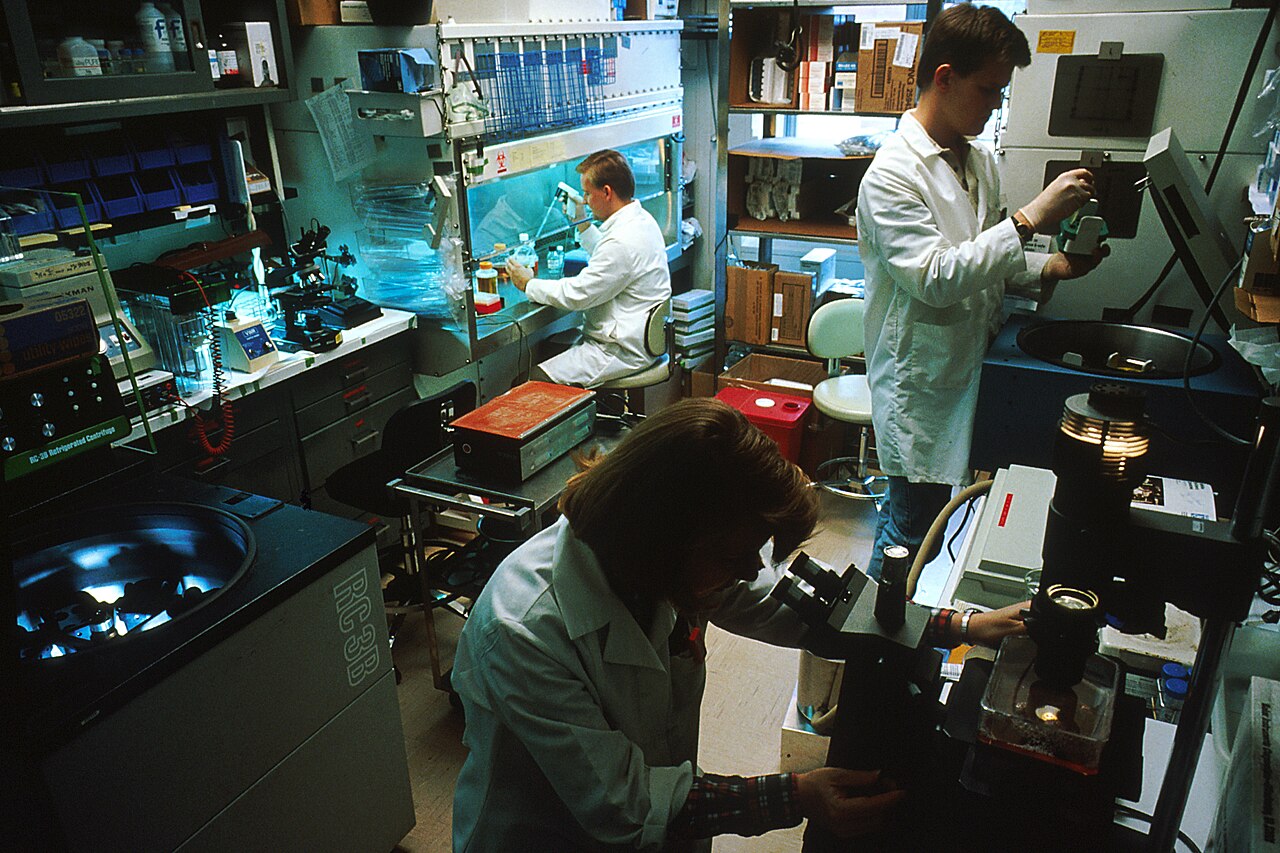
Image credit: Photo by Bill Branson (National Cancer Institute), “Laboratory,” public domain, via Wikimedia Commons.

1. What Brockman said (and the careful reading)
Quoted across multiple outlets, the near-term passage runs roughly:
“Having cures for diseases is something that’s become also a trope in this field, but I think that you’re gonna see real delivery and real significant strides and impacts on biology, health, and curing of diseases over the next 12 months, 18 months.”
The longer-horizon passage, as rendered by TechSpot and Wccftech:
“I think that you look at something like biology, and that’s not something that’s unique to just humans. I think that we all suffer, that the question of even just thinking about death becoming a choice. All of this is possible.”
What that is: an executive forecast about research impact inside a concrete window, plus an aspirational statement that mortality could one day become optional.
What that is not: a named approved drug, a regulatory calendar, a mortality rate target, or a dated promise that “death becomes optional by 2028.” Several careful write-ups (notably i10x and AIstify) stress that Brockman did not attach a timeline to the death-as-choice idea, and that he also acknowledged that full impacts in this field take time.
OpenAI has not, in the coverage we checked, published a matching product roadmap of “approved cures” for the next 18 months. Treat the statements as conference remarks backed by circulating video clips, not as a formal OpenAI medical roadmap.
2. Why the wording lands so hard
“AI will cure cancer” has been a conference trope for years. Brockman himself called cures a “trope,” then insisted the next year to year-and-a-half will show “real delivery.” That combination — acknowledging the cliché while doubling down on a short clock — is why the clip travelled.
TechSpot’s framing is sceptical in tone: the industry has promised medical miracles since ChatGPT’s launch, and “don’t hold your breath” is the subhead. Forward Future’s framing is more clinical: keep the 12–18 month biology claim, label the death claim as beyond present evidence. Both readings are compatible with the quotes.
3. Brockman is not alone — and that is part of the story
The “death optional / longevity solved” register is now a familiar dialect in tech:
- Elon Musk, in a January 2026 interview with Peter Diamandis cited by Wccftech, called longevity or “semi-immortality” an “extremely solvable problem,” arguing that bodies age in sync (“nobody has an old left arm and a young right arm”) and that changing that “program” would extend life. In late October 2026 he again said “longevity is coming,” according to the same secondary coverage.
- Peter Diamandis has argued that the practical goal is not to die “from something stupid” before roughly 2030, after which stacked technologies — with AI as a driver — could approach “longevity escape velocity.”
- Bryan Johnson, the high-profile biohacker, has framed AI as one of the tools that could end the presumption that some conditions are incurable.
- Palantir CTO Shyam Sankar, as quoted by TechSpot, offered a darker mirror image: that many AI researchers are so sure AI will cure cancer that they have taken up smoking — a “mass psychosis social delusion,” in his phrase. Whether or not that anecdote is fair, it shows that even inside tech there is pushback against treating AI medical destiny as settled.
X news digests after Brockman’s talk also circulated comments from longevity researchers who are optimistic about longer horizons (for example “longevity escape velocity” by the mid-2030s). Those are opinions in a heated debate, not clinical results.
4. What “AI in health” can already mean in 2026
Strip away immortality talk and the measurable work sits in a few buckets.
Protein structure and design tools
AlphaFold (DeepMind) and related systems predict protein structures and interactions. They are research tools, not medicines. Alphabet’s Isomorphic Labs builds on that line with a “drug design engine” aimed at designing candidates. As of late 2026 reporting (R&D World, Business Insider), Isomorphic’s internal programs remain largely preclinical, with a public ambition to start first human trials around end-2026 — a target that has already slipped once from an earlier end-2025 goal attributed to Demis Hassabis at Davos. Partnerships with large pharma (Novartis, Johnson & Johnson, Eli Lilly are named in Business Insider’s account) matter, but a partnership is not an approval.
Generative chemistry companies with named trials
A useful reality check is which AI-associated programs have actually entered human studies. A November 2026 survey on BioSkepsis and related pipeline write-ups describe, among others:
- Insilico Medicine — rentosertib (TNIK inhibitor) for idiopathic pulmonary fibrosis, with Phase 2a data published in Nature Medicine (2025) and a Phase 3 programme initiated according to the company; separately, ISM6331 (pan-TEAD) in oncology with early Phase 1 readouts presented in 2026.
- Recursion Pharmaceuticals — programmes with Phase 1b/2 data in areas such as familial adenomatous polyposis.
- Absci, Generate:Biomedicines, Iambic and others — antibody or small-molecule candidates in Phase 1 or later, depending on the asset.
Caveat: “AI-designed” is a marketing spectrum. Some programmes used generative models heavily for target or molecule design; others used AI as one tool among many. Independent reviewers (and regulators) care about trial endpoints, not about how cool the design stack was.
Diagnostics and clinical decision support
Companies such as Tempus sell molecular testing and data platforms with FDA-cleared diagnostic products in cancer care (as summarised in the same BioSkepsis table). Large language models are also being used — sometimes recklessly — as medical chatbots. An early-November X news digest described a case in which a terminally ill patient’s ChatGPT conversations allegedly downplayed a “terminal” diagnosis; that is an anecdote circulating on social media, not a peer-reviewed study, but it illustrates the harm surface when conversational AI meets oncology. Studies and lawsuits over inaccurate medical advice from LLMs have been growing; they are a counterweight to any narrative that “AI health” only means miracle drugs.
Agents that propose experiments
Secondary tech coverage (including Wccftech’s Brockman piece) points to multi-agent research systems that review literature, propose hypotheses and, in some reported evaluations, suggest candidates later tested in wet labs. Those demos are exciting when they hold up under peer review. They are still early steps on a path that ends, if it ends well, in multi-year trials.
5. The calendar nobody can prompt away
The strongest pushback to a 12–18 month “cures” headline is boring and structural:
- Preclinical work is not clinical proof. A beautiful binding prediction is not a safe dose in a human.
- Phase 3 trials commonly take years, not months. FDA guidance materials describe late-stage studies that often run one to four years. AI can help design trials, pick endpoints or analyse data faster; it does not teleport a cohort through follow-up.
- Most candidates fail. Industry failure rates from Phase 1 to approval remain high. AI may improve the odds at the top of the funnel; it has not abolished attrition.
- No AI-designed cancer drug (on the accounts we reviewed in early November 2026) has yet received full marketing authorisation from the FDA purely on the strength of being “AI-discovered.” Progress is real; category-defining approvals are still pending.
So the honest translation of Brockman’s near-term sentence is closer to: expect visible research and early clinical delivery in biology tooling, candidates and perhaps intermediate trial readouts — not expect death to be optional next winter.
6. Separating two bets
It helps to split the debate into two bets that are often smashed together on social media:
| Bet | Time horizon Brockman implied | What would count as evidence |
|---|---|---|
| A. AI accelerates biology & disease research | 12–18 months | Better candidates, published structures/assays, trial starts or positive intermediate readouts, diagnostic tools that change practice |
| B. Death becomes a “choice” | None given | Durable control of aging / major causes of death at population scale — far beyond any current trial |
Bet A is ambitious but continuous with work already in journals and clinics. Bet B is a philosophical and scientific programme measured in decades if it is possible at all. Forward Future’s caution applies specifically to Bet B. Conflating them is how conference rhetoric becomes misleading headlines.
7. OpenAI’s own incentives (without mind-reading)
Brockman is OpenAI’s president. He also used the same appearance, according to Wccftech, to talk about OpenAI’s 2026 business rebound — Codex attention problems earlier in the year, then growth tied to newer models and ChatGPT Work, with strong enterprise revenue claims for Q3. Medical moonshots sit comfortably next to fundraising, talent and regulatory narratives. That does not make the biology claim false; it does mean listeners should ask for mechanisms and milestones, not just cadence words like “real delivery.”
OpenAI has separately pushed health-adjacent products and research over time (from safety policies around medical advice to scientific models). This post does not attempt a full catalogue of OpenAI’s health roadmap; none of the outlets we relied on presented Brockman’s WSJ Tech lines as a product launch.
8. Expert and industry pushback, summarised
- Clinical realists: trial length, manufacturing, toxicology and regulators dominate the clock (AIstify’s reading of FDA process).
- Sceptics inside tech: Sankar’s “mass psychosis” jab; TechSpot’s “still waiting for AI to cure cancer.”
- Longevity optimists: Diamandis, Johnson, some researchers cited in X digests — they treat Brockman’s direction as plausible on a longer arc, not as a 2027 consumer feature.
- Pipeline empiricists: watch Insilico Phase 3, Isomorphic’s first-in-human timing, Recursion readouts — scoreboards that update without a keynote.
9. What we could not verify
- A complete official transcript published by OpenAI or WSJ of the full fireside chat (we relied on multi-outlet quote agreement and circulating clips described by those outlets).
- Any OpenAI filing that schedules “cures” as deliverables for 2027.
- Population-level mortality effects from AI systems — none exist to verify.
- Every secondary anecdote (smoking researchers, individual ChatGPT medical chats) beyond the outlets that reported them.
Bottom line
Greg Brockman’s WSJ Tech remarks are best read as two stacked claims. The first — meaningful AI impact on biology and disease work inside roughly a year and a half — is a bold executive forecast that can be scored against trial registries, journal papers and diagnostic clearances. The second — death as a choice — is speculative, undated and, as Forward Future put it, beyond the evidence we have now. AI is already changing how drugs are proposed and how some diagnostics are run. Turning those changes into fewer funerals still runs through the slow machinery of medicine. That machinery is speeding up at the edges. It has not, as of November 2026, made mortality optional.
Sources
- TechSpot – Brockman on death as a choice / 12–18 month medical strides (5 Nov 2026)
- Wccftech – Brockman remarks and Musk longevity parallels
- Forward Future briefing (6 Nov 2026)
- i10x – careful parsing of the WSJ Tech quotes
- AIstify – death-as-choice vs near-term disease progress
- Estadão / TecMundo – Portuguese-language coverage of the same quotes
- BioSkepsis – AI tools and drug pipeline stages (Nov 2026)
- R&D World – Isomorphic Labs first trials target
- Business Insider – Isomorphic Labs cancer-drug race