
Every AI answer, every trained model and every video generated by a machine ends up as a line on an electricity bill. Europe wants much more computing at home, as we described in our posts AI Chips and Data Centers in Europe and Japan: What Is Built, What Is Planned and What Is Still on Paper (November 2026) and Moonshot AI’s Hunt for 8,000 Blackwell GPUs in Europe: Renting Around Export Controls. Those posts were about chips, buildings and who rents what. This one asks the question underneath: where does the electricity come from, and how does it get to the building?
This is a status check as of 11 November 2026. We separate measured facts (what was actually consumed or decided), forecasts (what analysts expect) and announcements (what companies say they will do). All units are metric; where a source used another unit we say so. Anything we could not confirm is listed in its own section near the end.
The short version
- Today, data centers are a small share of European electricity, but a very uneven one. The European Commission puts EU data centers at about 3% of electricity demand by 2030 (forecast). In Ireland they are already 23% of metered electricity (measured, 2025).
- Forecasts agree on direction, not on size. The IEA, ENTSO-E and the Commission all expect growth of roughly 50% or more between 2025 and 2030 in Europe, but the base year and the scope differ, so the totals do not line up.
- The binding constraint is the grid connection, not the power plant. The IEA reports waiting times for a grid connection of two to ten years in the EU, and seven to ten years in the big hubs (Frankfurt, London, Amsterdam, Paris, Dublin).
- Nuclear is mostly letters of intent. The only firm nuclear supply deal we found for European data centers is a 40 MW share of EDF’s existing French fleet for Data4. Small modular reactors (SMRs) are agreements to study or pre-order, with first units expected around 2030 at the earliest.
- Rules are tightening. EU operators already report energy and water data every year; the Commission has now adopted a rating scheme and opened work on minimum standards. Germany already has binding efficiency and heat-reuse rules for new sites.
- The AI gigafactories are a modest slice of the total, if they are built. Our own arithmetic from the tender’s minimum figures: at most about 8 TWh a year of IT electricity, similar to all of Ireland’s data centers today.
Four terms you need before the numbers
MW and MWh. A megawatt (MW) is a rate of power, like the speed of a car. A megawatt-hour (MWh) is the energy used when 1 MW runs for an hour, like the distance driven. A 100 MW data center running flat out for a year uses about 876,000 MWh.
TWh. A terawatt-hour is a billion kilowatt-hours, or a million MWh. National electricity use is counted in TWh per year.
MVA. Grid operators often quote connection size in megavolt-amperes, which is close to MW for most purposes. Ireland’s rules below use this unit.
PUE. Power Usage Effectiveness is the total energy of the facility divided by the energy that reaches the IT equipment. A PUE of 1.0 would mean no overhead at all; 1.36 means that for every 100 units of IT energy, a further 36 go to cooling, power conversion and so on. Lower is better.
PPA. A power purchase agreement is a long-term contract in which a company buys electricity, often from one named wind or solar farm, at an agreed price. It does not by itself deliver power to the data center’s own cable; it pays for generation somewhere on the grid.
SMR. A small modular reactor is a nuclear reactor much smaller than a conventional plant, designed to be built largely in a factory. The designs named below are in the range of about 300 to 470 MW of electrical output per unit.
How much electricity? Forecasts and what they leave out
Worldwide (IEA). The International Energy Agency’s 2025 Energy and AI report put global data-center consumption at about 415 TWh in 2024, around 1.5% of world electricity, with Europe at about 15% of that. In April 2026 its Key Questions on Energy and AI update said data-center demand grew 17% in 2025 and that AI-focused data centers grew 50%. Its updated outlook sees global data-center consumption roughly doubling from about 485 TWh in 2025 to about 950 TWh in 2030, around 3% of world electricity (forecast).
Europe (several sources). The Commission’s September 2026 report states that EU data centers used 68 TWh in 2024 and that this is expected to rise to 114 TWh by 2030, or 3.2% of EU demand. The 2030 number is attributed to the IEA. ENTSO-E, the association of European transmission system operators, published its own report in May 2026. It cites an estimate of about 87 TWh for Europe in 2024 and 134 TWh in 2030 at the low end, with a range of 199 to 254 TWh for 2035. It counts more than 10,500 facilities with at least 50 kW of IT load and about 12.7 GW of IT capacity in Europe (about 9.9 GW in the EU).
Why these numbers differ. They mix “EU” and “Europe” (which includes the UK, Norway and Switzerland), different base years, and different definitions of what counts as a data center. Treat them as a range, not as one figure. All agree on the direction: ENTSO-E’s summary says demand is expected to grow by more than 50% from 2025 to 2030.
Germany. A 2024 Bitkom/Borderstep study estimated German data centers and small IT installations at just under 20 TWh in 2024, rising to over 30 TWh in 2030 in the base case (range 25 to 37 TWh).
What the forecasts do not know. The IEA notes that not all projects in the pipeline will be finished, that new servers take years to fill a building, and that servers rarely run at their rated maximum. It also notes that the energy per simple AI text query has fallen sharply, while video generation, reasoning and agent tasks can use hundreds or thousands of times more energy per request. Which effect wins is the main uncertainty.
The real bottleneck: getting connected
Building a data center typically takes one to two years, the IEA points out, while expanding electricity infrastructure takes much longer. In its November 2025 commentary on Europe it reports:
- Waiting times for a grid connection in the EU range from two to ten years, depending on the country; in the main hubs seven to ten years.
- Most installed capacity sits in a few hubs known as FLAP-D: Frankfurt, London, Amsterdam, Paris and Dublin, with Copenhagen and Milan growing. Most announced new capacity is still planned for these same hubs.
- If the whole project pipeline were built, European capacity would be about 130% above today’s; the IEA’s own modelling expects only about 70% growth by 2030, partly because of grid congestion and delays.
- Data centers are expected to account for about 10% of EU electricity demand growth to 2030; the rest comes from heating, transport and industry.
- Grid congestion cost about €4.3 billion directly in 2024, according to the EU energy regulators’ agency ACER, as quoted by the IEA.
What the transmission operators say. ENTSO-E’s May 2026 report adds two points that are easy to miss. First, access to electricity is the biggest challenge for almost 80% of European data-center operators, and connection lead times range from a few years to more than a decade in constrained regions. Second, there is a stability issue: data centers protect their servers with uninterruptible power supplies (UPS, battery systems), and ENTSO-E warns that these can disconnect hundreds of megawatts at once during a minor grid disturbance. If that risk persists, operators may have to run the system with less wind and solar. In most European regions data centers do not yet threaten the supply of electricity, ENTSO-E says, but it names Ireland as a place where this is already visible.
The same report sees an upside: with the right rules, the batteries and controllable loads in data centers could act as flexible grid resources. The IEA agrees and suggests non-firm connections, where the data center accepts being switched down in rare tight hours in return for a faster connection.
Ireland: from moratorium to “bring your own power”
Ireland is the European case study. The Central Statistics Office reports that data centers used 7,663 GWh (7.7 TWh) in 2025, up 10% on 2024, or 23% of all metered electricity, compared with 5% in 2015. Households together used 28%. This is measured data, and it is the highest share we found in Europe.
For years new connections around Dublin were effectively blocked. On 12 December 2025 the energy regulator CRU published a new policy that, in KPMG’s words, ended the blanket moratorium. The main conditions for new connections, according to CRU and EirGrid:
- Sites of 10 MVA or more must bring dispatchable generation or storage, on site or nearby, that covers 100% of their requested import capacity (on a derated basis), and these units must take part in the electricity market.
- Operators must meet at least 80% of annual demand with additional Irish renewable generation, within six years of connection. Plants that already receive state support do not count.
- Grid operators must judge each request by its location on the network, and must publish where capacity exists.
EirGrid’s May 2026 overview says that data centers meeting these rules could be accommodated on the 220 kV grid in the Galway, Limerick and Cork areas, with potential for roughly 50 to 100 MW per site and 150 to 300 MW in total (an early desktop assessment, not a connection offer). It builds on an older roadmap that assumed Dublin-area data centers would not grow beyond 1.3 GW.
The lesson for Europe: Ireland has turned a hard stop into an obligation to add generation and storage next to every large new load. That helps the grid, but it raises the cost and, in practice, favors operators who can finance a power plant alongside a data center.
Amsterdam and Frankfurt: two hubs, the same wait
Amsterdam. Since 11 June 2025 the city has admitted no new large data centers, as grid operator Liander states. The province of Noord-Holland’s 2025 to 2027 strategy allows no new hyperscale developments, and a law-firm briefing from September 2026 adds that Haarlemmermeer and Hollands Kroon have used up their planned data-center space. On the grid side, TenneT’s 2026 update pushed back the expected end of congestion in several Noord-Holland areas: for example Vijfhuizen from 2031 to 2033 to 2036, and Noord-Holland Noord from 2036 to a window of 2035 to 2038. One area improved: around the Oostzaan substation congestion is now expected to end in 2029 to 2030, a year earlier than planned, so some of the roughly 120 waiting customers can be served. Liander and TenneT are building the Nieuwe Hemweg station, with about 1 GW in total, and expect Amsterdam to use three to four times today’s electricity by 2050.
Frankfurt. Frankfurt is Europe’s biggest internet exchange point and a data-center capital. Its local grid company NRM Netzdienste (part of Mainova) says demand for connections clearly exceeds the power available from the upstream transmission grid, and expects restrictions on new large connections until the mid-2030s. The city government said in January 2026 that sufficient energy for further data centers will not be available in the coming years. Delays to TenneT’s new Eschborn substation pushed the timeline back. NRM now allocates scarce capacity pro rata: applications run from 1 February 2026 to 31 January 2027, with notifications expected from about 15 April 2027. Der Spiegel reports 55 data centers in the city and 13 more planned by 2030, with 23 more sites planned in surrounding districts. The neighboring grid operator Syna told the trade paper ZfK that requests for roughly 800 MW of extra data-center capacity in a recent half-year were about as large as Frankfurt’s peak load, and that newcomers must plan for the early or mid-2030s.
Both hubs show the same pattern: the demand is real, the grid reinforcement is slow, and investors move to places with spare capacity.
Nuclear and SMRs: mostly intentions, one real contract
Tech companies talk a lot about nuclear power because data centers need electricity around the clock. In Europe, what is actually signed looks like this:
- A real supply contract. In September 2025, Data4 and EDF signed a 12-year “nuclear production allocation contract”: a share of 40 MW from EDF’s existing French reactors, with a cost-and-risk-sharing mechanism, deliveries from 2026 and an estimated 230 GWh per year (EDF press release). That is existing nuclear, not a new reactor.
- A letter of intent. In August 2025 Equinix signed a letter of intent with Dutch developer ULC-Energy for a PPA of up to 250 MWe from Rolls-Royce SMR reactors in the Netherlands. Equinix itself describes it as “explore” and an LOI. The reactor design is 470 MWe per unit and no site or schedule is fixed. Equinix also announced a pre-order for 500 MWe from French start-up Stellaria for Europe. A research firm, Rystad, counts the Dutch deal as a nuclear PPA; we treat it as an intention.
- A feasibility study. In October 2025, Swedish cloud company evroc, reactor developer Blykalla and nuclear-site owner Studsvik signed an MoU to assess co-locating data centers with small reactors at Studsvik’s site in Nyköping.
- A site plan in the UK. Holtec, EDF UK and Tritax have a memorandum of understanding for a data-center campus of up to 1 GW at Cottam, with Holtec SMR-300 reactors expected to run in the 2030s and the data center to start on other power earlier. In June 2026, according to World Nuclear News, Holtec and EDF submitted a proposal for up to four SMR-300 units, about 1.3 GW of electricity.
The IEA sees the first SMRs coming online around 2030, with nuclear’s extra contribution to data-center supply to 2035 occurring mainly in China, Japan and the United States, not in Europe. For the AI build-out of 2026 to 2029, nuclear will therefore matter mostly through existing plants and long-term contracts, not new reactors.
Renewables, PPAs and storage
Wind and solar are still the main source of new European clean power, and data centers have become big buyers. But the contracting picture has weakened. According to Rystad Energy:
- European data-center PPA volumes fell from 4.2 GW in 2024 to 2.6 GW in 2025, even though data-center capacity is forecast to grow from about 16 GW in 2024 to 36 GW in 2030 (Rystad’s figures, which use a different scope from ENTSO-E’s 12.7 GW).
- Offshore wind deals collapsed from 1.35 GW (2024) to 0.5 GW (2025) and 100 MW in the first quarter of 2026. Rystad blames offshore wind delays, falling “capture rates” (the average price solar or wind receives compared with the market) and more hours of negative prices.
- Amazon, Google and Microsoft dominate; Amazon alone signed more than 3 GW since 2024. Spain leads by volume with more than 2 GW across 12 deals, including Amazon’s 596 MW hybrid wind and solar agreement. Data-center PPAs made up 20% of European offtake between 2024 and the first quarter of 2026.
- Rystad notes that Microsoft is reportedly reconsidering its 24/7 carbon-free energy pledge, and that Google has said hourly matching by 2030 will be difficult.
Storage. AI training causes large and fast swings in power use, which is why the IEA calls storage critical. It expects around 20 to 25 GW of batteries inside data centers worldwide by 2030 (forecast). In the US, developers also build on-site gas generation; the IEA estimates that reliable gas supply needs 30% to 70% more capacity than the load itself. Ireland’s new rules effectively push European developers toward the same combination of on-site gas or batteries plus new renewables.
A caution on PPAs: a contract for wind power in Spain does not deliver electrons to a data center in Frankfurt. It finances new generation; the data center still needs a grid connection.
Heat reuse: a good idea with a seasonal problem
Nearly all electricity a data center uses ends up as heat. Reusing it can replace fossil heating, but it only works with a nearby customer, usually a district heating network.
The European Commission’s September 2026 report puts the problem in numbers: only 67 data centers reported any heat reuse in the first reporting period, and about 1.8% of the heat generated by reporting data centers is reused. Reasons include missing heat customers, unsuitable timing and the cost of upgrading and transporting the heat.
Working examples, per the operators and a university study (Bytes2Heat):
- Odense, Denmark (Meta): 165,000 MWh of surplus heat a year goes into the district heating system, serving up to about 9,000 households.
- Mäntsälä, Finland: server exhaust air at about 37 °C is lifted by heat pumps to 85 °C; in 2018, 20 GWh, or 54% of the town’s heating, came from the data center.
- Frankfurt Westville: waste heat of about 30 °C from a Telehouse data center, lifted by heat pumps, supplies a new residential quarter under a 15-year contract with Mainova. In summer the quarter needs only a fraction of the heat.
- Hamina, Finland (Google): announced in 2024 to supply about 80% of the local district heating network’s needs, free of charge. We did not confirm that it is now operating.
The pattern: server heat is low-grade (30 to 40 °C), so heat pumps are usually needed, and demand is highest when it is cold, while data centers run all year.
EU rules: reporting, ratings and the next step
Reporting today. Under Article 12 of the recast Energy Efficiency Directive (EU 2023/1791), operators of data centers with at least 500 kW of IT power must report energy, water and other data to a European database. Delegated Regulation (EU) 2024/1364 set the first deadline for 15 September 2024 and then 15 May every year since 2025. The Commission calculates indicators from the data: PUE, water usage effectiveness (WUE, cubic meters of water per MWh of IT energy), energy reuse factor (ERF) and renewable energy factor (REF).
What the first data show (Commission report, 21 September 2026, covering the first period): 770 data centers reported, about 36% of the estimated number required to do so; six member states reported none. The average PUE was 1.36, ranging by country from 1.15 to 1.66, and 1.64 for the smallest sites (500 to 1,000 kW). Average WUE was 0.58, with a range of 0.07 to 1.28. The average renewable share was 0.86. About half of reporting sites exceed a recommended PUE of 1.5 and/or a WUE of 0.4. The IEA estimates that minimum performance standards could save about 65 TWh a year worldwide, almost 20 TWh in Europe.
What is new. The Commission has adopted Delegated Regulation (EU) 2026/7000 creating a common rating scheme for data centers, and has started a call for evidence and public consultation on minimum performance standards, to be followed by an impact assessment. That is a first step, not a proposal. In June 2026 it also published a Strategic Roadmap for Digitalisation and AI in energy (COM(2026) 501), which promotes “tripartite agreements” between authorities, data-center operators and energy companies; 14 industry associations signed a declaration of intent. Summaries of the roadmap mention a “use-it-or-lose-it” rule against speculative grid reservations; we have not checked the exact legal wording.
Germany goes further. Section 11 of the Energy Efficiency Act (EnEfG) requires existing data centers to reach a PUE of 1.5 from 1 July 2027 and 1.3 from 1 July 2030. Centers starting operation from 1 July 2026 need a PUE of 1.2 or better and at least 10% reused energy (planned 15% from mid-2027 and 20% from mid-2028), with exceptions where no heat customer exists. Operators must also cover their electricity with renewables on an accounting basis: 50% since 2024 and 100% from 1 January 2027.
The AI gigafactories: how much power do they need?
The EU’s call for up to seven AI gigafactories (four medium, three large) is the most concrete public test of Europe’s ambitions. According to the Sullivan & Cromwell memo on the call documents and the EuroHPC FAQ:
- Medium sites need at least 75,000 and large sites at least 100,000 “H100-equivalent” AI accelerators. For comparison, the call estimates JUPITER at about 24,000.
- Power at the start (phase 1): about 15 to 30 MW for medium sites and 20 to 50 MW for large sites. At full scale (phase 2): a minimum IT load of 120 MW (medium) and 150 MW (large), unless a lower figure is justified.
- The call sets no minimum renewable share, but better-evidenced sustainability plans score higher.
- Up to €10 billion of public money is meant to attract at least €20 billion of private investment.
- Per EuroHPC’s page updated on 5 November 2026, bids for the large-site lot are due on 3 December 2026 and for the medium-site lot on 4 February 2027. Some earlier documents, such as the July FAQ and an October law-firm memo, still show 12 November; the extension supersedes them.
Our own arithmetic, not an official figure. Four sites at 120 MW plus three at 150 MW add up to 930 MW of IT load. Running continuously for a year, that is about 8.1 TWh of IT electricity; with a typical overhead (PUE 1.2 to 1.36) about 10 to 11 TWh for the whole facilities. That is an upper bound: not all seven may be awarded, and sites rarely run at full load. It is less than a tenth of the roughly 114 TWh forecast for European data centers in 2030, and close to Ireland’s entire data-center consumption in 2025. The gigafactories are therefore not what will break Europe’s grids by themselves; the concern is that each is a 100-MW-plus load that must find a connection in the same hubs and regions with queues. The IEA also warns that AI racks are getting denser: by 2027 a single rack could draw as much peak power as 65 households.
Outlook: what to watch
The IEA’s own summary of the situation is that the speed of AI is colliding with the speed of grids, transformers and permits. Our reading of the evidence:
- Near term (2026 to 2028): growth is capped more by connections than by chips. Expect new projects to move to places with spare capacity (the IEA names Spain and Finland as emerging hubs), and more on-site storage and generation.
- Mid term (to 2030): Frankfurt and Amsterdam are not expected to free up large new capacity before the early-to-mid 2030s; Ireland will show whether “bring your own power” works. First SMRs are not expected before about 2030.
- Dates to watch: the AI-gigafactory bid deadlines (3 December 2026 and 4 February 2027); the Commission’s work on minimum performance standards; NRM’s Frankfurt allocation results (from about April 2027); the next annual EU data-center reports (due 15 May 2027); the legislative path of the Cloud and AI Development Act, which aims to at least triple EU data-center capacity in five to seven years.
- Bigger uncertainties: whether AI efficiency gains outrun the growth in use, whether financing holds, and whether a shortage of high-bandwidth memory, which the IEA expects to last through at least the end of 2027, slows the build-out.
What we could not verify
- A single “Europe” demand figure. The 68 TWh (EU, 2024), 87 TWh (Europe, 2024, ENTSO-E) and 114 TWh (2030) figures come from different scopes. We could not check the IEA’s own data table for Europe and relied on the Commission’s quotation of it; a trade summary of the IEA base case gave 72 TWh for 2025, which we did not confirm at the source.
- Whether Hamina’s heat recovery is operating, and the status of Frankfurt’s Westville scheme after 2023.
- The date of the Syna statement (800 MW of requests in “the first half”); the trade article did not make the year clear in the text we read.
- The exact text of the Commission’s “use-it-or-lose-it” proposal; we read summaries.
- The 120/150 MW gigafactory figures at the primary source. They come from Sullivan & Cromwell’s memo citing the tender specifications; the EuroHPC FAQ itself only says “adequate power capacity”.
- The June 2026 Holtec/EDF Cottam proposal details (up to four SMR-300 units, about 1.3 GW), which we read through a World Nuclear News summary.
- Whether any of the SMR agreements will become built plants. Several are explicitly non-binding.
- Mistral’s, Stargate Norway’s and other individual campuses’ power contracts, which we did not find in primary sources.
FAQ
How much electricity do data centers use in Europe? Estimates for 2024 range from about 68 TWh (EU, Commission) to about 87 TWh (Europe, ENTSO-E’s cited estimate). The Commission expects 114 TWh by 2030, about 3.2% of EU demand.
Which country is most affected? By share, Ireland: 23% of metered electricity in 2025 (CSO). By absolute grid pressure, the Frankfurt and Amsterdam regions.
Is there still a data-center moratorium in Dublin? The blanket moratorium ended with the CRU decision of 12 December 2025, but new sites must provide their own matching generation or storage and 80% additional renewable supply, and location limits still apply.
Can nuclear power run Europe’s AI data centers? Not in the near term. A 40 MW allocation of existing French nuclear power for Data4 is signed; SMR projects are letters of intent, studies or proposals, with first units around 2030 at the earliest.
What is PUE and is the EU average good? PUE is total facility energy divided by IT energy. The reported EU average was 1.36 in 2024, better than the 1.58 global average the Commission cites for 2023, but roughly half of sites exceeded the recommended 1.5.
Do EU data centers have to report their energy use? Yes, if they have at least 500 kW of IT power: every year by 15 May under the Energy Efficiency Directive framework. Public ratings and minimum standards are coming.
How much power will the AI gigafactories need? Per the call, 20 to 50 MW at the start and a minimum of 120 to 150 MW of IT load at full scale per site. Our arithmetic gives an upper bound of about 8 TWh a year of IT electricity for seven sites.
Does reusing waste heat solve the problem? It helps where a heat network is nearby. Today only about 1.8% of reported data-center heat in the EU is reused.
Image credit
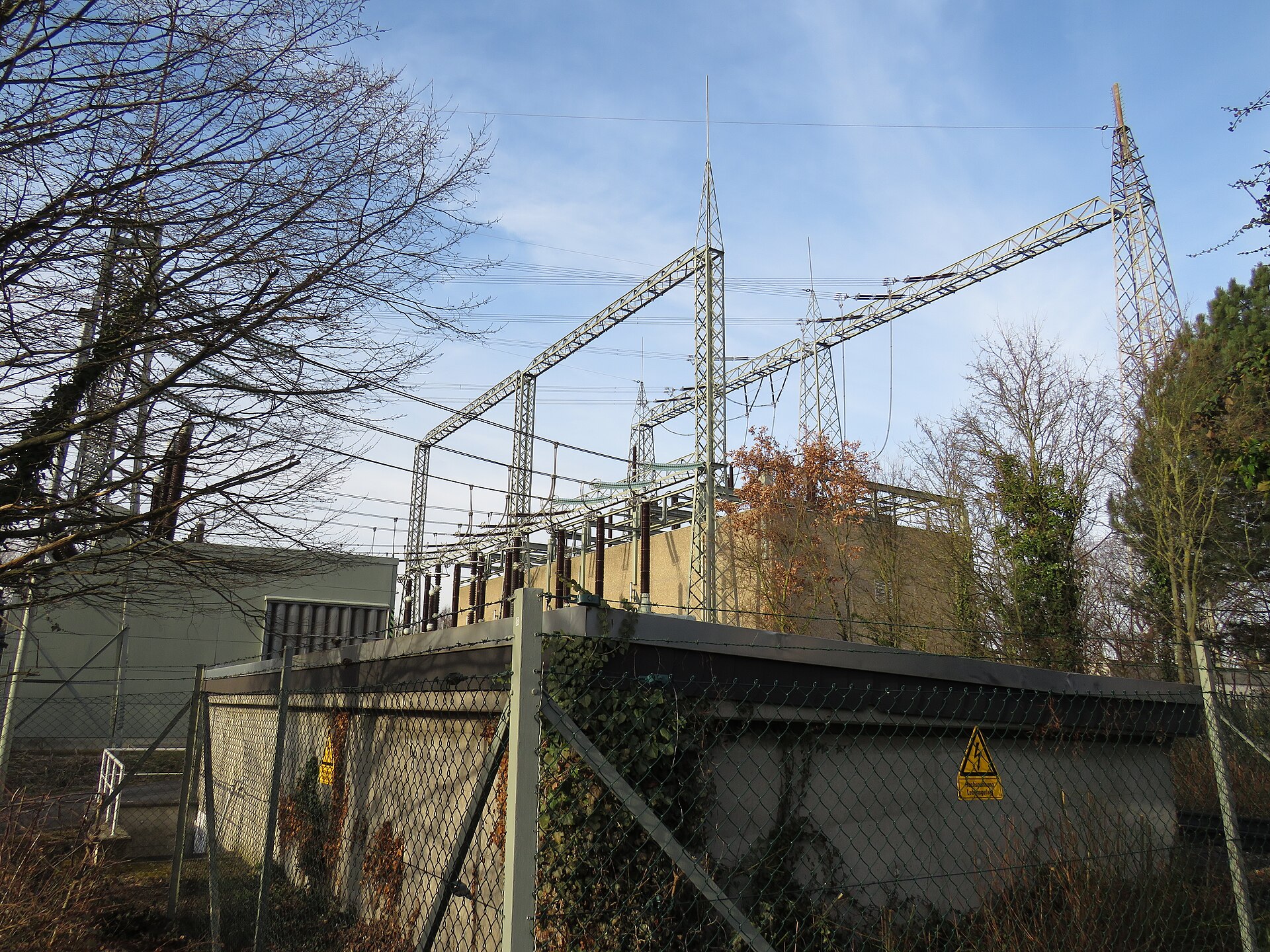
Photo: Adl252 (Wikimedia Commons user), “Umspannwerk Frankfurt-Südwest”, CC BY-SA 4.0, via Wikimedia Commons. The picture shows a 380/110 kV substation in Frankfurt as an example of grid infrastructure; it is not a data center.

Sources
Demand and forecasts
- IEA: Energy and AI, executive summary (2025)
- IEA: Key Questions on Energy and AI, executive summary (16 Apr 2026)
- IEA: Overcoming energy constraints is key to delivering on Europe’s data centre goals (16 Nov 2025)
- ENTSO-E: Data centres and the power system (report, May 2026) and news item (8 May 2026)
- European Commission: Report on the energy efficiency of data centres in the EU, COM(2026) 500 (21 Sep 2026)
- Bitkom/Borderstep: Rechenzentren in Deutschland (Nov 2024, German)
- Hessian Landtag, Kleine Anfrage on data-center power demand (German, citing Bitkom/Borderstep 2025)
Ireland
- CSO: Data Centres Metered Electricity Consumption 2025 (7 Jul 2026)
- CRU: decision on new electricity connection policy for data centres (12 Dec 2025)
- EirGrid: Data Centre Connection Offer Process and Policy v3 (May 2026) and Constrained Area Overview (May 2026)
- KPMG Ireland: Ireland’s data centre policy reset
Netherlands and Germany
- Liander: Strict data-center policy means fewer substations (Dutch, 2025)
- Liander: Longer waiting times in Noord-Holland (Dutch, 2026)
- Liander and TenneT: construction of Nieuwe Hemweg station (Dutch, 2026)
- TenneT: No extra space on the electricity grid in large parts of Noord-Holland
- Clifford Chance: Data Centres in Noord-Holland (Sep 2026)
- NRM Netzdienste Rhein-Main: Pro-Rata-Verfahren Strom (German)
- City of Frankfurt: answer to question 3796 (29 Jan 2026, German)
- Der Spiegel: Stromknappheit bremst Ausbau von Rechenzentren in Frankfurt (German)
- ZfK: Syna, Rechenzentren warten auf Anschluss bis 2030er (German)
Nuclear, PPAs and heat
- EDF: Data4 signs agreement with EDF (4 Sep 2025)
- Equinix: collaboration with ULC-Energy (14 Aug 2025)
- evroc, Blykalla and Studsvik MoU (6 Oct 2025)
- EDF Energy: Holtec, EDF UK and Tritax plans for Cottam and World Nuclear News: Holtec and EDF submit UK SMR project proposal
- Rystad Energy: European data center PPAs fall even as capacity buildout accelerates
- Meta: Odense data center fact sheet (PDF)
- DCD: Google launches heat recovery project at Hamina (21 May 2024)
- Bytes2Heat: Best-practice overview (University of Stuttgart IER, 2024)
EU rules and gigafactories
- Commission Delegated Regulation (EU) 2024/1364 (EUR-Lex)
- European Commission: scheme for rating the sustainability of data centres (15 Mar 2024)
- European Commission: Strategic Roadmap for Digitalisation and AI in energy (3 Jun 2026)
- Germany: § 11 EnEfG, Klimaneutrale Rechenzentren (German)
- EuroHPC JU: Call for tenders for AI Gigafactory consortia (updated 5 Nov 2026)
- EuroHPC JU: AI Gigafactories FAQ (PDF, 30 Jul 2026)
- Sullivan & Cromwell: EuroHPC Joint Undertaking Launches AI Gigafactories Call (8 Oct 2026)
Image