
For most of the AI boom, Nvidia was described as the company selling the “picks and shovels”: the graphics processors (GPUs) that train and run large AI models. In 2026 it became something more. Through purchase promises, guarantees and credit backstops, Nvidia also helps finance the companies that buy its chips. CNBC calls it the “central bank of AI”.
That role is now under a spotlight. On 11 November 2026, Nvidia’s board accepted the resignation of co-founder Jensen Huang as CEO, president and board member, effective immediately, according to the company’s SEC filing. Chief financial officer Colette Kress became interim CEO. This article explains what the financing web is, what the numbers mean, and what is fact versus estimate. It is a status check as of the morning of 13 November 2026.
The short version
- Leadership change (fact): Huang resigned on 11 November; the company announced it on 12 November. Kress is interim CEO and stays CFO. Long-time director Harvey C. Jones became board chair. A search for a permanent CEO is under way (SEC 8-K, Reuters via Investing.com).
- Why he left (reporting): Reuters reports that Huang stepped down after revelations of extramarital affairs, one reportedly involving a suspected Chinese spy. This article focuses on the business consequences, not the private matter.
- Market reaction (fact): Reuters reported Nvidia shares fell as much as 14% on 12 November before closing down 4.3%.
- The financing web (reporting and estimate): CNBC lists several large commitments, including up to $36 billion in cloud-service purchases from “neoclouds”, a conditional, phased $105 billion guarantee for an OpenAI and SB Energy data-center project in Ohio, and a backstop of up to $125 billion of a $500 billion Wall Street credit program. A Columbia Business School professor estimates the total at about $400 billion (CNBC).
- Expert view: Former FDIC chair Sheila Bair told CNBC Nvidia is not “too big to fail in a bank sense at all”, but that “Nvidia going down would be a pretty seismic event.”
Key terms in plain English
Neoclouds are newer cloud companies, such as CoreWeave or Lambda, that fill data centers with Nvidia GPUs and rent that computing power to AI developers. They are often financed with large loans.
Circular financing describes deals where a supplier helps pay for, guarantee or buy back capacity from its own customers, so money flows in a loop. In a boom this can speed growth; in a downturn the same loop can spread losses.
A guarantee or backstop is a promise to pay if someone else cannot. It is a contingent obligation: it only costs money if certain conditions occur. That is why a headline maximum is not the same as a bill that is due.
Private credit means loans made by investment funds rather than banks. Regulators watch it closely because it is less transparent than bank lending.
What is in the web, line by line
According to CNBC’s analysis, Nvidia’s commitments come in different forms:
- Cloud purchase promises. Nvidia disclosed in July 2026 that it had committed to buy up to $36 billion of cloud services from neoclouds. That gives those firms reliable revenue, which helps them borrow money to buy more Nvidia chips.
- The Ohio data-center guarantee. CNBC describes a phased guarantee of $105 billion, subject to conditions, for a major OpenAI and SB Energy project. Reuters reported that an earlier plan of $250 billion was “pared to $120 billion”. The exact current figure therefore differs between sources, and the conditions have not been published in detail.
- A credit backstop. Nvidia promised to backstop up to $125 billion of a $500 billion credit program run by Wall Street firms.
- Investments. Reuters notes that Huang pushed Nvidia to invest in customers and AI infrastructure companies, including OpenAI and Lambda.
Stijn Van Nieuwerburgh, a finance professor at Columbia Business School, estimates the total obligations at about $400 billion. That figure is an academic estimate, not a number Nvidia has reported. He also told CNBC these obligations “are unlikely to come due all at once, if ever”, and compared them with Nvidia’s market value of roughly $3.9 trillion after the share decline: “The company would have to get to the brink of extinction before all these guarantees come into jeopardy.”
Why a CEO change matters for the money
Reuters reports that Kress and her finance staff had clashed with Huang over large, risky financing deals, according to two people familiar with the matter. One source told Reuters: “I think it’s unlikely anyone but Jensen is going to invest in his own customers as aggressively.”
This leads to the central question for the AI industry: will Nvidia keep acting as a lender of last resort for AI infrastructure? If it becomes more cautious, neoclouds and data-center developers may find loans harder or more expensive to get. CNBC reported earlier signs of stress: a market measure of the cost of insuring CoreWeave’s debt rose sharply between 1 October and 5 November before settling, citing LSEG data. An adviser quoted by CNBC said Nvidia had already started asking for firmer customer contracts before backing a client, roughly three months ago.
None of this means projects will be cancelled. It means the terms of AI financing may change.
Is Nvidia “too big to fail”?
The phrase comes from the 2008 financial crisis, when banks were rescued because their collapse could have taken down the financial system. Experts quoted by CNBC see important differences:
- A bank can collapse quickly if depositors lose confidence and withdraw money. Nvidia has no depositors and still sells products customers want.
- Nvidia has a large equity cushion, meaning its value far exceeds the estimated obligations.
- The real risk, according to Bair, is exposure: how much banks, private credit funds and borrowers depend on Nvidia’s promises and on the value of GPUs used as collateral.
CNBC also reports that the Federal Reserve and other institutions are monitoring the AI buildout for signs that an unexpected event could destabilize the financial system.
Facts, estimates and predictions
| Statement | Type | Source |
|---|---|---|
| Huang resigned on 11 November; Kress is interim CEO | Fact (company filing) | SEC 8-K |
| Shares fell up to 14%, closed down 4.3% on 12 November | Fact (market data reported) | Reuters |
| Up to $36 billion in neocloud cloud purchases | Fact (Nvidia disclosure, reported) | CNBC |
| Ohio guarantee of $105 billion (or $120 billion) | Reporting, figures differ | CNBC, Reuters |
| Total obligations of about $400 billion | Academic estimate | CNBC (Van Nieuwerburgh) |
| Nvidia will become more cautious under Kress | Prediction / opinion of sources | Reuters |
What to watch next
- 18 November: Kress told employees in a memo that the company will host a meeting that day, Reuters reports.
- The permanent CEO search: Reuters says internal and external candidates are being considered.
- Credit markets: loan and debt-insurance pricing for neoclouds is the clearest early signal of whether lenders see more risk.
- Policy: Reuters reports that lawmakers from both parties are calling for tougher limits on China’s access to advanced AI chips after the scandal. A separate Reuters report, summarised by Forward Future, said a blacklisted Chinese university bought Nvidia H200 chips, based on customs records.
FAQ
Does Nvidia owe $400 billion? No. About $400 billion is an estimate of total commitments and guarantees, most of them conditional. It is not debt that is due now.
What is circular financing in AI? A loop in which a chip supplier helps its customers buy or rent its own chips, for example through purchase promises or loan guarantees.
Who runs Nvidia now? Colette Kress, Nvidia’s CFO since 2013, is interim CEO while the board searches for a permanent successor.
Could this slow the AI data-center boom? Possibly, if financing becomes tighter. That is a risk being discussed by analysts, not an observed outcome yet.
Image credit and sources
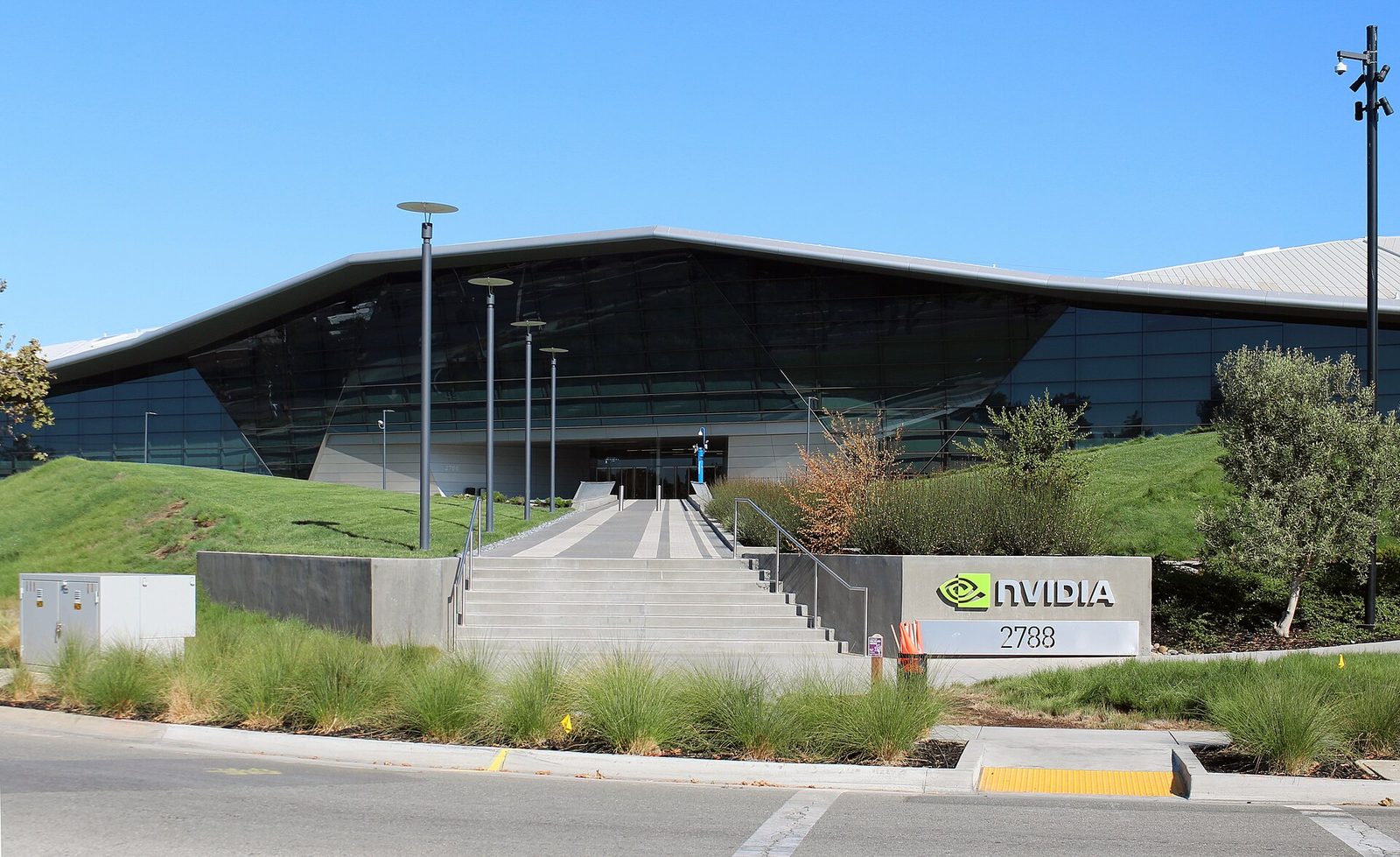
Image: Photo by Coolcaesar, “NVIDIA Headquarters” (2018), CC BY-SA 4.0, via Wikimedia Commons. Scaled down, otherwise unchanged.

Primary source
Reporting
- CNBC: Jensen Huang’s ouster tests Nvidia’s role as the ‘central bank of AI’ (11 Nov 2026, updated 12 Nov)
- CNBC video: Nvidia’s financing web raises new risks (12 Nov 2026)
- Reuters via Investing.com: Nvidia CEO Jensen Huang resigns (12 Nov 2026)
- Reuters via Investing.com: Colette Kress, the CFO who challenged Huang’s bets (12 Nov 2026)
- Forward Future daily briefing, 12 Nov 2026